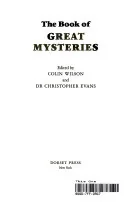
The Book of Great Mysteries
 77
77

The Book of Great Mysteries
Colin Wilson and Christopher Riche Evans’s The Book of Great Mysteries is a sprawling, ambitious attempt to catalogue the uncanny. Its strength lies in the sheer breadth of its inquiry, connecting seemingly disparate phenomena—from UFO sightings and psychic abilities to historical anomalies—under a wide-ranging umbrella of speculative philosophy. The authors are adept at presenting complex ideas in a digestible manner, a characteristic hallmark of Wilson’s extensive bibliography. However, the book’s ambition sometimes outstrips its analytical rigor; the connections drawn can feel tenuous, and the lack of stringent evidential standards, while perhaps fitting for the subject matter, may leave skeptical readers wanting more. A particularly engaging section discusses the concept of 'Great Work' as applied to personal transformation, suggesting an alchemical approach to self-discovery. Ultimately, it serves as a broad, if occasionally superficial, exploration of the unexplained that invites further personal investigation.
📝 Description
77
### What It Is
The Book of Great Mysteries, co-authored by Colin Wilson and Christopher Riche Evans, presents a sweeping survey of esoteric thought and phenomena. First published in 1990, the work examines a broad spectrum of subjects, from parapsychology and occult history to consciousness studies and the nature of reality itself. It functions as an accessible entry point into complex metaphysical ideas, drawing connections between disparate fields and historical accounts.
### Who It's For
This book is intended for individuals curious about the edges of conventional knowledge. Readers who have encountered unexplained phenomena, pondered the limits of scientific materialism, or are simply seeking a more expansive understanding of human potential will find fertile ground here. It caters to those who appreciate a synthesis of historical research, anecdotal evidence, and philosophical inquiry into the mysteries of existence.
### Historical Context
Emerging in the late 20th century, The Book of Great Mysteries arrived during a period of renewed interest in consciousness research and alternative philosophies, partly fueled by earlier movements like the counterculture of the 1960s and the established esoteric traditions. Wilson, already a prolific author known for works like 'The Outsider' (1956), brought his distinctive approach to exploring the 'occult' and the human psyche. The book engaged with ongoing debates about the validity of psychic phenomena and the limitations of purely empirical scientific models, placing it within a lineage of thinkers attempting to bridge the rational and the transrational.
### Key Concepts
The work explores various concepts central to esoteric studies, including the nature of consciousness beyond the physical brain, the potential for expanded human perception, and the existence of archetypal patterns influencing human experience. It delves into historical accounts of paranormal events and individuals who claimed extraordinary abilities, seeking to identify underlying principles. The book also touches upon theories regarding alternate realities and the possibility of hidden dimensions, encouraging readers to consider frameworks that extend beyond the observable physical universe.
💡 Why Read This Book?
• Gain an overview of historical and contemporary accounts of unexplained phenomena, learning how figures like Helena Blavatsky and Charles Fort documented extraordinary events. • Understand the potential for consciousness to operate beyond known biological constraints, exploring concepts like psychic perception as presented in the book. • Discover how esoteric traditions have historically sought to explain mysteries, drawing connections between ancient philosophies and modern parapsychology.
⭐ Reader Reviews
Honest opinions from readers who have explored this book.
❓ Frequently Asked Questions
When was The Book of Great Mysteries first published?
The Book of Great Mysteries by Colin Wilson and Christopher Riche Evans was first published in 1990. This places its release within a period of burgeoning interest in consciousness studies and alternative explanations for phenomena.
What kind of subjects does The Book of Great Mysteries cover?
The book covers a wide array of esoteric subjects, including parapsychology, occult history, consciousness studies, unexplained phenomena, and the nature of reality. It aims to synthesize various fields of inquiry into the mysterious aspects of existence.
Is Colin Wilson known for writing about esoteric topics?
Yes, Colin Wilson was a prolific author known for his extensive work on the 'occult', consciousness, and human potential. His earlier book, 'The Outsider' (1956), established his reputation for exploring unconventional aspects of human experience.
Does the book offer scientific explanations for mysteries?
While the book discusses phenomena often considered outside mainstream science, its approach is more speculative and philosophical. It explores potential frameworks and theories rather than providing definitive scientific proofs.
Who would benefit most from reading this book?
Individuals curious about the unexplained, students of esoteric philosophy, and those interested in the intersection of consciousness, psychology, and the paranormal would find this book beneficial.
Are there specific historical figures discussed in the book?
The book references numerous historical figures associated with occultism, parapsychology, and esoteric thought. These often serve as case studies or examples within the broader exploration of mysteries.
🔮 Key Themes & Symbolism
Consciousness Beyond the Physical
The work examines the hypothesis that consciousness is not solely a product of the physical brain but may possess qualities that transcend biological limitations. It explores accounts of psychic phenomena, out-of-body experiences, and altered states of awareness as potential evidence for this broader view of mind. The book seeks to integrate these experiences into a coherent philosophical framework, suggesting that human potential may extend far beyond conventional understanding.
Archetypal Patterns and Synchronicity
Drawing inspiration from thinkers like Carl Jung, the book investigates the concept of recurring archetypal patterns in human myths, dreams, and experiences. It explores how these universal symbols might manifest and influence events in the physical world, often through the lens of synchronicity – meaningful coincidences that suggest an underlying order. The authors consider these patterns as clues to a deeper reality.
The Nature of Reality
The Book of Great Mysteries questions the assumption that the physical, observable universe is the entirety of existence. It presents various philosophical and anecdotal arguments for the existence of hidden dimensions, alternate realities, and subtler forms of energy or information. The text encourages a re-evaluation of reality based on experiences that defy materialist explanations, positing a more complex and multi-layered cosmos.
Historical Esoteric Traditions
The authors survey a wide range of historical esoteric traditions and movements, from ancient mystery schools to more recent occult revivals. They analyze the common threads and core concepts found across these diverse systems, suggesting a perennial wisdom underlying various spiritual and mystical practices. This historical perspective serves to contextualize contemporary explorations of the unknown.
💬 Memorable Quotes
“The mind is not a passive recipient of sensory data but an active explorer of reality.”
— This interpretation highlights the book's stance that human consciousness plays a dynamic role in shaping our perception and understanding of existence, rather than merely reflecting external stimuli.
“Synchronicity suggests that the universe operates with a meaningful, interconnected logic.”
— This paraphrase points to the book's exploration of meaningful coincidences, implying that such events are not random but are indicative of an underlying order or intelligence within the cosmos.
“Paranormal phenomena challenge the boundaries of materialistic science.”
— This highlights the central theme that unexplained events, such as psychic abilities or apparitions, serve to question and potentially expand the limits of current scientific paradigms.
“The 'Great Work' can be understood as the profound transformation of the self.”
— This suggests the book applies alchemical concepts to personal development, viewing self-improvement and spiritual evolution as a significant, transformative undertaking.
“Human potential may extend far beyond our current perceived limitations.”
— This interpretation reflects the book's optimistic view on the untapped capabilities of human beings, encouraging exploration into expanded states of awareness and extraordinary abilities.
🌙 Esoteric Significance
Tradition
The work draws broadly from Western esotericism, encompassing elements of Hermeticism, Jungian psychology (particularly archetypes and synchronicity), and general occult philosophy. It doesn't strictly adhere to a single lineage but rather acts as a synthesis, attempting to find common ground between various mystical, magical, and parapsychological traditions. Its departure lies in its accessible, almost journalistic style, aiming to demystify these concepts for a wider audience rather than engage in specialized, initiatory study.
Symbolism
While not heavily reliant on a single symbolic system, the book touches upon universal motifs. The concept of the 'Great Work' itself is a potent alchemical symbol for personal transformation and spiritual attainment. Additionally, the recurring theme of 'hidden knowledge' or 'gnosis' represents the pursuit of understanding that transcends ordinary perception, often symbolized by light breaking through darkness or the unveiling of secrets.
Modern Relevance
Contemporary interest in consciousness studies, quantum mysticism, and the integration of spiritual practices with psychological well-being echoes themes present in this book. Thinkers and practitioners exploring transpersonal psychology, lucid dreaming, and even certain branches of New Age philosophy often engage with the foundational questions about reality and consciousness that Wilson and Evans raised. The book's broad approach continues to serve as an accessible entry point for those curious about expanding their worldview.
👥 Who Should Read This Book
• Curious individuals seeking an introduction to the breadth of esoteric inquiry, including parapsychology and occult history. • Students of comparative religion and philosophy interested in how different traditions attempt to explain the mysteries of existence. • Readers who appreciate Colin Wilson's previous work and are interested in his explorations of consciousness and human potential.
📜 Historical Context
Published in 1990, The Book of Great Mysteries emerged during a period where interest in esoteric subjects, parapsychology, and consciousness studies continued to grow, building on the legacy of the 1960s counterculture and earlier occult revivals. Colin Wilson, a prominent figure who had already explored themes of existentialism and the 'outsider' in works like 'The Outsider' (1956), brought his established voice to a broader audience interested in the unexplained. The book's approach, synthesizing historical accounts, anecdotal evidence, and philosophical speculation, stood in contrast to the increasingly specialized and often reductionist methodologies of mainstream academic psychology and physics. While figures like Fritjof Capra were exploring the 'Tao of Physics,' Wilson and Evans were more directly engaging with phenomena traditionally relegated to the fringes of Western thought, offering a more eclectic and less theoretically constrained perspective than the rigorous empiricism favored by many scientific institutions of the era.
📔 Journal Prompts
The concept of consciousness extending beyond the physical brain: how does this idea challenge your current worldview?
Reflect on a personal experience of synchronicity and its potential meaning.
Consider the historical accounts of psychic phenomena discussed; what commonalities do you observe?
Explore the 'Great Work' as presented; how might this concept apply to your own life path?
What are the implications of a reality more complex than our current materialist understanding allows?
🗂️ Glossary
Parapsychology
The study of alleged psychic phenomena and other paranormal claims, such as telepathy, clairvoyance, precognition, psychokinesis, and survival after death.
Occultism
A category of mystical or supernatural traditions, practices, and beliefs that are on the fringe of the main religions and philosophies. It often involves hidden knowledge and esoteric disciplines.
Consciousness Studies
An interdisciplinary field that investigates the nature of consciousness, its origins, and its relation to the physical body and the brain.
Synchronicity
A concept developed by psychologist Carl Jung, referring to events that are 'meaningful coincidences' – seemingly related occurrences that are not causally linked but appear to have a significant connection.
Archetype
In Jungian psychology, an inherited, universal pattern or image that derives from the collective unconscious and is believed to influence behavior and perception.
Materialism
The philosophical belief that matter is the fundamental substance in nature, and that all phenomena, including mental states and consciousness, can be explained by the interactions of matter.
Gnosis
Knowledge of spiritual matters, often understood as a direct, intuitive, or experiential understanding that leads to salvation or enlightenment.