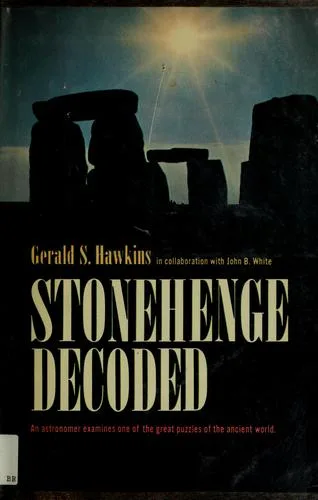
Stonehenge decoded
 83
83

Stonehenge decoded
Hawkins and White's "Stonehenge Decoded" offers a compelling, albeit specific, interpretation of the famous Wiltshire monument. The strength of the book lies in its meticulous cataloging of alignments and its persistent, logical pursuit of a singular purpose: astronomical prediction. The authors meticulously detail how various stones and markers, including the Aubrey holes, could have functioned to predict solar and lunar events with remarkable accuracy for their time.
A significant limitation, however, is the book's singular focus. While the astronomical interpretation is robustly argued, it tends to sideline other potential functions or meanings of Stonehenge, such as its role in ritual, social gathering, or as a symbolic landscape feature. The work's insistence on a purely scientific, almost mechanical, function can feel reductive to some.
Read more ↓
One particularly memorable section details the proposed alignments for predicting lunar standstills, a complex 18.6-year cycle that few modern readers might expect prehistoric peoples to have tracked. The authors present this as evidence of a profound understanding of celestial mechanics.
Ultimately, "Stonehenge Decoded" is a vital, if narrowly focused, contribution to understanding the potential astronomical sophistication of Neolithic builders.
📝 Description
83
### What It Is Stonehenge Decoded, first published in 1988 by Gerald S. Hawkins and John Bradley White, presents a comprehensive analysis of the prehistoric monument of Stonehenge. It moves beyond mere description to propose a functional interpretation, arguing that the site served as a sophisticated astronomical observatory.
### Who It's For This work is aimed at serious students of archaeoastronomy, ancient history, and megalithic structures. It will appeal to those who appreciate rigorous, evidence-based arguments applied to ancient mysteries, particularly individuals interested in the intersection of early human ingenuity and celestial observation.
### Historical Context The book emerged during a period of intense scholarly interest in archaeoastronomy, building upon earlier work by figures like Alfred Watkins and Alexander Thom. Hawkins's own previous research, particularly his 1973 book 'Megalithic Lunar Observatories,' laid significant groundwork for this detailed examination. The 1980s saw a growing acceptance of the idea that ancient peoples possessed advanced astronomical knowledge.
### Key Concepts The central thesis posits Stonehenge as a computational device for predicting astronomical events. This includes solstices, equinoxes, and lunar standstills, requiring alignment of numerous stones and Aubrey holes. The authors detail specific alignments and the mathematical relationships they suggest, proposing a complex system for tracking celestial cycles.
💡 Why Read This Book?
• Learn how Stonehenge's structure, including specific stones and the Aubrey holes, may have been engineered as a sophisticated tool for predicting solar and lunar cycles, offering a concrete understanding of Neolithic astronomical capabilities. • Understand the historical context of archaeoastronomy in the late 20th century, recognizing how Hawkins's work contributed to the discourse following figures like Alexander Thom. • Grasp the complex concept of lunar standstills and how the book proposes Stonehenge could have been used to track this 18.6-year celestial event, demonstrating advanced observational methods.
⭐ Reader Reviews
Honest opinions from readers who have explored this book.
❓ Frequently Asked Questions
What is the primary argument of 'Stonehenge Decoded' regarding the monument's purpose?
The book argues that Stonehenge functioned primarily as an advanced astronomical observatory, a sophisticated computational device for predicting significant solar and lunar events.
Who were the authors of 'Stonehenge Decoded'?
The authors are Gerald S. Hawkins, an astronomer, and John Bradley White. The book was first published in 1988.
What specific astronomical events does the book suggest Stonehenge was used to track?
The work explores the monument's potential for tracking solstices, equinoxes, and the complex 18.6-year lunar standstill cycles.
What evidence do Hawkins and White present for their astronomical theory?
They detail numerous alignments between stones, post holes, and surrounding landscape features, correlating these with celestial event timings.
Does the book discuss other potential uses for Stonehenge besides astronomical observation?
While the primary focus is astronomical, the book acknowledges the monument's likely ceremonial significance, but centers its argument on the calculational capabilities.
What role do the Aubrey Holes play in the book's theory?
The Aubrey Holes are presented as crucial components of the observational system, potentially used for marking lunar positions and predicting cycles.
🔮 Key Themes & Symbolism
Neolithic Astronomical Computation
The central theme revolves around the hypothesis that Stonehenge was not merely a temple or gathering place, but a functional device for complex astronomical calculations. Hawkins and White meticulously detail how the arrangement of megaliths, post holes (like the Aubrey Holes), and surrounding landscape features align with significant celestial events. They propose that the builders possessed a sophisticated understanding of solar and lunar cycles, enabling them to predict phenomena such as solstices, equinoxes, and even the more intricate 18.6-year lunar standstill cycle. This perspective reframes Stonehenge as an early form of scientific instrument, demonstrating remarkable foresight and mathematical acumen in prehistoric societies.
Megalithic Engineering and Alignment
This theme focuses on the practical engineering and architectural aspects that support the astronomical interpretation. The authors examine the precise placement of the sarsen stones and bluestones, as well as the significance of the ditch and bank. Specific attention is given to the observational possibilities offered by various alignments, such as the Heel Stone with the sunrise at the summer solstice. The book delves into the methods by which these ancient builders could have achieved such accuracy, suggesting a deep knowledge of surveying and construction techniques applied with astronomical purpose.
The Lunar Standstill Puzzle
A particularly compelling aspect of the book is its exploration of Stonehenge's potential role in tracking lunar standstills. This phenomenon, occurring approximately every 18.6 years, represents the extreme points of the moon's rising and setting positions. Hawkins and White present evidence suggesting that the monument's design, particularly the alignment of certain stones and the use of the Aubrey Holes, was intended to observe and perhaps predict these complex lunar movements, indicating a level of astronomical sophistication previously underestimated for the Neolithic period.
Archaeoastronomy in the Late 20th Century
The book is situated within the burgeoning field of archaeoastronomy in the latter half of the 20th century. It builds upon and engages with the work of earlier researchers like Alfred Watkins and Alexander Thom, who also proposed astronomical functions for ancient sites. Hawkins's previous work, 'Megalithic Lunar Observatories' (1973), is a direct precursor. 'Stonehenge Decoded' represents a significant contribution to the ongoing debate about the scientific and mathematical knowledge of prehistoric peoples, advocating for a more empirical and less purely ritualistic understanding of these ancient monuments.
💬 Memorable Quotes
“The work explores how the Stonehenge monument may have served as a computational device for predicting astronomical events.”
— This paraphrased concept highlights the book's core argument: that Stonehenge was more than just a ceremonial site; it was a functional tool for understanding and forecasting celestial cycles, suggesting advanced scientific knowledge among its builders.
“Specific alignments suggest the builders tracked the complex 18.6-year lunar standstill cycle.”
— This points to a key piece of evidence presented by the authors, emphasizing the precision required to observe and calculate such a long-term lunar phenomenon, underscoring the monument's sophisticated astronomical purpose.
“The Aubrey Holes are interpreted as integral to a system for marking and predicting lunar positions.”
— This interpretation focuses on a specific feature of Stonehenge, the Aubrey Holes, and its proposed role within the book's overarching astronomical framework, illustrating how different elements of the site work together.
“Hawkins and White challenged prevailing views by presenting Stonehenge as a scientific instrument.”
— This statement captures the book's impact on scholarly discourse, positioning it as a work that pushed against traditional interpretations by emphasizing the scientific and mathematical capabilities of Neolithic societies.
“The book details the potential for predicting solstices and equinoxes through precise stone placement.”
— This highlights the more commonly understood astronomical functions attributed to Stonehenge, grounding the book's complex theories in more accessible solar observations and demonstrating the site's calendrical utility.
🌙 Esoteric Significance
Tradition
While not strictly aligned with a single esoteric lineage like Hermeticism or Kabbalism, "Stonehenge Decoded" taps into the broader Western esoteric tradition's fascination with ancient mysteries and lost knowledge. It shares an affinity with traditions that seek to uncover hidden scientific or spiritual truths within ancient structures and texts. The work can be seen as a secularized echo of Gnostic quests for hidden wisdom, applying scientific methodology to reveal the 'gnosis' of astronomical understanding embedded within the stones.
Symbolism
The primary 'symbol' explored is Stonehenge itself, reinterpreted not just as a sacred site but as a functional symbol of cosmic order and human intellect. The alignments represent the connection between the terrestrial and the celestial, a core concept in many esoteric systems. The solstices and equinoxes symbolize cosmic cycles of death and rebirth, light and darkness, while the lunar standstill, representing the extremes of the moon's celestial path, can be seen as a symbol of cyclical completion and the hidden potential within natural rhythms.
Modern Relevance
Contemporary archaeoastronomy continues to build on the methodologies explored in "Stonehenge Decoded." Modern researchers, often employing advanced digital modeling and surveying techniques, investigate sites worldwide for astronomical correlations. Furthermore, the book's emphasis on ancient scientific literacy resonates with modern interest in indigenous knowledge systems and the intellectual achievements of early civilizations. It informs contemporary discussions about the capabilities of prehistoric societies and the enduring human impulse to understand and map the cosmos.
👥 Who Should Read This Book
• Students of archaeoastronomy and comparative ancient studies seeking a foundational argument for Stonehenge's astronomical purpose. • History enthusiasts interested in the scientific and mathematical capabilities of Neolithic societies and the evolution of observational practices. • Skeptics and proponents of alternative interpretations of ancient sites, looking for a rigorously argued, evidence-based perspective on Stonehenge's function.
📜 Historical Context
Published in 1988, "Stonehenge Decoded" emerged during a vibrant period for archaeoastronomy, a field gaining academic traction. Gerald S. Hawkins, an astronomer, had already established a reputation with his 1973 book, 'Megalithic Lunar Observatories,' which proposed similar astronomical functions for other ancient sites. This era saw scholars like Alexander Thom, who published extensively on megalithic astronomy from the 1950s onwards, influencing the discourse. The work by Hawkins and White built upon this foundation, offering detailed analyses of Stonehenge's alignments. While the idea of ancient astronomical knowledge was gaining acceptance, it faced skepticism from traditional archaeologists who sometimes viewed such interpretations as speculative or overly reliant on coincidence. The reception was generally positive among those in the archaeoastronomy community, who saw it as further evidence for sophisticated prehistoric observation, though some mainstream archaeologists remained cautious about the singular focus on astronomical calculation.
📔 Journal Prompts
The proposed function of Stonehenge as a computational device for predicting solar and lunar events.
The specific alignments detailed for tracking the 18.6-year lunar standstill cycle.
The role of the Aubrey Holes in the proposed astronomical observation system.
The author's interpretation of the builders' mathematical and observational skills.
Comparing Hawkins's hypothesis with other theories about Stonehenge's purpose.
🗂️ Glossary
Archaeoastronomy
The interdisciplinary study of how people in the past perceived and utilized astronomical phenomena in their cultures, often by analyzing ancient sites and artifacts for celestial alignments.
Solstice
The point in the year when the sun reaches its highest or lowest declination, resulting in the longest and shortest days, respectively. These occur around June 21st and December 21st in the Northern Hemisphere.
Equinox
The time of year when the day and night are of equal length, occurring twice annually around March 20th and September 22nd, when the sun crosses the celestial equator.
Lunar Standstill
A complex astronomical cycle occurring approximately every 18.6 years, during which the moon reaches its northernmost and southernmost rising and setting points on the horizon. There are major and minor standstills.
Aubrey Holes
A ring of 56 pits discovered around the outside of the sarsen stone circle at Stonehenge, named after the 17th-century antiquary John Aubrey. Their exact purpose is debated, but they are central to many astronomical theories.
Sarsen Stones
The large sandstone blocks forming the main uprights and lintels of the stone circles at Stonehenge, believed to have been quarried from the Marlborough Downs, about 20 miles north of the site.
Bluestones
The smaller stones, primarily of volcanic origin, that make up one of the inner circles and the outer horseshoe at Stonehenge. They were transported from the Preseli Hills in Wales, over 150 miles away.