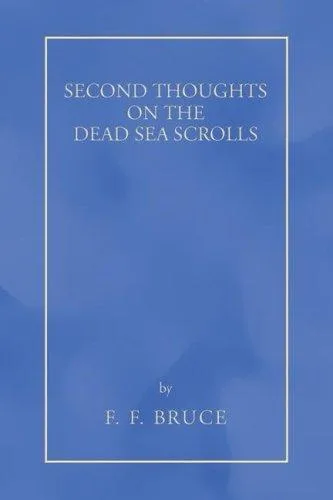
Second Thoughts on the Dead Sea Scrolls
 83
83

Second Thoughts on the Dead Sea Scrolls
Frederick Fyvie Bruce’s "Second Thoughts on the Dead Sea Scrolls" represents a mature scholar’s grappling with evidence that had, by 1986, become both a subject of intense study and considerable speculation. Bruce navigates the labyrinthine scholarly arguments with a clarity that is, at times, almost too understated for the material’s inherent drama. His careful dissection of paleographical dating, particularly concerning the period between the 2nd century BCE and the 1st century CE, demonstrates a meticulous approach. A particular strength lies in his balanced assessment of the scrolls' relationship to nascent Christianity, avoiding the more extreme claims that characterized some earlier scholarship. However, the book’s dense academic focus, while a virtue for specialists, may leave the general reader desiring more direct engagement with the most striking textual fragments. The author's measured tone, while commendable, sometimes struggles to convey the sheer revolutionary impact these texts had on biblical studies. Ultimately, "Second Thoughts" serves as an indispensable, if demanding, checkpoint for anyone serious about the scrolls' academic legacy.
📝 Description
83
### What It Is Frederick Fyvie Bruce's "Second Thoughts on the Dead Sea Scrolls," first published in 1986, offers a critical re-evaluation of the foundational discoveries of the Qumran caves. It engages directly with the textual evidence and the scholarly debates that emerged in the decades following the initial finds. The work is not a sensationalist exposé but a sober, scholarly assessment, aiming to clarify the often-conflicting interpretations that arose around these ancient manuscripts.
### Who It's For This book is suited for serious students of early Judaism and Christian origins, particularly those who have already encountered the primary texts and some of the attendant scholarly discourse. It will appeal to individuals seeking a nuanced perspective beyond popular accounts, those interested in the history of biblical scholarship, and readers who appreciate rigorous analysis of ancient documents. It is for those who want to understand the *process* of scholarly interpretation as much as the conclusions.
### Historical Context The initial discovery of the Dead Sea Scrolls began in 1947, sparking intense academic and popular interest. By the 1980s, a substantial body of secondary literature had accumulated, often marked by divergent theories regarding the scrolls' authorship, date, and relationship to early Christianity. Bruce's work emerges in this environment, addressing prevailing hypotheses and offering his own considered perspectives, contributing to the ongoing academic conversation that also involved scholars like Frank Moore Cross and Roland de Vaux.
### Key Concepts The book critically examines the identification of the Qumran community, the nature of the sectarian texts versus other manuscript types found, and the linguistic features of the scrolls. Bruce analyzes the evidence for Essene affiliation, the dating of the scrolls based on paleography and carbon-14 analysis, and the implications of the scrolls for understanding the New Testament period. It also explores the significance of texts like the Community Rule and the War Scroll.
💡 Why Read This Book?
• Gain a critical perspective on the Essene hypothesis by examining Bruce's analysis of texts like the Community Rule, understanding the scholarly debate surrounding sectarian authorship. • Grasp the nuances of dating the scrolls through Bruce's engagement with paleography and carbon-14 analysis, appreciating the scientific and historical methods applied circa 1986. • Understand the historical milieu of early Christian origins by exploring Bruce's discussion of the scrolls' relationship to the New Testament period, offering a scholarly counterpoint to sensationalist theories.
⭐ Reader Reviews
Honest opinions from readers who have explored this book.
❓ Frequently Asked Questions
What specific Qumran texts does Frederick Fyvie Bruce analyze in "Second Thoughts on the Dead Sea Scrolls"?
Bruce specifically examines key Qumran documents such as the Community Rule (Serekh ha-Yahad) and the War Scroll (Milhamah). His analysis also touches upon the significance of other texts like the Temple Scroll and various biblical manuscripts found in the caves.
When were the Dead Sea Scrolls discovered, and how does this timeline affect Bruce's analysis?
The initial discoveries began in 1947. Bruce's "Second Thoughts," published in 1986, reflects on decades of subsequent scholarly debate and analysis, allowing him to address prevailing theories and offer a more consolidated perspective based on accumulated research.
What is the significance of paleography in understanding the Dead Sea Scrolls, according to Bruce?
Paleography, the study of ancient handwriting, is crucial for dating the scrolls. Bruce discusses how the styles of script, particularly those from the 2nd century BCE to the 1st century CE, provide key evidence for the manuscripts' age and origin.
Does Bruce connect the Dead Sea Scrolls to the Essenes?
Yes, Bruce engages with the strong scholarly consensus that linked the scrolls to the Essenes, a Jewish sect. He evaluates the evidence supporting this identification, considering the community rules and beliefs reflected in the texts.
What was the scholarly climate surrounding the Dead Sea Scrolls when this book was published in 1986?
By 1986, numerous theories about the scrolls' origins, authorship, and relationship to early Christianity were circulating. Bruce's work sought to provide a critical reassessment amidst this complex and sometimes contentious scholarly landscape.
How does "Second Thoughts on the Dead Sea Scrolls" differ from popular accounts of the discovery?
Unlike popular accounts, Bruce's book offers a rigorous, academic examination. It focuses on textual criticism, historical context, and scholarly methodology rather than sensationalism, providing a nuanced perspective for those interested in genuine research.
🔮 Key Themes & Symbolism
Textual Authenticity and Dating
Bruce meticulously scrutinizes the methods used to authenticate and date the Dead Sea Scrolls, moving beyond initial excitement to a phase of rigorous academic verification. He engages with paleographical analysis, comparing script styles from the Hellenistic and Roman periods (e.g., 2nd century BCE to 1st century CE) to establish chronological frameworks. The work addresses the application of radiocarbon dating and its implications, weighing its results against traditional scholarly methods. This focus underscores the critical importance of establishing a reliable timeline for the scrolls to understand their historical and religious context accurately.
The Qumran Community and Essene Identity
A central theme is the identification of the community responsible for producing and preserving the Qumran library. Bruce evaluates the evidence linking the scrolls to the Essenes, a Jewish ascetic group prominent in the Second Temple period. He dissects texts like the Community Rule (Serekh ha-Yahad) to identify characteristic Essene beliefs, practices, and organizational structures. The book explores the arguments for and against this identification, considering alternative theories and the challenges posed by the diversity of texts found within the Qumran caves.
Dead Sea Scrolls and Early Christianity
Bruce offers a considered perspective on the relationship between the Dead Sea Scrolls and the emergence of Christianity. He carefully assesses claims that sought to find direct parallels or precursors to Christian teachings and figures within the Qumran texts. The work focuses on providing a balanced view, distinguishing between genuine historical connections and speculative overreach. By examining shared terminology, eschatological expectations, and messianic ideas, Bruce helps readers understand how the scrolls illuminate the Jewish milieu from which Christianity arose.
History of Scholarship
The book implicitly charts the evolution of Dead Sea Scrolls scholarship from the initial discoveries in 1947 through the decades that followed. Bruce addresses the work of earlier scholars and the prevailing debates of his time (circa 1986). His "second thoughts" suggest a dynamic field where initial interpretations are continually refined or challenged by new evidence and analytical approaches. This meta-commentary on the academic process itself is a valuable component for understanding how knowledge about these ancient texts has been constructed.
💬 Memorable Quotes
“The Community Rule contains regulations for the organization of the community.”
— This paraphrased concept highlights the Serekh ha-Yahad's function as a foundational document detailing the structure and governance of the Qumran sect, a key piece of evidence for understanding their communal life and identity.
“Paleographical dating relies on the evolution of script styles.”
— This highlights a core methodological principle Bruce employs, emphasizing that the changes in handwriting over time (from the 2nd century BCE onwards) provide a crucial, albeit complex, tool for establishing the age of the scrolls.
“The scrolls offer insight into the Jewish background of Jesus and his followers.”
— This interpretation points to Bruce's focus on the broader religious landscape of Judea during the Second Temple period, framing the scrolls as essential context for understanding the origins of Christianity.
“Radiocarbon dating provided new data for chronological assessment.”
— This references the scientific methods applied to the scrolls, acknowledging how techniques like carbon-14 analysis, developed significantly after the initial finds, offered independent verification or challenge to earlier dating conclusions.
“Identification with the Essenes remains a strong hypothesis.”
— This paraphrased concept reflects Bruce's engagement with the dominant scholarly theory linking the Qumran community to the Essenes, indicating that while debated, this remains a significant interpretive framework for the scrolls.
🌙 Esoteric Significance
Tradition
While the Dead Sea Scrolls themselves predate many formalized esoteric traditions, their discovery and interpretation have profoundly influenced modern esoteric thought, particularly within Hermetic, Gnostic, and Kabbalistic circles. These traditions often seek ancient roots and hidden wisdom, and the scrolls, with their unique interpretations of scripture and apocalyptic visions, offered compelling material. Bruce's work, by providing a scholarly lens, allows esoteric practitioners to engage with the historical context of these texts more critically, discerning between historical reality and later esoteric appropriations.
Symbolism
The Dead Sea Scrolls are rich in symbolism, particularly concerning purity, covenant, and eschatological conflict. The 'Community Rule' (Serekh ha-Yahad), for instance, symbolizes the ideal community as a 'House of Holiness' separated from the profane world. The frequent references to light versus darkness, and the War Scroll's depiction of the 'Sons of Light' battling the 'Sons of Darkness,' offer potent dualistic imagery. These symbolic frameworks have been adopted and reinterpreted within various esoteric traditions to represent spiritual battles and paths to enlightenment.
Modern Relevance
Contemporary esoteric thinkers and practitioners continue to draw upon the Dead Sea Scrolls, often focusing on their unique theological perspectives and perceived mystical teachings. Groups exploring Gnostic texts, early Christian mysticism, and Jewish esoteric traditions find resonance in the scrolls' emphasis on divine revelation, angelic encounters, and messianic expectations. Bruce's scholarly analysis, though historical, provides a crucial grounding, enabling modern seekers to differentiate between the historical Essenes and the layers of interpretation and esoteric symbolism that have accrued around these texts over centuries.
👥 Who Should Read This Book
• Students of Second Temple Judaism: Those researching the diverse religious landscape of Judea between 200 BCE and 70 CE will find Bruce's analysis essential for understanding the Essene hypothesis and the scrolls' context. • Comparative Religion Scholars: Individuals comparing early Jewish sects with early Christian movements will benefit from Bruce's balanced assessment of textual connections and divergences. • History of Biblical Scholarship Enthusiasts: Readers interested in how ancient texts are studied and interpreted will appreciate Bruce's critical engagement with the scholarly debates surrounding the scrolls up to 1986.
📜 Historical Context
Frederick Fyvie Bruce's "Second Thoughts on the Dead Sea Scrolls," published in 1986, arrived at a pivotal moment in the study of these ancient manuscripts. The initial discoveries, commencing in 1947, had ignited a firestorm of academic and popular interest, leading to decades of intense excavation, publication, and debate. By the mid-1980s, the scholarly landscape was crowded with competing theories regarding the scrolls' authorship, provenance, and theological implications. Scholars like Frank Moore Cross had already proposed influential theories about the scrolls' sectarian nature, while Roland de Vaux's archaeological work at Qumran provided crucial context. Bruce's work engaged directly with this complex legacy, offering a sober reassessment that sought to clarify the evidence and counter more speculative interpretations that had gained traction in popular discourse. The reception of the scrolls had been marked by both immense enthusiasm and considerable controversy, including delays in publication, making Bruce's contribution a significant voice in the ongoing academic conversation.
📔 Journal Prompts
The Community Rule's regulations for communal life.
Paleographical dating methods applied to ancient manuscripts.
The concept of the 'Sons of Light' versus 'Sons of Darkness'.
Bruce's assessment of Essene identity markers.
The historical context of 1st-century CE Judean religious movements.
🗂️ Glossary
Paleography
The study of ancient handwriting. In relation to the Dead Sea Scrolls, it involves analyzing the style, form, and evolution of script over time (e.g., from the 2nd century BCE to the 1st century CE) to help date the manuscripts.
Serekh ha-Yahad
Also known as the Community Rule, this is one of the most significant sectarian texts found among the Dead Sea Scrolls. It outlines the rules, beliefs, and organization of the Qumran community.
Essenes
A Jewish ascetic sect that flourished during the Second Temple period. Many scholars, including Bruce, have linked the Qumran community and the Dead Sea Scrolls to the Essenes based on textual evidence and historical accounts.
Radiocarbon Dating
A scientific method used to determine the age of organic materials, such as parchment. Applied to the Dead Sea Scrolls, it provided a crucial scientific check on dates derived from paleography and other historical evidence.
Second Temple Period
The era in Jewish history from the rebuilding of the Second Temple in Jerusalem around 516 BCE until its destruction by the Romans in 70 CE. The Dead Sea Scrolls largely date from this period.
Sectarian Texts
Manuscripts believed to have been written by a specific religious group or sect, in contrast to biblical texts or other non-sectarian writings. The Community Rule is a prime example of a sectarian text found at Qumran.
Apocalyptic Literature
A genre of literature characterized by visions, symbolic language, and predictions of future events, often involving divine intervention and the end of the world. The scrolls contain significant apocalyptic writings.