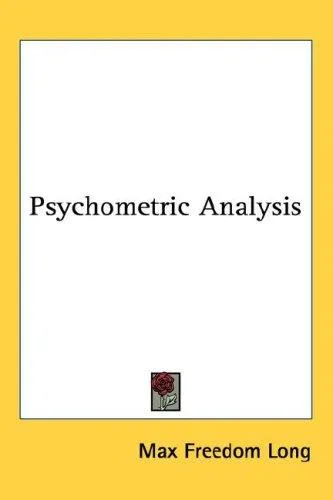
Psychometric Analysis
 83
83

Psychometric Analysis
Max Freedom Long’s "Psychometric Analysis" offers a pragmatic, if somewhat dated, framework for understanding psychometry. The strength lies in its methodical approach; Long doesn't just assert the possibility of psychometry but attempts to codify its practice with exercises. However, the conceptual language, while earnest, occasionally feels insulated from broader developments in consciousness studies and quantum physics that have emerged since its first publication in 2006. The sections detailing 'attunement' and 'imprint interpretation' are particularly useful, providing concrete steps rather than vague instructions. A limitation is the lack of engagement with modern scientific methodologies or critiques of psychometry, which might leave some readers wanting more rigorous validation. Despite this, the book serves as a valuable primer for those entering the field, offering a clear pathway for personal exploration.
This is a solid, if unadorned, guide to the practice of psychometry.
📝 Description
83
### What It Is
Psychometric Analysis is a foundational text exploring the principles and practices of psychometry, the purported ability to gain information about an object or person through tactile contact. Max Freedom Long's work presents a systematic approach to developing and utilizing this psychic faculty. It moves beyond anecdotal accounts to offer structured exercises and theoretical underpinnings for those seeking to understand and engage with subtle energies.
### Who It's For
This book is intended for individuals seriously investigating extrasensory perception and the mind's latent capabilities. It will appeal to students of parapsychology, occult studies, and those interested in the historical development of consciousness research. Readers seeking practical methods for enhancing intuition and exploring non-local awareness will find specific guidance within its pages.
### Historical Context
The original publication of this work in 2006 places it within a modern resurgence of interest in esoteric subjects, following decades of scientific skepticism and popular occult revivals. It engages with a lineage of thought that includes figures like J.W. Dunne and his theories on serialism, and the broader parapsychological research conducted throughout the 20th century. The book offers a perspective on psychometry that aims for systematic understanding in an era where the internet has facilitated wider dissemination of such knowledge.
### Key Concepts
Long introduces concepts such as the 'aura' or energetic imprint left on objects, the importance of focused intention, and techniques for 'tuning in' to residual vibrations. The work emphasizes the role of the subconscious mind as a conduit for psychometric impressions and provides methods for interpreting these subtle communications. It suggests that consistent practice can lead to reliable and verifiable readings, moving psychometry from a speculative art to a demonstrable skill.
💡 Why Read This Book?
• Learn specific techniques for developing tactile intuition, as detailed in the 'Attunement Exercises' section, offering a tangible method for psychic development not found in general meditation guides. • Understand the concept of residual 'imprints' on objects, a core tenet of psychometry, providing a framework for interpreting subtle energetic information beyond everyday perception. • Gain insight into the early 21st-century approach to psychometry, as presented in its 2006 publication, situating your understanding within a specific period of esoteric literature.
⭐ Reader Reviews
Honest opinions from readers who have explored this book.
❓ Frequently Asked Questions
What is psychometry according to Max Freedom Long?
Max Freedom Long defines psychometry as the ability to perceive information about an object or person through physical touch. His work, first published in 2006, outlines methods for developing and applying this psychic faculty.
When was Psychometric Analysis first published?
The book 'Psychometric Analysis' by Max Freedom Long was first published in 2006, positioning it within a contemporary wave of interest in esoteric and psychic phenomena.
Are there practical exercises in Psychometric Analysis?
Yes, the book includes structured exercises designed to help readers develop their psychometric abilities, focusing on attunement and the interpretation of energetic imprints left on objects.
What is the historical context of this book?
Published in 2006, 'Psychometric Analysis' emerged during a modern revival of interest in psychic studies, drawing on and contributing to the discourse around extrasensory perception.
Who is Max Freedom Long?
Max Freedom Long is the author of 'Psychometric Analysis.' His work, originating in 2006, focuses on the systematic exploration and development of psychometric abilities.
Does the book explain the theory behind psychometry?
Yes, 'Psychometric Analysis' explores the theoretical underpinnings of psychometry, discussing concepts like residual energy, subconscious perception, and intentional focus.
🔮 Key Themes & Symbolism
The Energetic Imprint
The central concept is that objects retain an energetic 'imprint' or vibration from their past experiences and owners. Long posits that this imprint is a form of residual energy, akin to a subtle echo, which can be perceived by a sensitive individual. The book details how to attune oneself to these imprints, suggesting that focused intent and a prepared subconscious are crucial for receiving clear impressions. This theme is fundamental to understanding how psychometric readings are theoretically possible, moving beyond mere guesswork to a structured energetic interaction.
Developing Psychic Sensitivity
Long's work is not just theoretical; it provides a practical roadmap for cultivating psychometric abilities. He outlines specific exercises designed to enhance intuition and the capacity to perceive subtle energies. These often involve tactile engagement with objects, emphasizing patience, focus, and the systematic interpretation of sensory data. The emphasis is on developing a reliable skill through consistent practice, rather than relying on innate, uncontrolled psychic flashes, making it accessible for dedicated students.
Subconscious as a Conduit
A key element in Long's approach is the role of the subconscious mind. He suggests that conscious, analytical thought can interfere with the reception of psychometric impressions. Instead, the subconscious acts as the primary receiver, translating the object's energetic signature into intuitive insights or sensory perceptions. The book guides readers on how to quiet the conscious mind and allow the subconscious to process the subtle information, thereby enhancing the accuracy and depth of psychometric readings.
Systematic Interpretation
Beyond simply 'feeling' something from an object, 'Psychometric Analysis' stresses the importance of systematic interpretation. Long provides frameworks for categorizing and understanding the types of impressions received, whether they are visual, auditory, emotional, or purely conceptual. This analytical component helps distinguish genuine psychometric data from imagination or projection, aiming to establish a verifiable methodology for psychometric practice. The book advocates for cross-referencing impressions and seeking patterns for greater clarity.
💬 Memorable Quotes
“The object holds the vibration of its past.”
— This concise statement encapsulates the core principle of psychometry as presented by Long: that inanimate objects are not inert but carry energetic residues from their history, which can be accessed through touch.
“Focus the mind, but let the subconscious perceive.”
— This highlights Long's view on the psychometric process, emphasizing the need for directed attention to initiate the reading, while allowing the deeper, intuitive faculties of the subconscious to receive the subtle impressions.
“Every touch leaves a trace.”
— This phrase underscores the idea that interactions, particularly those charged with emotion or significance, leave a palpable energetic mark on objects, forming the basis for psychometric investigation.
“Practice is the key to unlocking latent abilities.”
— Long consistently advocates for diligent effort in developing psychometric skills. This quote reflects his belief that consistent, structured practice is essential for transforming potential psychic capacities into reliable abilities.
“Interpret the subtle signals with clarity.”
— This points to the analytical aspect of psychometry discussed in the book, where receiving impressions is only the first step; the true skill lies in discerning and understanding the meaning of these subtle energetic communications.
🌙 Esoteric Significance
Tradition
While not explicitly aligned with a single esoteric lineage like Hermeticism or Kabbalah, Long's work on psychometry draws from the broader Western Esoteric Tradition's interest in subtle energies and the expansion of human perception beyond the five senses. It aligns with the Theosophical emphasis on unseen forces and the development of psychic faculties, as well as modern New Age concepts of energetic resonance and spiritual intuition.
Symbolism
The primary 'symbol' in psychometry is the object itself, which acts as a vessel for imprinted information. The act of touch becomes a symbolic key, unlocking access to the object's history or its owner's experiences. Long's methodology implies that the tactile connection is a direct, symbolic link to the past, transforming a mundane action into a profound act of communion with residual energies.
Modern Relevance
Long's approach to psychometry continues to inform contemporary practitioners and researchers interested in intuitive development and energy work. His emphasis on structured practice and interpretation resonates with modern self-help and esoteric education, where systematic learning is valued. Thinkers and groups focusing on intuitive arts, energy healing, and evidential mediumship often draw upon foundational texts like this for understanding the mechanics of psychic perception.
👥 Who Should Read This Book
• Aspiring psychometrists seeking a structured introduction to the practice, offering clear exercises for developing tactile intuition and interpreting impressions. • Students of parapsychology interested in historical methodologies for exploring extrasensory perception, providing a specific case study from the early 21st century. • Individuals exploring intuition development who want practical, repeatable techniques for accessing non-local information beyond standard meditation or visualization practices.
📜 Historical Context
Max Freedom Long’s "Psychometric Analysis," first published in 2006, emerged in an era where interest in parapsychology and esoteric studies was experiencing a resurgence, partly fueled by the internet's accessibility to diverse knowledge. The book positions itself within a long tradition of exploring psychic phenomena, tracing back to early 20th-century investigators like J.W. Dunne, whose theories on time and consciousness resonated with those exploring extrasensory perception. While scientific skepticism remained a dominant force, authors like Long sought to offer structured methodologies for phenomena that were often dismissed. The work can be seen as a contribution to the popularization of psychic studies, offering practical guidance that contrasted with more academic or purely theoretical approaches prevalent at the time. It engaged with the legacy of thinkers who, like Dunne, attempted to systematize subjective experience and perception.
📔 Journal Prompts
Reflect on the concept of the 'energetic imprint' on everyday objects.
Analyze the effectiveness of 'attunement' exercises for accessing subtle information.
Consider how the 'subconscious mind' might process psychometric data.
Evaluate the potential for systematic interpretation of psychometric impressions.
Explore the ethical considerations of accessing information through touch.
🗂️ Glossary
Psychometry
The purported psychic ability to perceive information about an object or person through tactile contact, including history, emotions, or physical characteristics.
Energetic Imprint
The residual energetic vibration or information that an object is believed to retain from its history, owners, or significant events.
Attunement
The process of mentally and energetically preparing oneself to receive subtle impressions from an object through focused concentration and intention.
Residual Vibration
Subtle energetic frequencies left behind on objects or in locations by past events, emotions, or individuals.
Subconscious Perception
The theory that the subconscious mind acts as the primary receiver for psychometric impressions, translating them into intuitive insights or sensory data.
Intuitive Interpretation
The process of discerning and understanding the meaning of psychometric impressions received, often involving symbolic or non-linear comprehension.
Tactile Contact
The physical act of touching an object, which is considered the primary method for initiating and conducting a psychometric reading.