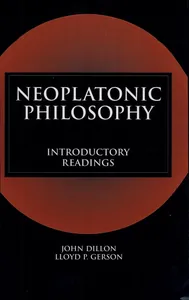
Neoplatonic philosophy
 82
82

Neoplatonic philosophy
John M. Dillon and Lloyd P. Gerson’s survey of Neoplatonic philosophy provides a much-needed scholarly overview for a contemporary audience. The authors adeptly map the intellectual lineage from Plato's dialogues to the intricate metaphysical hierarchies constructed by Plotinus and his successors. A particular strength lies in their clear exposition of complex concepts like the hypostases, making the system accessible without oversimplification. However, the sheer density of the material, while accurate, might present a steep learning curve for absolute beginners. The discussion of Porphyry’s commentaries on Aristotle, for example, is illuminating but requires prior familiarity with both figures. Despite this, the work serves as a solid, fact-based introduction to a philosophical tradition that underpins much of Western esotericism.
📝 Description
82
### What It Is This volume offers a comprehensive survey of Neoplatonic philosophy, tracing its development from the foundational ideas of Plato through the complex systems of Plotinus, Porphyry, Iamblichus, and Proclus. It examines the core tenets of this influential ancient school of thought, including its metaphysics, epistemology, and ethics.
### Who It's For The book is designed for students and scholars of ancient philosophy, religious studies, and intellectual history. It serves as a rigorous introduction for those new to the subject, providing essential background and analytical tools, while also offering nuanced discussions valuable for specialists.
### Historical Context Neoplatonism emerged in the Roman Empire, particularly in Alexandria and Athens, during the 3rd century CE. It represented a significant reinterpretation of Platonic thought, deeply influencing later Christian, Jewish, and Islamic mystical traditions. This work situates Neoplatonism within its Hellenistic philosophical milieu, contrasting it with Stoicism and Aristotelianism.
### Key Concepts The text elucidates central Neoplatonic doctrines such as the One, the hypostases (Intellect, Soul), emanation, theurgy, and the ascent of the soul. It explores how these concepts were articulated and debated by key figures, providing a clear understanding of their interconnectedness and their role in the Neoplatonic worldview.
💡 Why Read This Book?
• Gain a structured understanding of the Neoplatonic system, learning about concepts like the hypostases and emanation as presented by Plotinus. • Grasp the historical development of Neoplatonism from its Platonic roots to its late antique formulations, noting its emergence in the 3rd century CE. • Explore the philosophical underpinnings of later esoteric traditions by examining the influence of thinkers like Iamblichus on the development of theurgy.
⭐ Reader Reviews
Honest opinions from readers who have explored this book.
❓ Frequently Asked Questions
What is the primary goal of Neoplatonic philosophy?
The primary goal is the ascent of the soul towards the ultimate principle, the One, through intellectual and spiritual purification. This journey involves understanding the emanated reality and transcending the material world.
Who was Plotinus and why is he important?
Plotinus (c. 204/5 – 270 CE) is considered the founder of Neoplatonism. His philosophical system, compiled by his student Porphyry in the Enneads, established the core doctrines of the One, Intellect, and Soul, influencing centuries of thought.
How did Neoplatonism differ from earlier Platonism?
Neoplatonism systematized and elaborated on Plato's ideas, introducing a hierarchical cosmology with distinct hypostases (The One, Intellect, Soul) and emphasizing mystical union with the divine. It also incorporated elements of Aristotelianism and Stoicism.
What is the concept of 'emanation' in Neoplatonism?
Emanation describes how reality flows or proceeds from the One, the supreme, ineffable principle, without diminishing it. This process generates the lower levels of existence, such as Intellect and Soul, in a cascading order.
What role does theurgy play in later Neoplatonism?
Theurgy, particularly emphasized by Iamblichus, involved ritual practices aimed at facilitating the soul's ascent and union with the divine. It was seen as a necessary complement to philosophical contemplation for achieving salvation.
When was the original publication of this work?
The work 'Neoplatonic Philosophy' by John M. Dillon and Lloyd P. Gerson was first published in 2004.
🔮 Key Themes & Symbolism
The One and Emanation
This work meticulously details the Neoplatonic conception of the One, the ultimate, transcendent source of all being, and the process of emanation through which reality unfolds. It explains how subsequent hypostases—Intellect (Nous) and Soul (Psyche)—derive their existence from the One without diminishing its unity. The esoteric significance lies in understanding this hierarchical structure as a map of consciousness and a pathway for the soul's return to its divine origin.
The Soul's Ascent
A central theme is the Neoplatonic doctrine of the soul's journey back to the One. The book explores the Neoplatonic view of the soul's descent into the material world and the methods, both philosophical and practical (like theurgy), advocated for its purification and ascent. This resonates with esoteric traditions seeking liberation from the material realm and reunion with the divine intellect.
Metaphysics and Cosmology
The text provides a thorough examination of Neoplatonic metaphysics, including the structure of reality as conceived by thinkers like Plotinus and Proclus. It elucidates the intricate cosmology, explaining the relationships between different levels of existence and the ultimate aim of achieving a unified understanding of the cosmos as divinely ordered.
Influence on Later Thought
The book traces the profound and often overlooked influence of Neoplatonism on subsequent philosophical, religious, and mystical traditions, including early Christian theology, Islamic philosophy, and Renaissance esotericism. Understanding Neoplatonism is crucial for grasping the intellectual currents that shaped these later movements.
💬 Memorable Quotes
“The One is not any existing thing, but is prior to all existing things.”
— This statement encapsulates the radical transcendence of the Neoplatonic Godhead. It emphasizes that the ultimate reality is beyond all categories of being and comprehension, a concept fundamental to mystical theology.
“The Intellect contains all beings in itself.”
— This refers to the second hypostasis, Nous, which is the realm of Forms or Ideas. It's the divine mind where all archetypes and intelligibles exist eternally, serving as the blueprint for the subsequent unfolding of reality.
“The Soul is the mediator between the intelligible and sensible worlds.”
— This highlights the crucial role of the Soul (Psyche) as a connecting principle. It bridges the gap between the purely intellectual realm and the physical world, enabling knowledge and influencing the material order.
“The goal is to make the soul like the One.”
— This expresses the ultimate aim of Neoplatonic practice: achieving a state of unity and divine likeness. It signifies a process of spiritual purification and intellectual contemplation to align oneself with the ultimate principle.
“Theurgy aims at a divine union.”
— This interpretation points to the practical, ritualistic dimension of later Neoplatonism, particularly associated with Iamblichus. Theurgy is presented not merely as worship but as a method for achieving direct communion with the gods.
🌙 Esoteric Significance
Tradition
Neoplatonism is a cornerstone of Western esoteric philosophy, bridging classical Greek thought with later mystical traditions. It provides a philosophical scaffolding for Gnostic, Hermetic, and Kabbalistic systems, offering a sophisticated cosmology of emanation and ascent that aligns with concepts of divine unity and spiritual liberation found across these lineages.
Symbolism
Key symbols include the 'One' as the ineffable source, representing absolute unity and transcendence. The 'hypostases' (Intellect, Soul) symbolize hierarchical levels of consciousness and being. The 'ascent of the soul' is a central motif, signifying the journey from material entanglement to spiritual enlightenment, often visualized as a return to the primordial light.
Modern Relevance
Contemporary esoteric practitioners and scholars of mysticism draw heavily on Neoplatonic thought. It informs modern magical theories, contemplative practices, and philosophical explorations of consciousness. Thinkers and groups interested in perennial philosophy and comparative mysticism often find Neoplatonism a crucial link between ancient wisdom and contemporary spiritual seeking.
👥 Who Should Read This Book
• Students of ancient philosophy seeking a rigorous introduction to Plato's successors and their complex metaphysical systems. • Scholars of comparative religion and intellectual history interested in the roots of Western mysticism and esoteric traditions. • Individuals exploring contemplative practices and metaphysical frameworks that aim for spiritual union and understanding of divine order.
📜 Historical Context
Emerging in the 3rd century CE, Neoplatonism represented a sophisticated synthesis and development of Platonic philosophy, deeply engaging with the intellectual climate of the Hellenistic and Roman periods. Thinkers like Plotinus, writing in Rome, and later Iamblichus and Proclus in Athens, established intricate metaphysical systems that sought to explain the origin and structure of reality. This school of thought offered a powerful alternative to prevailing philosophies such as Stoicism and Aristotelianism, providing a framework for understanding the divine, the cosmos, and the human soul's place within it. Neoplatonism's influence was pervasive; it profoundly shaped the theological and philosophical discourse of emerging Christianity, as well as Jewish and Islamic mysticism, becoming a foundational element in the Western esoteric tradition. Its reception was complex, often viewed with suspicion by established religious authorities but embraced by those seeking deeper spiritual and intellectual understanding.
📔 Journal Prompts
The concept of the One: explore its implications for ultimate reality.
The hypostases: how do Intellect and Soul function as intermediaries?
Plotinus's view on the soul's descent: what does it signify for human experience?
Iamblichus and theurgy: what is the relationship between ritual and salvation?
The Neoplatonic cosmos: reflect on its hierarchical structure.
🗂️ Glossary
The One
The ultimate, transcendent, and ineffable source of all reality in Neoplatonism. It is beyond being, thought, and description, yet is the origin from which all existence emanates.
Hypostasis
A fundamental principle or level of reality in Neoplatonic metaphysics. The primary hypostases are The One, Intellect (Nous), and Soul (Psyche).
Nous
The second hypostasis, often translated as Intellect or Mind. It is the realm of the Forms or Ideas, containing the divine blueprint of the cosmos and existing in perfect unity.
Psyche
The third hypostasis, the Soul. It acts as a mediator between the intelligible world (Nous) and the sensible world, animating and ordering both.
Emanation
The process by which reality flows from The One without diminishing it. It describes the cascading generation of lower levels of existence from higher principles.
Theurgy
Ritual practices, particularly emphasized by Iamblichus, aimed at facilitating the soul's purification and ascent to the divine. It involves invocations and ceremonies to align with higher powers.
Ascent of the Soul
The Neoplatonic path of spiritual and intellectual purification leading the soul back to its divine source, The One, through contemplation and practice.