Mastering Yang Style Taijiquan
 80
80

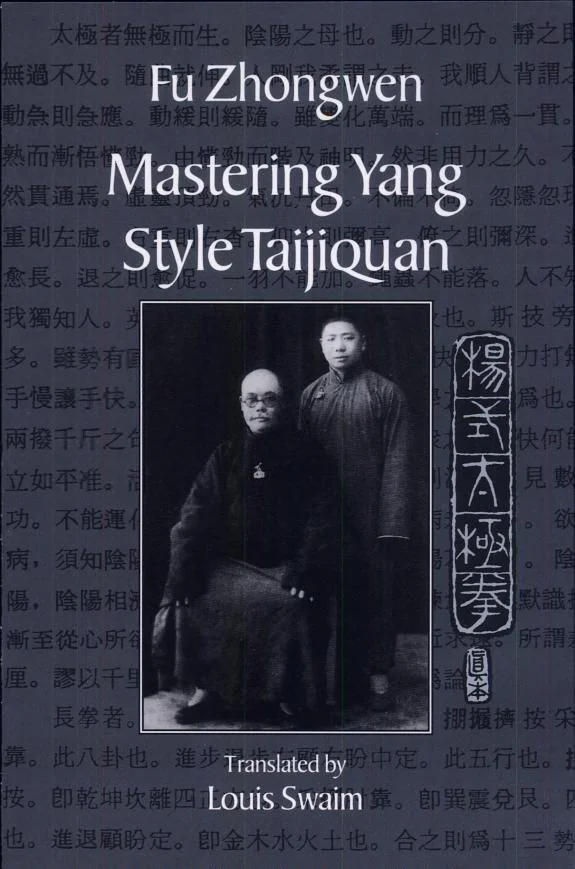
Mastering Yang Style Taijiquan
Fu Zhongwen's Mastering Yang Style Taijiquan offers a direct lineage transmission that is rare in contemporary Tai Chi literature. The book's strength lies in its meticulous detail, grounded in Fu's extensive study with Yang Chengfu. The line drawings, while simple, are remarkably effective in illustrating the subtle shifts in weight and intention required for each posture. A notable limitation, however, is the book's dense prose, which can be challenging for absolute beginners without prior instruction. The section on the "Push Hands" (Tui Shou) practice, while present, could benefit from more visual aids given its crucial role in developing sensitivity. Despite this, the work remains an authoritative reference for understanding the Yang family's specific approach to Taijiquan, particularly for serious students.
📝 Description
80
### What It Is Mastering Yang Style Taijiquan is a foundational text offering detailed instruction in the Yang family's renowned form of Tai Chi. Originally published in 1999, this handbook serves as a comprehensive guide for practitioners seeking to understand and execute the intricate movements of this internal martial art. It distills decades of lineage transmission, providing a clear pathway for learning.
### Who It's For This volume is essential for martial artists, Qigong practitioners, and those interested in cultivating internal energy and mindful movement. Students of Yang style specifically will find unparalleled depth. It is also valuable for historians of Chinese culture and martial traditions, offering a direct look into a significant practice.
### Historical Context This work is rooted in the direct transmission of Taijiquan from Yang Chengfu, considered the foremost proponent of the art in the early to mid-20th century. Fu Zhongwen, the author, was a dedicated disciple, meticulously learning and preserving the form. The book provides a link to this pivotal period, bridging the gap between historical practice and modern understanding.
### Key Concepts The text elucidates fundamental Taijiquan principles such as rooting, yielding, and the coordination of mind and body. It emphasizes the importance of correct posture, alignment, and the flow of Qi. The detailed movement descriptions focus on cultivating internal strength and balance, moving beyond mere physical technique to explore the energetic dimensions of the practice.
💡 Why Read This Book?
• Gain precise instructions on the Yang style form, directly influenced by Fu Zhongwen's 20 years studying with Yang Chengfu, offering unparalleled lineage accuracy. • Understand the subtle energetic principles and postural alignments crucial for developing internal power, as detailed in the text's explanations of Qi cultivation. • Access a historical resource featuring line drawings that meticulously demonstrate each movement, providing a visual key to the art's traditional execution.
⭐ Reader Reviews
Honest opinions from readers who have explored this book.
❓ Frequently Asked Questions
What is the primary focus of Fu Zhongwen's "Mastering Yang Style Taijiquan"?
The book's primary focus is providing detailed, step-by-step instructions for the Yang style of Taijiquan, based on the author's extensive training under Yang Chengfu.
When was "Mastering Yang Style Taijiquan" first published?
The original publication date for "Mastering Yang Style Taijiquan" by Fu Zhongwen was 1999.
Who was Yang Chengfu and why is he important to this book?
Yang Chengfu was a pivotal figure in popularizing Taijiquan and was the author's teacher. Fu Zhongwen's instructions are directly informed by his 20 years of study with Yang Chengfu.
Are there illustrations in "Mastering Yang Style Taijiquan"?
Yes, the book includes line drawings that demonstrate the movements of the Taijiquan form, serving as a visual guide for practitioners.
What makes this book different from other Tai Chi books?
Its value lies in its direct lineage transmission from Yang Chengfu through Fu Zhongwen, offering an authentic and detailed account of the Yang style's principles and practice.
Is "Mastering Yang Style Taijiquan" suitable for complete beginners?
While comprehensive, the book's detail can be dense. It is most beneficial for serious students or those with some prior exposure to Tai Chi, ideally with guidance.
🔮 Key Themes & Symbolism
Lineage Transmission
The work underscores the paramount importance of direct teacher-student lineage in martial arts. Fu Zhongwen's meticulous adherence to the teachings of Yang Chengfu, the foremost proponent of Yang style Taijiquan, serves as a model. This transmission ensures the integrity and subtle nuances of the art are preserved, moving beyond generic interpretations to embody the specific energetic and structural principles passed down through generations.
Internal Cultivation
Beyond physical technique, the book emphasizes the cultivation of internal energy (Qi) and mental focus. It details how specific postures and transitions, when performed with correct intention and internal awareness, foster the circulation of vital energy. This focus on the mind-body connection is central to Taijiquan's effectiveness as both a martial art and a health practice, aiming for balance and harmony within the practitioner.
Movement as Meditation
The practice of Yang Style Taijiquan, as presented, can be viewed as a moving meditation. The slow, deliberate execution of the form encourages a state of present-moment awareness, quieting the discursive mind. Each posture and transition requires concentration, integrating the physical body with mental discipline, leading to a profound sense of centeredness and calm.
Structural Integrity
A core tenet is the maintenance of correct structural alignment throughout the form. This involves understanding principles like rooting, maintaining an upright spine, and coordinating the limbs. Proper structure ensures efficient power generation and transmission, while also preventing injury and facilitating the free flow of Qi. The book provides detailed guidance on achieving this essential physical foundation.
💬 Memorable Quotes
“The body should be like a coiled spring.”
— This metaphor highlights the potential for stored power within relaxed, correctly aligned postures. It suggests that movement should originate from a place of internal tension and readiness, not brute force.
“The feet must be firmly rooted, yet the body remains agile.”
— This speaks to the paradoxical nature of Taijiquan – stability combined with fluidity. It emphasizes the importance of a strong connection to the ground while maintaining the capacity for rapid, subtle shifts in weight and direction.
“The mind leads the Qi, and the Qi leads the body.”
— This encapsulates the internal martial arts principle of intent driving action. It prioritizes mental focus and energetic flow over mere physical exertion, suggesting that true power arises from a unified mind-body connection.
“Each movement should flow seamlessly into the next.”
— This highlights the importance of continuity and connection in the Taijiquan form. It discourages jerky or isolated movements, advocating for a smooth, unbroken sequence that mirrors the natural flow of energy.
“Yielding is not weakness, but a strategy of redirection.”
— This is a core principle of Taijiquan's martial application. It explains that instead of meeting force with force, one redirects an opponent's energy, using their own momentum against them.
🌙 Esoteric Significance
Tradition
While Taijiquan itself is often viewed through a lens of traditional Chinese medicine and martial arts, its internal aspects—cultivating Qi, integrating mind and body, and achieving energetic balance—place it within a broader spectrum of Taoist contemplative and energetic practices. It shares common ground with Qigong and internal alchemy, focusing on harmonizing the individual with natural energetic principles.
Symbolism
The slow, circular movements themselves symbolize the Taoist concept of the Tao – the natural, flowing order of the universe. Specific postures often evoke natural phenomena or embody principles like Yin and Yang (e.g., the balance between yielding and asserting). The concept of Qi as a vital life force is central, representing the energetic current that animates all things and must be cultivated for health and efficacy.
Modern Relevance
Contemporary practitioners of mindfulness, somatic psychology, and even certain branches of energy medicine find resonance in Taijiquan's emphasis on embodied awareness, breath control, and the mind-body connection. Its principles of yielding, balance, and internal strength offer valuable lessons for navigating the stresses of modern life and cultivating resilience, extending its relevance beyond traditional martial applications.
👥 Who Should Read This Book
• Dedicated practitioners of Yang Style Taijiquan seeking to deepen their understanding of form and internal principles through direct lineage instruction. • Students of Chinese martial arts history and philosophy interested in authoritative accounts of traditional practices from the early 20th century. • Individuals exploring Taoist energetic cultivation and mindful movement disciplines who seek a structured, yet profound, path to internal development.
📜 Historical Context
Published in 1999, Fu Zhongwen's Mastering Yang Style Taijiquan arrived at a time when Western interest in Chinese internal martial arts was rapidly expanding, yet authentic lineage texts remained relatively scarce. The work's significance lies in its direct transmission from Yang Chengfu, who was instrumental in popularizing and refining the Yang style throughout the early to mid-20th century. Fu Zhongwen, having studied with Yang Chengfu for two decades, offered an authoritative account. While competing schools like Baguazhang and Xingyiquan also gained traction, Yang style Taijiquan, with its emphasis on yielding and health benefits, particularly appealed to a broader audience. The book’s reception was largely positive among dedicated practitioners seeking depth beyond superficial introductions, cementing its status as a key resource for understanding this specific martial tradition.
📔 Journal Prompts
The concept of the 'coiled spring' in posture.
The mind leading the Qi, and the Qi leading the body.
Rootedness versus agility in footwork.
The seamless flow between movements.
The principle of yielding as a strategic redirection.
🗂️ Glossary
Taijiquan
Literally 'Supreme Ultimate Fist,' a Chinese internal martial art practiced for both its health benefits and self-defense applications. Known for its slow, flowing movements and emphasis on internal energy cultivation.
Yang Style
One of the major styles of Taijiquan, characterized by its relatively slow, large, and graceful movements, emphasizing softness, yielding, and balance. It is the most widely practiced style globally.
Qi (Chi)
A fundamental concept in traditional Chinese culture, often translated as vital energy or life force. In Taijiquan, cultivating and directing Qi is central to practice.
Rooting
The ability to maintain a stable connection to the ground, providing a solid base from which to generate power and remain balanced, even when pushed or moved.
Push Hands (Tui Shou)
A training method in Taijiquan designed to develop sensitivity, balance, and the ability to yield and redirect an opponent's force. It involves two practitioners maintaining contact and responding to each other's movements.
Form (Tao Lu)
The sequence of choreographed movements that constitute the practice of Taijiquan. Each form has a specific number of movements and a particular sequence, passed down through generations.
Internal Alchemy (Neidan)
A Taoist practice focused on cultivating the body's internal energies to achieve spiritual and physical transformation. Taijiquan shares many principles with Neidan.