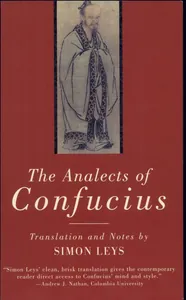
Lun yu

 76
76

Lun yu
The enduring relevance of The Analects hinges on its practical, aphoristic style, which Confucius's disciples meticulously recorded. Unlike didactic texts, it presents a series of dialogues and observations that invite contemplation rather than dictating dogma. A notable strength is its focus on self-cultivation as the basis for societal improvement, exemplified in passages discussing the rectification of names. However, the compilation’s fragmented nature can sometimes obscure a unified philosophical system, requiring readers to synthesize ideas across disparate sayings. A passage concerning the proper way to serve a ruler, for instance, highlights the tension between loyalty and honest counsel. It remains a cornerstone text for understanding East Asian ethics.
📝 Description
76
### What It Is The Lun yu, commonly known in English as The Analects, is a foundational text of Confucianism, comprising sayings and ideas attributed to the Chinese philosopher Confucius and his contemporaries. Compiled by his disciples, it offers a window into Confucius's ethical and social philosophy, emphasizing personal cultivation, righteousness, and proper conduct. It is not a systematic treatise but a collection of aphorisms, dialogues, and anecdotes that provide guidance on how to live a virtuous life and govern effectively.
### Who It's For This work is essential for scholars of East Asian philosophy, students of ethics, and anyone interested in the historical roots of moral and political thought in China. It is particularly relevant for those exploring the development of virtue ethics and the concept of societal harmony. Readers seeking to understand the cultural and philosophical underpinnings of East Asian societies will find it invaluable.
### Historical Context Compiled in the Spring and Autumn period and Warring States period of Chinese history (roughly 771-256 BCE), The Analects emerged from a time of significant social and political upheaval. Confucius (551–479 BCE) himself lived during this era, seeking to restore order and morality through his teachings. His ideas contrasted with the Legalist school, which advocated strict laws and punishments, by stressing the importance of ritual (li) and benevolence (ren) as foundations for governance and social cohesion. The text was later consolidated and heavily influenced the imperial examination system from the Han Dynasty onwards.
### Key Concepts The Analects introduces several core philosophical concepts that have shaped East Asian thought for millennia. Central among these is 'ren' (仁), often translated as benevolence, humaneness, or goodness, representing the ideal virtue of empathy and concern for others. 'Li' (禮) refers to ritual propriety, etiquette, and social norms, crucial for maintaining social order and expressing respect. 'Junzi' (君子), the noble person or gentleman, is the ideal individual who embodies these virtues through continuous self-cultivation and ethical practice. The text also emphasizes filial piety ('xiao' 孝) and loyalty ('zhong' 忠) as vital components of a well-ordered society.
💡 Why Read This Book?
• Gain insight into the concept of 'ren' (仁), understanding how Confucius advocated for humaneness and empathy as the bedrock of personal conduct and societal harmony. • Explore the principle of 'li' (禮), learning how ritual propriety and social etiquette were considered essential by Confucius for maintaining order and demonstrating respect. • Grasp the ideal of the 'junzi' (君子), the noble person, and how continuous self-cultivation was presented as the path to achieving personal virtue and effective leadership.
⭐ Reader Reviews
Honest opinions from readers who have explored this book.
❓ Frequently Asked Questions
When was The Analects first compiled by Confucius's disciples?
The Analects were compiled by Confucius's disciples and their students, likely over several decades following his death in 479 BCE, during the Spring and Autumn and Warring States periods.
What is the primary meaning of 'ren' (仁) in The Analects?
'Ren' (仁) is a core concept in The Analects, generally translated as benevolence, humaneness, or goodness. It signifies a deep empathy and concern for others, forming the foundation of Confucian ethics.
How does 'li' (禮) differ from modern etiquette in The Analects?
'Li' (禮) in The Analects encompasses not just etiquette but also ritual, propriety, and social norms. It's about performing actions in the correct manner to cultivate virtue and maintain social harmony, extending beyond mere politeness.
Who is the 'junzi' (君子) as described in The Analects?
The 'junzi' (君子) represents the ideal person in Confucian thought – a noble individual who embodies virtues like benevolence, righteousness, and propriety through constant self-cultivation and ethical practice.
What is the significance of filial piety ('xiao' 孝) in Confucius's teachings?
Filial piety ('xiao' 孝), respect and obedience towards one's parents and elders, is presented in The Analects as a fundamental virtue and the root of all other ethical conduct, essential for familial and social order.
Did Confucius himself write The Analects?
No, Confucius (551–479 BCE) did not write The Analects. The text is a compilation of his sayings and deeds, recorded by his disciples and their followers after his passing.
🔮 Key Themes & Symbolism
The Cultivation of Ren (仁)
Central to the Lun yu is the concept of 'ren' (仁), the embodiment of humaneness, benevolence, and moral goodness. Confucius emphasized that this virtue is cultivated through diligent self-reflection, ethical action, and sincere interpersonal relationships. It is not an innate quality but a practice, developed through consistent effort in adhering to principles of empathy and consideration for others. The text suggests that achieving 'ren' is the ultimate goal of personal development, influencing one's conduct in all aspects of life, from family to governance.
The Role of Li (禮)
'Li' (禮) refers to rites, rituals, propriety, and social norms. In the Lun yu, 'li' is presented as the outward expression of inner virtue and the framework for maintaining social order and harmony. It involves adhering to established customs, performing ceremonies correctly, and conducting oneself with appropriate deference and respect. Confucius believed that proper observance of 'li' not only shapes individual character but also stabilizes the community, guiding interactions and preventing social discord through established patterns of behavior.
The Ideal of the Junzi (君子)
The 'junzi' (君子), often translated as the noble person or gentleman, is the exemplar of Confucian virtue. This ideal is achieved through continuous moral education and self-improvement, embodying 'ren' and 'li' in practice. A 'junzi' is characterized by integrity, righteousness, and a commitment to ethical principles, distinguishing them from the 'small person' focused on personal gain. The pursuit of becoming a 'junzi' is a lifelong endeavor, requiring constant vigilance over one's thoughts and actions.
Governance and Righteousness
The Lun yu frequently addresses the principles of good governance, linking effective leadership directly to the moral character of the ruler. Confucius argued that a leader should govern by moral example ('de' 德) rather than by force or strict laws. The concept of righteousness ('yi' 義) is paramount, suggesting that leaders and officials must prioritize what is morally correct over personal advantage or expediency. A ruler who embodies virtue can inspire loyalty and foster a harmonious society, creating an environment where the populace thrives.
💬 Memorable Quotes
“The Master said, 'Is it not a joy to learn and to practice what you have learned?'”
— This saying highlights Confucius's emphasis on the active and rewarding nature of continuous learning and the application of knowledge. It suggests that true satisfaction comes not just from acquiring wisdom but from integrating it into one's life and actions.
“The Master said, 'If you learn without thinking, you will be lost. If you think without learning, you will be in danger.'”
— This aphorism underscores the necessity of balancing theoretical knowledge with critical reflection. It cautions against rote memorization without understanding and against abstract thought devoid of empirical grounding, advocating for an integrated approach to wisdom.
“The Master said, 'A young man should be filial to his parents at home and respectful to elders abroad. He should be earnest and trustworthy. He should overflow in kindness to all, and attach himself to the benevolent.'”
— This quote outlines fundamental ethical duties, beginning with familial obligations ('xiao' 孝) and respect for seniors. It extends to general trustworthiness and broad benevolence, culminating in seeking the company of virtuous individuals, illustrating a progressive path to moral development.
“The Master said, 'The superior man is modest in his speech, but exceeds in his actions.'”
— This highlights the Confucian ideal of the 'junzi' (君子). It contrasts superficial talk with substantive deeds, valuing humility in expression while prioritizing impactful and virtuous actions as the true measure of a person's character.
“The Master said, 'Do not do to others what you do not want done to yourself.'”
— This principle, often referred to as the 'Silver Rule,' encapsulates the essence of empathy and reciprocity. It serves as a fundamental guide for ethical interaction, promoting consideration for others' feelings and perspectives in all dealings.
🌙 Esoteric Significance
Tradition
While primarily a philosophical and ethical text, The Analects holds significant esoteric relevance within East Asian traditions, particularly influencing Neo-Confucianism and later esoteric interpretations. Its emphasis on self-cultivation and the alignment of the individual with cosmic principles can be seen as a path toward spiritual realization, akin to inner alchemy. The meticulous study and application of its principles are viewed by some as a form of disciplined spiritual practice, aiming to perfect human nature and achieve harmony with the Tao or the natural order.
Symbolism
Key symbols in The Analects include 'ren' (仁) and 'li' (禮). 'Ren' symbolizes the inner core of human goodness, the vital energy of compassion and empathy that animates moral life. 'Li' symbolizes the structured expression of this inner virtue, the outward forms and rituals that channel energy constructively and maintain social and cosmic balance. The 'junzi' (君子) itself functions as a symbol of perfected human potential, the individual who has harmonized their inner spirit with outward conduct.
Modern Relevance
Contemporary thinkers and practitioners in fields ranging from positive psychology to global ethics draw inspiration from The Analects. Its focus on character development, ethical leadership, and social harmony resonates in discussions about sustainable development, mindfulness, and the search for meaning in a complex world. Various schools of contemplative practice and philosophical study continue to explore its teachings as a guide for cultivating inner peace and ethical engagement with society.
👥 Who Should Read This Book
• Students of comparative philosophy: To understand the foundational texts that shaped East Asian ethical and political thought for over two thousand years. • Aspiring leaders and ethicists: To explore Confucius's emphasis on virtue-based leadership and the cultivation of character as the basis for effective governance. • Individuals seeking self-improvement: To engage with ancient wisdom on personal cultivation, righteousness, and building harmonious relationships.
📜 Historical Context
The Lun yu emerged from the intellectual ferment of China's Spring and Autumn (771–476 BCE) and Warring States (475–221 BCE) periods, a time marked by political fragmentation and philosophical inquiry. Confucius (551–479 BCE) sought to restore social and political order through ethical teachings centered on virtue and ritual. His philosophy stood in contrast to emerging Legalist doctrines, which advocated strict adherence to laws and punishments. The compilation of The Analects by his disciples began after his death and continued for decades. The text gained immense prominence during the Han Dynasty (206 BCE–220 CE), becoming a cornerstone of the imperial examination system and profoundly shaping Chinese governance, education, and social values for over two millennia.
📔 Journal Prompts
The concept of 'ren' (仁) and its practical application in daily interactions.
The role of 'li' (禮) in structuring social harmony and personal conduct.
Reflecting on the qualities of the 'junzi' (君子) and personal progress towards this ideal.
How the principle of 'yi' (義) guides decisions in situations of personal gain versus moral obligation.
The practice of filial piety ('xiao' 孝) within contemporary family structures.
🗂️ Glossary
Ren (仁)
The core Confucian virtue, often translated as benevolence, humaneness, or goodness. It signifies empathy, compassion, and profound concern for others, forming the basis of ethical conduct.
Li (禮)
Ritual propriety, etiquette, and social norms. 'Li' encompasses ceremonies, customs, and correct behavior, seen as essential for maintaining social order and expressing respect.
Junzi (君子)
The 'noble person' or 'gentleman.' The ideal individual in Confucianism, characterized by moral virtue, integrity, and continuous self-cultivation.
Xiao (孝)
Filial piety. The virtue of respect, obedience, and care towards one's parents and elders, considered a fundamental ethical principle.
Yi (義)
Righteousness or justice. The principle of doing what is morally correct and appropriate, often contrasted with personal profit or expediency.
De (德)
Virtue or moral power. In governance, it refers to the influence a virtuous ruler has on the populace through moral example, rather than coercion.
Rectification of Names (正名)
The concept that names and titles should correspond to reality. For instance, a ruler should truly act like a ruler, a minister like a minister, to ensure social order.