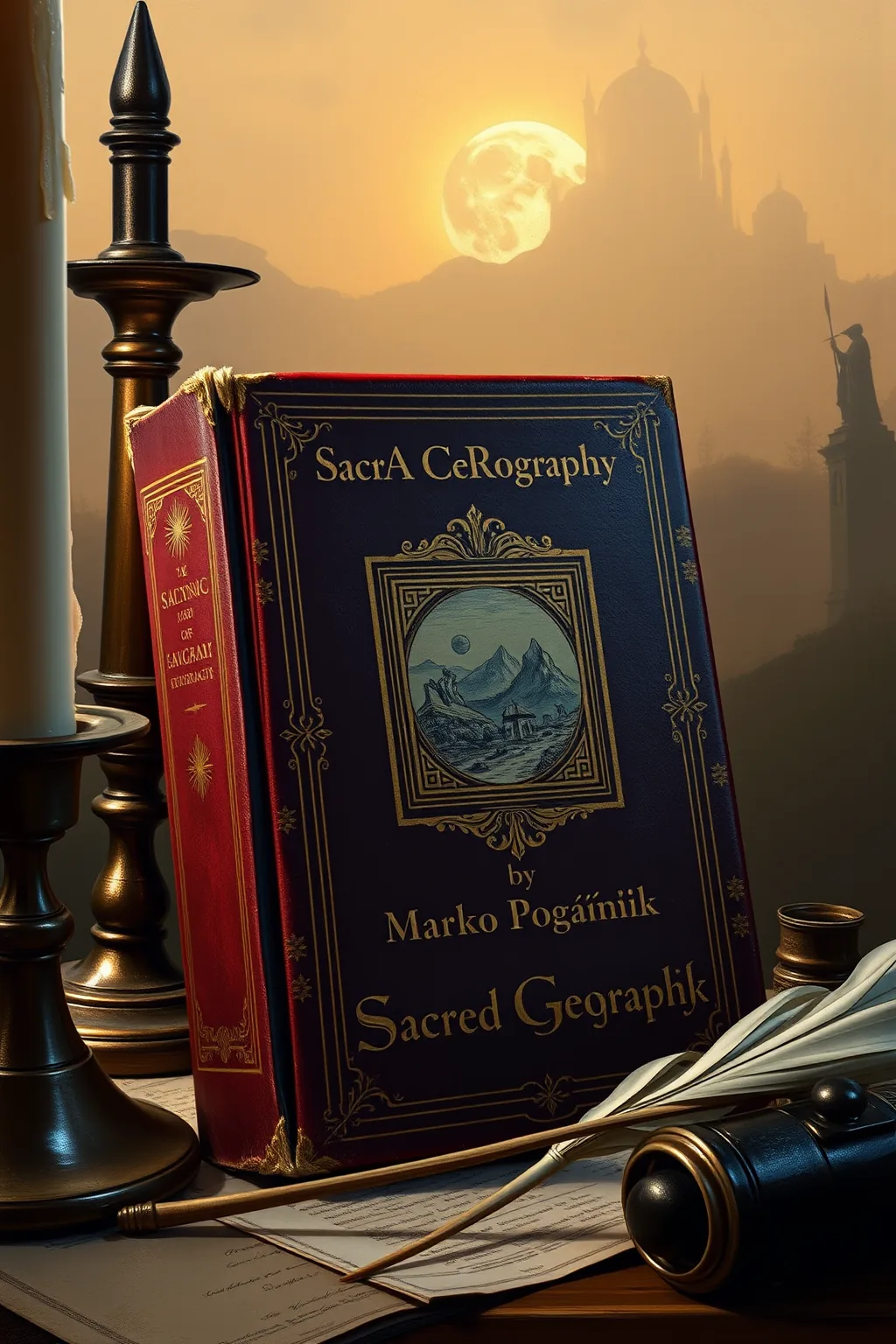
Sacred Geography
 83
83

Sacred Geography
Marko Pogačnik's 'Sacred Geography' offers a compelling, if at times dense, perspective on geomancy. The author's extensive fieldwork, spanning decades, lends a palpable authority to his descriptions of earth energies. He moves beyond mere theory, presenting geomancy as an embodied practice. A particular strength lies in his detailed explanations of how to perceive subtle landscape features, such as the energetic 'veins' of the earth. However, the text could benefit from more explicit visual aids to accompany the complex diagrams and concepts he introduces. The section on 'The Living Earth' is particularly impactful, revealing a profound connection between planetary health and human well-being. This work is a significant contribution for those willing to engage with its demanding yet rewarding content.
📝 Description
83
Marko Pogačnik's 2007 book, Sacred Geography, details his practical geomancy experience and theories.
Sacred Geography expands on Pogačnik's earlier German work, 'School of Geomancy' from 1996. This 2007 text presents his developed understanding of geomancy, shaped by his extensive fieldwork. Pogačnik sought to explain geomancy as a complete system accessible to a wider audience. The book is for anyone interested in earth energies and how they connect with human awareness. It will appeal to those practicing earth-based spirituality, geographers looking at unconventional mapping, and students of esoteric traditions who want to apply ancient concepts practically.
The central idea of Sacred Geography is the Earth as a living being with an energetic body. Pogačnik provides methods for sensing and working with these subtle energies. He often uses symbolic representations and direct sensory experience within landscapes. This approach sets his work apart from purely academic or historical studies of geomancy. It follows a personal, hands-on method that emphasizes direct engagement with the land.
Published in 2007, Sacred Geography arrives during a period of renewed interest in earth mysteries, influenced by figures like John Michell and the Cambridge geomancers. Pogačnik's work is part of a tradition that views the Earth not merely as a physical space but as a living, conscious entity. His methods align with practices that seek to understand and interact with the subtle energies of place, often referred to as ley lines or telluric currents. This perspective connects to older traditions of sacred geography and landscape divination.
💡 Why Read This Book?
• Learn Pogačnik's evolved geomantic principles, distinct from his 1996 "School of Geomancy," offering a more mature perspective on earth energies. • Discover practical methods for perceiving and interacting with the Earth's subtle energetic body, derived from his extensive field work. • Understand the concept of the 'Living Earth' as presented by Pogačnik, connecting planetary vitality to human consciousness.
⭐ Reader Reviews
Honest opinions from readers who have explored this book.
❓ Frequently Asked Questions
What is the difference between this book and Marko Pogačnik's "School of Geomancy"?
Sacred Geography represents an evolution in Pogačnik's understanding and practical application of geomancy since his 1996 German publication, "Schule der Geomantie." This later work incorporates deeper insights gained from over a decade of further field research and contemplation.
What are 'earth energies' as discussed by Pogačnik?
Pogačnik describes 'earth energies' as the subtle, vital forces that permeate the planet, akin to an energetic body or circulatory system. He provides methods for perceiving these energies in specific locations through landscape observation and sensory awareness.
Is Sacred Geography suitable for beginners in geomancy?
While Pogačnik aims for public consciousness, the book assumes a certain level of engagement. Beginners might find it beneficial to first familiarize themselves with basic geomantic concepts before delving into Pogačnik's advanced, field-oriented approach.
What kind of practical exercises are included in Sacred Geography?
The book details Pogačnik's methods for landscape reading, identifying energetic lines and centers, and interacting with these forces. These are often experiential and require direct engagement with natural environments.
When was Sacred Geography first published?
Sacred Geography by Marko Pogačnik was first published in December 2007, reflecting his accumulated knowledge and practical geomantic work up to that point.
Does the book explain how to create geomantic maps?
Yes, Pogačnik's work implicitly and explicitly guides readers in understanding and potentially mapping the energetic flows and structures within landscapes, moving beyond conventional cartography.
🔮 Key Themes & Symbolism
Geomantic Perception
Pogačnik emphasizes a direct, sensory approach to perceiving the Earth's energetic architecture. This involves attuning to landscape features not just visually, but through a deeper, intuitive awareness. He details how subtle signs in topography, water flows, and vegetation can indicate underlying energetic currents, differentiating his work from purely theoretical geomancy.
The Living Earth
Central to Pogačnik's philosophy is the concept of the Earth as a conscious, living entity. Sacred Geography explores the planet's energetic body, its 'veins' and 'centers,' and posits a reciprocal relationship between the Earth's vitality and the well-being of humanity. This perspective frames geomancy as a practice of planetary healing and communion.
Landscape as Energetic Map
The book presents landscapes not merely as physical spaces but as dynamic energetic fields. Pogačnik's work provides tools and frameworks for reading these fields, understanding how they are structured, and how they influence consciousness and life. This involves recognizing patterns and flows that are often invisible to the uninitiated observer.
Evolution of Geomantic Practice
Pogačnik explicitly contrasts Sacred Geography with his earlier "School of Geomancy" (1996), highlighting the significant evolution in his understanding and practical application of geomancy. This theme underscores the dynamic nature of esoteric knowledge and the importance of ongoing fieldwork and personal development.
💬 Memorable Quotes
Direct passages from the work, attributed to the author.
“My knowledge of geomancy, coupled with my practical field work, has evolved and deepened.”
— This statement highlights Pogačnik's emphasis on experiential learning and the development of his geomantic theories over more than a decade since his previous major work on the subject.
“This is my second effort to present geomancy as a whole to the public consciousness.”
— Pogačnik frames Sacred Geography as a deliberate attempt to synthesize and communicate his comprehensive understanding of geomancy, indicating a desire to make complex esoteric concepts accessible.
“More than ten years ago, I wrote my first book on this subject in German.”
— This direct comparison to his 1996 German publication, 'Schule der Geomantie,' serves to situate Sacred Geography within the broader context of his scholarly and practical development in the field.
“I was compelled to write a completely new book.”
— This expresses the author's strong motivation, driven by significant advancements in his personal knowledge and practical experience, to create a fresh and updated exposition of geomancy.
“I presented geomancy as a whole.”
— This signifies Pogačnik's intention to offer a holistic view of geomancy, encompassing its theoretical underpinnings, practical applications, and its philosophical implications for understanding the Earth.
🌙 Esoteric Significance
Tradition
Sacred Geography situates itself within the broader tradition of geomancy, which has roots in ancient divination practices and medieval European earth magic. Pogačnik extends this by integrating it with a modern ecological and consciousness-oriented perspective, viewing the Earth as a sentient being. This departs from purely divinatory or astrological applications, framing geomancy as a path of planetary stewardship and energetic communion.
Symbolism
The book employs symbolic representations of landscape energies, often depicted as lines, nodes, and flows ('veins' and 'centers'). These symbols are not arbitrary but are intended to map the subtle, living body of the Earth. Pogačnik's work emphasizes symbols that arise from direct observation and energetic perception, aiming to translate felt experience into communicable forms.
Modern Relevance
Contemporary ecological spirituality, ecopsychology, and landscape design informed by subtle energies draw significantly from Pogačnik's conceptualization of the 'Living Earth.' Thinkers and practitioners exploring planetary consciousness, ley line research, and sacred sites often reference his work as a foundational text for understanding the energetic dimension of place.
👥 Who Should Read This Book
• Students of earth-based spiritualities seeking to deepen their connection to place and understand landscape energies. • Practitioners of geomancy looking to expand their knowledge beyond traditional divination methods into landscape perception and energetic interaction. • Environmental activists and concerned individuals interested in holistic perspectives on planetary health and the interconnectedness of consciousness and ecology.
📜 Historical Context
Published in December 2007, Sacred Geography arrived during a period of resurgence for earth mysteries and geomancy, influenced by earlier works and figures like John Michell and Paul Devereux. While academic archaeology and folklore studies were exploring ancient sites, Pogačnik's approach was distinctly experiential and esoteric, focusing on the energetic qualities of landscapes rather than purely historical or structural analysis. His work offered a counterpoint to more conventional earth sciences and even some spiritual traditions that treated geomancy as solely divination-based. The book's emergence provided practitioners with a more developed, fieldwork-informed perspective on the 'Living Earth' concept, building on a lineage that traces back to medieval geomantic texts but reinterpreting it through contemporary consciousness.
📔 Journal Prompts
The concept of the 'Living Earth' presented by Pogačnik.
Your personal perception of subtle landscape energies.
The evolution of geomantic practice since 1996.
Identifying energetic 'veins' in a familiar landscape.
The connection between planetary vitality and human consciousness.
🗂️ Glossary
Geomancy
The practice of divination by means of figures or lines or natural objects or circumstances, often involving the interpretation of earth energies and landscape features.
Earth Energies
Subtle, vital forces that Pogačnik posits permeate the planet, forming an energetic body or circulatory system that can be perceived and interacted with.
Living Earth
Pogačnik's concept of the Earth as a conscious, sentient entity with a discernible energetic structure and vital life force.
Landscape Reading
The practice of discerning and interpreting the energetic qualities, flows, and structures within a given natural environment.
Energetic Veins
Lines or currents of subtle energy that Pogačnik identifies within the Earth's landscape, analogous to circulatory systems.
Energetic Centers
Specific points or nodes within the landscape where earth energies converge or manifest with particular intensity.
Public Consciousness
The collective awareness and understanding of a particular subject or concept within society, which Pogačnik aims to influence regarding geomancy.