La Rama Dorada

 77
77

La Rama Dorada
Frazer's *The Golden Bough*, even in its translated form, remains a colossal achievement in its attempt to map the global landscape of ritual and belief. The sheer breadth of evidence cataloged is staggering; one can scarcely open the book without encountering an obscure rite or myth that illuminates a broader pattern. The section on the sacred king, detailing practices from ancient Rome to indigenous Australia, is particularly compelling for its synthesis of disparate cultural threads. However, the work's overarching evolutionary narrative, positing a linear progression from magic to religion, feels dated and overly schematic by modern anthropological standards. Frazer's tendency to impose a Western rationalist framework onto diverse belief systems can also feel reductive. Despite these limitations, the book's encyclopedic nature ensures its continued value as a reference and a source of inspiration for understanding the deep roots of human ritual behavior. It is a foundational text, albeit one best read with critical awareness of its historical context.
📝 Description
77
James George Frazer's *The Golden Bough* was first published in its complete form between 1911 and 1915.
La Rama Dorada presents James George Frazer's extensive comparative study of magic and religion. The complete work, published between 1911 and 1915, details ancient rituals, myths, and customs from around the world. Frazer aimed to chart the development of human thought, moving from early magical beliefs to monotheistic religion. His book is a large collection of evidence gathered from various cultures.
This text is useful for those studying anthropology, comparative mythology, and religious history. Specialists in folklore, psychology, and literary criticism will also find relevant material. Individuals interested in the origins of Western esotericism, the evolution of ritual, and the comparison of ancient belief systems will find it a significant reference. It is especially pertinent for understanding how different cultural practices might connect.
Published in the late Victorian era, *The Golden Bough* emerged during a time of academic focus on the origins of religion and societal structures. Frazer's work, influenced by evolutionary theories, engaged with early anthropological thought. While not strictly an esoteric text in itself, its detailed examination of magical practices, mythologies, and religious evolution provided source material and conceptual frameworks that later influenced various esoteric traditions. Its comparative approach highlighted patterns in belief and ritual that resonated with occult and mystical inquiries into universal spiritual laws.
💡 Why Read This Book?
• Understand the comparative methodology Frazer applied to global myths and rituals, offering a foundational perspective on the study of religion and magic, exemplified by his analysis of the Nemi ritual. • Gain insight into Frazer's concept of the dying-and-reviving god motif, a recurring archetype across ancient cultures that influenced later literary and psychological studies. • Explore the extensive ethnographic data compiled on practices like taboo and scapegoating, providing concrete examples of early human attempts to manage social order and natural forces.
⭐ Reader Reviews
Honest opinions from readers who have explored this book.
❓ Frequently Asked Questions
What is the historical significance of Frazer's 'The Golden Bough'?
First published in its complete form between 1911 and 1915, 'The Golden Bough' was a landmark in early anthropology and comparative religion, influencing thinkers like T.S. Eliot and impacting the study of myth and ritual for decades.
What are the core concepts explored in 'La Rama Dorada'?
The book explores the evolution of human thought from magic to religion, focusing on concepts such as sympathetic magic, the sacred king, fertility rites, and the dying-and-reviving god motif.
How does 'La Rama Dorada' relate to esoteric traditions?
While not strictly an esoteric text, its extensive documentation of ancient rituals, magic, and religious beliefs provides a rich source of comparative material for esoteric scholars studying the roots of Western mysticism and occult practices.
Who was James George Frazer?
Sir James George Frazer (1854-1941) was a Scottish cultural anthropologist whose monumental work 'The Golden Bough' became a foundational text in the study of comparative religion and mythology.
Is 'La Rama Dorada' a primary source for ancient magic?
It is a secondary analysis, compiling and comparing accounts of magic and religion from numerous primary sources and ethnographic studies available up to the early 20th century. It acts as a vast comparative overview.
What is the 'Nemi ritual' mentioned in relation to Frazer's work?
The Nemi ritual, concerning the priest of Diana at Lake Nemi in Italy and his violent succession, served as a central, albeit debated, example for Frazer's theory of the sacred king and ritual regicide.
🔮 Key Themes & Symbolism
Magic and Religion Evolution
Frazer posits a developmental trajectory where magic, seen as a mistaken science based on faulty logic (like the Law of Similarity or Contagion), precedes religion. Religion, in turn, emerges as a more developed attempt to control the supernatural, eventually giving way to scientific understanding. This framework, though challenged by later anthropologists, provided a powerful lens for analyzing belief systems and their perceived origins across diverse cultures, from ancient Greece to indigenous African societies. The book meticulously catalogues examples supporting this thesis.
The Sacred King and Ritual Death
A significant thread in Frazer's work is the figure of the divine or sacred king, often bound by strict taboos and ritual obligations, including, in many instances, ritual death or assassination. The priest of Nemi, who had to kill his predecessor to assume the role, serves as a prime example. Frazer connects this to the widespread motif of the dying-and-reviving god, suggesting a common underlying psychological need to ensure the perpetual renewal of life and fertility through symbolic sacrifice and rebirth.
Sympathetic Magic and Taboo
The book elaborates on two fundamental principles Frazer identified in primitive magic: the Law of Similarity (like produces like) and the Law of Contact or Contagion (things once in contact continue to act on each other). These principles explain practices like effigy magic or the use of personal relics. Complementing these are the pervasive rules of taboo, designed to prevent harmful contact with sacred or dangerous forces, reflecting an early understanding of spiritual or energetic pollution and the need for careful interaction with the unseen world.
Myth, Ritual, and Fertility
Frazer extensively links mythological narratives and ritual performances to the fundamental human concern with fertility – of land, crops, livestock, and people. Many ceremonies, from ancient spring festivals to initiation rites, are interpreted as attempts to ensure agricultural abundance or the continuation of the community. The concept of the scapegoat, bearing away sin or misfortune, is also analyzed in relation to appeasing divine powers and purifying the community to secure prosperity and well-being.
💬 Memorable Quotes
Direct passages from the work, attributed to the author.
“The king must die so that the land may live.”
— This represents the core idea behind Frazer's concept of the dying-and-reviving god and the sacred king, linking ritual regicide or sacrifice to the cyclical renewal of nature and societal well-being.
“Taboo is a Polynesian word signifying prohibition.”
— This highlights Frazer's use of specific terms from different cultures to illustrate universal concepts of prohibition and sacredness, crucial for understanding social regulation in early societies.
“What seems to us to be the same cause and effect may be nothing more than a succession of events.”
— This reflects Frazer's critical examination of perceived causal links in magical thinking, suggesting that apparent connections might be coincidental rather than based on true underlying principles.
💡 Key Ideas
Editorial paraphrase of the work's core concepts — not direct quotes.
The world is not governed by chance, but by the gradual unfolding of a plan.
This paraphrase captures Frazer's belief in an underlying order and progression within human history and belief systems, moving from primitive superstition towards more complex structures.
Magic is a mistaken science; religion is a propitiation of powers superior to man.
This concisely summarizes Frazer's thesis on the perceived evolutionary sequence of human thought, positioning magic as an early, flawed attempt at control, followed by religion as a means of appeasement.
🌙 Esoteric Significance
Tradition
While *The Golden Bough* is primarily a work of comparative anthropology and folklore, its extensive documentation of magical practices, ritual structures, and ancient religious beliefs has made it a foundational text for modern Western esotericism. It is frequently cited within Hermetic, ceremonial magic, and Neopagan circles as a source for understanding the historical roots and cross-cultural expressions of concepts they engage with, such as sympathetic magic, the divine king, and the cycle of death and rebirth.
Symbolism
Key symbols extensively analyzed include the **Golden Bough** itself, representing the Sibyl's guide to the underworld in Virgil's Aeneid and serving as a metaphor for esoteric knowledge or a key to understanding hidden truths. The **dying-and-reviving god** is another potent motif, symbolizing cyclical renewal, sacrifice, and the perennial hope for rebirth inherent in many nature-based spiritualities and mystery traditions. The **sacred king** embodies the intersection of divine power and human mortality, often tied to the land's fertility.
Modern Relevance
Contemporary practitioners of witchcraft, Wicca, and various forms of modern paganism often draw upon Frazer's work, particularly his discussions of fertility rites, seasonal festivals, and the archetype of the god-figure. Ritualists studying ceremonial magic may find his catalog of sympathetic magic useful for understanding historical magical techniques. Furthermore, scholars of depth psychology and comparative mythology continue to engage with Frazer's analyses of universal human concerns regarding life, death, and the divine.
👥 Who Should Read This Book
['• Students of comparative religion and anthropology: To grasp a foundational, albeit historical, framework for understanding the evolution of human belief systems and ritual practices across cultures.', '• Practitioners of Western Esotericism: To explore the documented historical antecedents and cross-cultural parallels of concepts like magic, ritual sacrifice, and divine kingship.', "• Literary and Cultural Critics: To understand the pervasive influence of Frazer's theories on 20th-century literature, art, and intellectual thought, particularly regarding myth and symbolism."]
📜 Historical Context
When James George Frazer published the definitive edition of *The Golden Bough* between 1911 and 1915, the study of anthropology was rapidly evolving. Frazer, a scholar at Cambridge, operated within a late Victorian and Edwardian intellectual milieu fascinated by evolutionary theory and the origins of civilization. His work synthesized vast amounts of ethnographic data, aiming to trace a linear progression from primitive magic through religion to science. This approach placed him in dialogue with, and sometimes in contrast to, contemporaries like Émile Durkheim, whose sociological approach to religion differed significantly. Frazer's evolutionary schema, while hugely influential, was also increasingly scrutinized. For instance, Bronisław Malinowski, a prominent anthropologist of the next generation, would later critique Frazer's armchair methodology and the perceived lack of empirical rigor in some of his interpretations, advocating for more immersive fieldwork.
📔 Journal Prompts
The concept of sympathetic magic: how might its principles of similarity and contagion be observed in contemporary phenomena?
Frazer's analysis of the sacred king: what enduring archetypes of leadership and sacrifice does this motif reveal?
The dying-and-reviving god: reflect on instances of cyclical renewal in personal experience or the natural world.
The role of taboo: consider how societal prohibitions function to maintain order and structure.
Comparing Frazer's evolutionary model with modern anthropological understandings of religion: what shifts in perspective are most significant?
🗂️ Glossary
Sympathetic Magic
A type of magic based on the belief that like produces like (Law of Similarity) or that things once in contact can affect each other at a distance (Law of Contagion).
Taboo
A prohibition, often religious or social, that forbids or restricts the use or approach of certain people, objects, or actions due to their sacred or dangerous nature.
Sacred King
A ruler whose person is considered divine or imbued with supernatural power, often subject to strict rituals and sometimes to ritual death to ensure societal or natural well-being.
Dying-and-Reviving God
A mythological or divine figure who undergoes a cycle of death and resurrection, often linked to seasonal agricultural cycles and symbolizing renewal and immortality.
Animism
The belief that natural objects, phenomena, and the universe itself possess souls or consciousness; a concept Frazer explored as an early stage of religious belief.
Scapegoat
An individual or group that is unjustly blamed for the wrongdoings or faults of others, often ritualistically punished or expelled to purify the community.
Law of Similarity
The principle underlying much imitative or homeopathic magic, stating that an effect resembles its cause; for example, harming an effigy harms the person represented.
🔮 Readers Also Liked
Browse all →









More by James George Frazer
All books →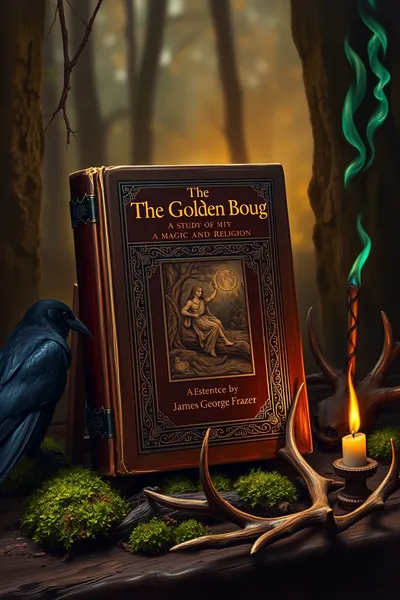


More Free Occult Philosophy Books
View all →