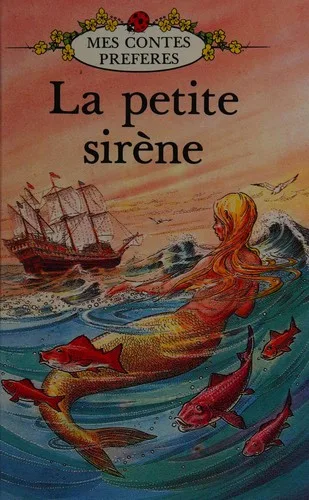
La Petite Sirene (French Well Loved Tales)
 72
72

La Petite Sirene (French Well Loved Tales)
The stark contrast between the original 1837 Danish text and its ubiquitous, saccharine adaptations is the most potent element of Andersen’s "The Little Mermaid." This edition, with its dual artistic contributions, brings a curious tension. Yayoi Kusama’s avant-garde visual language, though striking, sometimes feels jarringly anachronistic against the Romantic prose, creating a dialogue that is more confrontational than harmonious. Bernadette Watts's work, conversely, offers a more traditional, yet still evocative, visual accompaniment. The narrative’s exploration of the mermaid’s silent suffering and her yearning for an eternal soul, a concept rooted in medieval Christian theology, remains the story's enduring power. However, the sheer weight of subsequent cultural osmosis diminishes the original's impact for those already familiar with Disney's version. The true strength lies in confronting that original melancholy, a feat this edition facilitates, albeit unevenly.
📝 Description
72
Hans Christian Andersen's 1837 tale 'La Petite Sirene' confronts the cost of desire and the nature of the soul.
Hans Christian Andersen's "La Petite Sirene," first published in 1837, is more than a simple children's story. The original narrative examines sacrifice, deep longing, and the very essence of existence. This edition pairs Andersen's melancholic realism with illustrations by Yayoi Kusama and Bernadette Watts, appealing to those who prefer the unvarnished original over its softened adaptations.
The story emerged during the Romantic era, a time when folklore and individual emotion held sway. Andersen's work stood apart from earlier, more moralistic folk tales by incorporating a unique, often tragic, realism. The mermaid's quest for an immortal soul through love, her subsequent suffering, and the vast gulf between her world and the human one are central to the narrative. The cost of ambition and the pain of unrequited desire are laid bare.
Andersen's tale touches on themes of spiritual transformation and the attainment of an immortal soul, concepts that resonate within esoteric traditions. The mermaid's profound suffering and the immense sacrifice she endures to bridge the gap between her aquatic existence and the human world, driven by a desire for something beyond her own realm, mirrors certain mystical quests for enlightenment or a higher state of being. The narrative engages with the idea that profound change and transcendence often demand great personal cost.
💡 Why Read This Book?
• Understand the original narrative's philosophical depth, exploring the mermaid's quest for an immortal soul as articulated by Hans Christian Andersen in 1837, a concept far removed from modern children's adaptations. • Engage with the visual interpretations of Yayoi Kusama and Bernadette Watts, appreciating how contemporary art can reframe classic narratives, offering a distinct perspective from the 1935 publication of Watts's earlier work. • Examine the theme of sacrifice and unrequited love through the mermaid's silent suffering, a core element of the 1837 tale that highlights the personal cost of seeking a different existence.
⭐ Reader Reviews
Honest opinions from readers who have explored this book.
❓ Frequently Asked Questions
What is the original publication year of La Petite Sirene?
Hans Christian Andersen's "The Little Mermaid" was first published in Danish in 1837 as part of a collection of his fairy tales.
Who are the illustrators featured in this edition of La Petite Sirene?
This edition includes illustrations by both Yayoi Kusama and Bernadette Watts, offering distinct artistic interpretations of the classic tale.
Does this edition present the original, unadapted version of the story?
Yes, this edition aims to present Hans Christian Andersen's original narrative, which contains themes of sacrifice and melancholy not always present in popular adaptations.
What is the esoteric significance of the mermaid's desire for an immortal soul?
The mermaid's longing for an immortal soul reflects medieval Christian concepts of salvation and the spiritual realm, a prevalent philosophical undercurrent in 19th-century European thought.
How does Yayoi Kusama's art style relate to Hans Christian Andersen's tale?
Kusama's avant-garde and often surreal style provides a modern, sometimes jarring, visual counterpoint to Andersen's Romantic-era prose, prompting a re-examination of the fairy tale's themes.
When did Bernadette Watts first illustrate The Little Mermaid?
Bernadette Watts first illustrated "The Little Mermaid" for a 1935 publication, contributing a different visual interpretation to the tale's history.
🔮 Key Themes & Symbolism
The Quest for the Soul
The mermaid's central motivation is not merely to gain legs or a prince, but to acquire an immortal soul, a concept deeply influenced by 19th-century theological discussions. Andersen uses this desire to explore the perceived limitations of a non-human existence and the spiritual aspirations prevalent in European thought of the era. The tale questions what constitutes true existence and the price one might pay for spiritual transcendence.
Sacrifice and Transformation
The mermaid's journey is defined by profound self-sacrifice. She endures excruciating pain with each step and forfeits her voice, symbolizing the silencing of her true self for the possibility of a different life. This transformation highlights the inherent suffering that can accompany ambition and the pursuit of ideals, particularly when bridging disparate areas of being.
The Otherness of Being
Andersen contrasts the fluid, instinctual world of the sea with the rigid, terrestrial area of humans. The mermaid experiences alienation and misunderstanding in both, never fully belonging. Her longing for the human world stems from a desire for an immortal soul, but her physical and emotional experiences underscore the chasm between different forms of existence.
Unrequited Love and Melancholy
The tale is steeped in melancholy, particularly the mermaid's unrequited love for the prince. Her silent suffering and eventual dissolution into sea foam represent a potent symbol of loss and the pain of loving without reciprocation. This emotional core distinguishes it from lighter fairy tales and aligns it with Romantic literature's focus on intense, often sorrowful, emotion.
💬 Memorable Quotes
Direct passages from the work, attributed to the author.
“Every step she took felt as if she were walking upon sharp knives.”
— This visceral description details the physical cost of the mermaid's transformation. It emphasizes the extreme sacrifice and suffering she endures in pursuit of her goal, making her quest a potent metaphor for the pain inherent in radical change.
“The eldest princess was married to a king of a neighboring country; she had many children, and was very fond of them.”
— This factual statement, detailing the mermaid's sisters' lives, serves to highlight her own solitary and unfulfilled existence. It contrasts her sister's grounded, familial happiness with the mermaid's unattainable spiritual and romantic desires.
“She dissolved into foam.”
— The story's conclusion, where the mermaid transforms into sea foam rather than ceasing to exist, offers a symbolic end. It suggests a return to nature's elemental forces, a dissolution that is both tragic and perhaps a form of transcendence beyond corporeal death.
💡 Key Ideas
Editorial paraphrase of the work's core concepts — not direct quotes.
She knew that she could not have an immortal soul unless a human being loved her more than he did his father and mother.
This line captures the mermaid's driving ambition, linking romantic love directly to spiritual salvation. It highlights the theological underpinnings of her quest and the perceived limitations of her non-human existence within 19th-century European religious thought.
She looked at the beautiful child, and her heart was rent asunder.
This passage illustrates the depth of the mermaid's sorrow and her internal conflict. Witnessing the prince with another, she experiences profound anguish, showcasing the destructive power of unrequited love and the isolation of her silent suffering.
🌙 Esoteric Significance
Tradition
The tale aligns with certain Gnostic and Neoplatonic themes, particularly the concept of a spiritual realm (the immortal soul) that is unattainable through worldly means alone and requires a profound, often painful, transformation to access. The mermaid's yearning for a soul mirrors the Gnostic search for spiritual knowledge and liberation from the material world. Her dissolution into foam can be seen as a return to elemental forces, a common motif in Hermeticism.
Symbolism
The Sea: Represents the subconscious, the primal, the fluid area of emotion and instinct, and the origin of life. Its depth hides both mystery and danger. The Voice: Symbolizes identity, expression, and personal power. Its forfeiture signifies the sacrifice of self for a desired outcome, a silencing of the authentic self. The Prince: Represents the unattainable object of desire, the worldly prince embodying the realm the mermaid wishes to join but cannot fully inhabit.
Modern Relevance
Contemporary practitioners of Jungian psychology often interpret the mermaid's journey as a powerful allegory for individuation – the process of integrating the conscious and unconscious self. The tale's exploration of longing, sacrifice, and the search for meaning continues to inform modern fantasy literature and spiritual self-help narratives focusing on overcoming perceived limitations and embracing transformation.
👥 Who Should Read This Book
• Readers interested in comparative mythology and folklore, seeking to understand the evolution of fairy tales beyond simplified versions. • Students of 19th-century literature and Romanticism, examining how authors like Andersen engaged with themes of spirituality and human emotion. • Individuals exploring Jungian archetypes and symbolism, particularly the mermaid as a representation of the unconscious or the yearning for spiritual integration.
📜 Historical Context
Hans Christian Andersen's "The Little Mermaid" debuted in 1837, a period defined by European Romanticism, which championed emotion, individualism, and folklore. The tale diverged from the more morally didactic fairy tales popular at the time, such as those collected by the Brothers Grimm. Andersen infused his narrative with a profound melancholy and a focus on spiritual longing, reflecting contemporary discussions about the nature of the soul and the afterlife, influenced by Christian theology. The story’s reception was mixed; while popular, its somber tone and tragic ending were a departure from lighter fare, prompting some critics to deem it unsuitable for children, a sentiment echoed in later censorship debates surrounding fairy tales. Contemporaries like Edgar Allan Poe were also exploring darker psychological themes in their literature, though Poe's focus was generally on horror rather than existential yearning.
📔 Journal Prompts
The mermaid's sacrifice of her voice for the hope of an immortal soul.
The sea as a symbol of the subconscious and the human world as the conscious realm.
The pain of each step as a metaphor for personal transformation.
The prince's unawareness of the mermaid's sacrifice.
The final dissolution into sea foam and its spiritual implications.
🗂️ Glossary
Immortal Soul
In the context of the tale and 19th-century theology, the immortal soul is the spiritual essence of a person, believed to survive death and attain eternal life, often contingent on faith and virtuous living.
Sea Foam
The ephemeral bubbles formed on the surface of the sea. In the story, it represents the mermaid's final form, suggesting a dissolution into elemental nature rather than absolute annihilation.
Sorceress
A powerful female magic-user, often depicted as having control over natural forces. In the tale, she grants the mermaid her legs but exacts a steep price.
Prince
The human royal figure around whom the mermaid's romantic and spiritual quest revolves. He represents the object of her desire and the gatekeeper to the human world.
Daughters of the Air
Spiritual beings mentioned at the end of the tale, who are able to earn an immortal soul through good deeds, offering a path to transcendence beyond the mermaid's initial sacrifice.
Romanticism
An artistic, literary, and intellectual movement originating in Europe toward the end of the 18th century, characterized by its emphasis on emotion and individualism.
Gnosticism
An ancient religious and philosophical movement characterized by the belief that salvation comes through secret knowledge or wisdom (gnosis).
🔮 Readers Also Liked
Browse all →









More by Hans Christian Andersen, Yayoi Kusama, Bernadette Watts
All books →
More Free Occult Philosophy Books
View all →