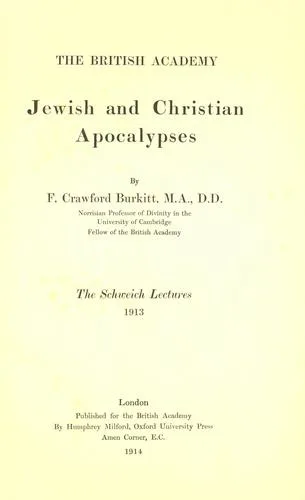
Jewish and Christian Apocalypses

 71
71

Jewish and Christian Apocalypses
F. Crawford Burkitt’s study, originally published in 2001, offers a rigorous comparison of Jewish and Christian apocalyptic texts, navigating a field often prone to sensationalism. Burkitt’s strength lies in his precise philological analysis, particularly evident when discussing the textual lineage of certain apocalyptic visions. He meticulously traces concepts from Daniel to the New Testament, providing a grounded scholarly perspective. A limitation, however, is the dense academic prose which may deter readers unaccustomed to early 20th-century theological scholarship. The chapter detailing the evolution of resurrection beliefs between the Testaments is particularly illuminating, showcasing the development of distinct eschatological frameworks. It remains a valuable, if demanding, resource for specialists.
📝 Description
71
F. Crawford Burkitt's 1914 study examines Jewish and Christian apocalyptic literature.
This 1914 study by F. Crawford Burkitt offers a scholarly look at early apocalyptic writings from Jewish and Christian traditions. The book concentrates on the theological and future-oriented ideas found in texts that described divine judgment, cosmic events, and eventual salvation. Burkitt analyzes how these religious expressions shared common concerns while also developing along different paths during a crucial time in their history.
The work is suited for scholars of religion, theologians, and students of ancient history and comparative religion. It addresses those interested in the beginnings of apocalyptic thought, the relationship between early Judaism and Christianity, and the literary and conceptual tools used to portray final realities. This is not an introductory text but a resource for serious academic research.
Burkitt places his analysis in the early centuries CE, a period marked by much apocalyptic speculation influenced by prophetic traditions and expectations of the end times. He shows how these texts arose from social and political pressures, as well as changing religious beliefs. This era saw considerable intellectual activity, with thinkers like Philo of Alexandria and later Christian writers wrestling with questions of divine intervention and the end of days.
Burkitt's work engages with texts that often formed part of esoteric traditions, wherein visions of the divine and future events were central. These texts, emerging from Jewish and Christian circles, frequently employed symbolic language to describe hidden realities and future cataclysms. The focus on angelic hierarchies, cosmic battles, and the structure of otherworldly realms places these writings within a broader context of mystical and visionary literature that sought to reveal divine plans and ultimate destinies.
💡 Why Read This Book?
• Gain a nuanced understanding of the shared and distinct eschatological visions between late Second Temple Judaism and early Christianity, as detailed in the comparative analysis of texts like the Book of Daniel and early Christian epistles. • Explore the scholarly methodology for analyzing ancient apocalyptic literature, learning how F. Crawford Burkitt applies textual criticism to trace the development of concepts like the 'Son of Man' figure. • Understand the specific historical pressures and intellectual currents that fueled apocalyptic thought in the 1st century CE, providing context for the emergence of these texts within the Roman world.
⭐ Reader Reviews
Honest opinions from readers who have explored this book.
❓ Frequently Asked Questions
What specific Jewish texts does F. Crawford Burkitt examine alongside Christian apocalypses?
Burkitt's work frequently references texts from the intertestamental period, including the Book of Daniel and selections from pseudepigraphal works that represent the development of Jewish apocalyptic thought before and during the early Christian era.
How does the book differentiate between Jewish and Christian apocalyptic motifs?
The study highlights divergences in messianic expectations and the role of Jesus Christ as a central figure in Christian apocalypses, contrasting this with the broader range of eschatological agents and outcomes found in Jewish traditions.
Is this book suitable for someone new to apocalyptic studies?
While comprehensive, the book assumes a strong background in biblical studies and classical languages. Newcomers might benefit from introductory texts before engaging with Burkitt's detailed scholarly analysis.
What is the significance of the 'Son of Man' concept in Burkitt's analysis?
Burkitt explores the evolution of the 'Son of Man' motif, tracing its roots in Jewish tradition and its subsequent interpretation and application within early Christian apocalyptic writings, particularly in relation to Christology.
Does the book discuss the historical reception of these apocalyptic texts?
The work focuses primarily on textual and theological analysis rather than reception history. However, it implicitly addresses reception by examining how these texts functioned within their original religious communities.
What scholarly disciplines are most relevant to understanding Jewish and Christian Apocalypses?
Key disciplines include biblical studies, ancient history, comparative religion, theology, and classical philology, reflecting the book's interdisciplinary approach to early religious literature.
🔮 Key Themes & Symbolism
Eschatological Frameworks
The book meticulously unpacks the divergent and convergent eschatological frameworks within Jewish and Christian traditions. It examines how concepts of divine judgment, cosmic renewal, and future redemption were articulated through distinct theological lenses. Burkitt analyzes how the anticipation of a messianic age and the ultimate triumph of divine will manifested in different textual traditions, providing a comparative study of their ultimate concerns.
The 'Son of Man' Motif
A significant focus is placed on the development and interpretation of the 'Son of Man' figure. Burkitt traces its origins and evolving significance within Jewish apocalyptic literature, particularly its transformation and application in early Christian theology. This motif serves as a crucial link for understanding Christological interpretations and the messianic expectations prevalent in the period.
Literary and Symbolic Language
The work delves into the characteristic literary devices and symbolic language employed in apocalyptic texts. It addresses how visionary experiences, angelic intermediaries, and cosmic imagery were used to convey complex theological ideas about the divine plan and the end of history. Understanding this symbolic lexicon is key to deciphering the esoteric messages within these ancient scriptures.
Interplay of Traditions
Burkitt's study highlights the dynamic interplay between Jewish and Christian thought during the 1st century CE. It explores how early Christian writers adapted and reinterpreted existing Jewish apocalyptic motifs to articulate their own unique theological claims, particularly concerning the person and work of Jesus. This demonstrates a crucial period of religious syncretism and divergence.
💬 Memorable Quotes
“The expectation of a future deliverance.”
— This paraphrase captures the core drive behind apocalyptic literature, which is the hope and anticipation of a divine intervention that will bring about a radical transformation of the current world order.
“The development of resurrection beliefs.”
— This highlights a key theological evolution explored in the book, showing how ideas about life after death and bodily resurrection transformed and diversified across different Jewish and Christian texts.
“Messianic hope and its varied expressions.”
— This points to the central theme of messianism, examining how the concept of a divinely appointed deliverer was understood and articulated differently within various Jewish sects and early Christian communities.
“The symbolic language of heavenly visions.”
— This refers to the distinct literary style of apocalypses, characterized by visionary experiences and symbolic imagery used to convey prophetic messages and eschatological truths.
“The influence of the Book of Daniel.”
— This emphasizes the foundational role of the Book of Daniel in shaping subsequent Jewish and Christian apocalyptic traditions, as analyzed by Burkitt.
🌙 Esoteric Significance
Tradition
This work primarily engages with the esoteric dimensions of Abrahamic religions, specifically within the lineage of apocalyptic thought that bridges late Second Temple Judaism and early Christianity. It explores the symbolic language and visionary experiences that informed mystical interpretations of divine revelation and cosmic order, forming a precursor to later Kabbalistic and Gnostic explorations of hidden knowledge.
Symbolism
Key symbols include the 'Son of Man,' representing a complex figure of divine authority and future vindication, and the visions of heavenly realms, which offer esoteric insights into the structure of the spiritual cosmos and angelic hierarchies. The book analyzes how these symbols functioned not merely as narrative elements but as vehicles for conveying profound theological and cosmological secrets.
Modern Relevance
Contemporary scholars of comparative religion and esoteric studies continue to draw on Burkitt's foundational analysis. His work informs modern interpretations of Gnostic texts, theosophical studies, and contemporary discussions on messianism and eschatology within various mystical traditions seeking to understand the historical roots of their symbolic language and ultimate concerns.
👥 Who Should Read This Book
• Scholars of Religious Studies and Biblical Exegesis: To gain a rigorous, comparative analysis of foundational apocalyptic texts and their theological underpinnings. • Students of Comparative Religion: To understand the historical and conceptual links between Jewish and early Christian eschatological thought. • Researchers of Ancient Mysticism: To explore the origins of visionary literature and symbolic language used to describe divine realities and future events.
📜 Historical Context
Published in 2001, F. Crawford Burkitt's "Jewish and Christian Apocalypses" engages with a rich scholarly tradition examining texts from the Hellenistic and Roman periods. This era, roughly from the 3rd century BCE to the 2nd century CE, was marked by intense eschatological speculation, influenced by both indigenous prophetic traditions and external philosophical currents. The book situates itself within the discourse surrounding the development of concepts like the Messiah, resurrection, and the structure of the cosmos. It implicitly grapples with the legacy of scholars like R.H. Charles, whose influential works on apocalyptic literature had long set the academic agenda. Burkitt's work contributes to understanding the intellectual landscape where figures like Philo of Alexandria and early Church Fathers like Justin Martyr were formulating their theological systems, often in dialogue with or reaction to Jewish interpretive traditions.
📔 Journal Prompts
The 'Son of Man' motif: trace its development from Jewish texts to early Christian interpretations.
Analyze the role of angelic beings as intermediaries in Jewish and Christian apocalyptic visions.
Compare the eschatological expectations presented in Daniel with those found in early Christian writings.
Reflect on the purpose and function of symbolic language in conveying hidden truths about the divine.
Consider the historical context of the 1st century CE and its impact on apocalyptic literature.
🗂️ Glossary
Apocalypse
A genre of revelatory literature, often featuring symbolic language and visions, that claims to disclose divine mysteries about the end times, cosmic struggles, and future salvation.
Eschatology
The theological study of concepts concerning death, judgment, the end of the world, and the ultimate destiny of humanity and the cosmos.
Messianism
Belief in a divinely appointed savior or liberator, often a king or prophet, who will restore a people or the world to a state of righteousness and peace.
Son of Man
A figure appearing in both Jewish and Christian apocalyptic texts, often associated with divine authority, judgment, and a climactic redemptive role.
Pseudepigrapha
Ancient religious writings attributed to biblical characters or other prominent figures, but not considered canonical by most Jewish or Christian traditions.
Intertestamental Period
The historical period between the completion of the Old Testament canon and the beginning of the New Testament era, a time of significant Jewish religious development.
Christology
The branch of Christian theology concerned with the nature, person, and work of Jesus Christ.













![Poetry, Tales and Selected Essays [74 stories, 62 poems, 5 essays]](/img/thumb/poetry-tales-and-selected-essays-74-stories-62-poems-5-essays-edgar-allan-poe-011383.webp)