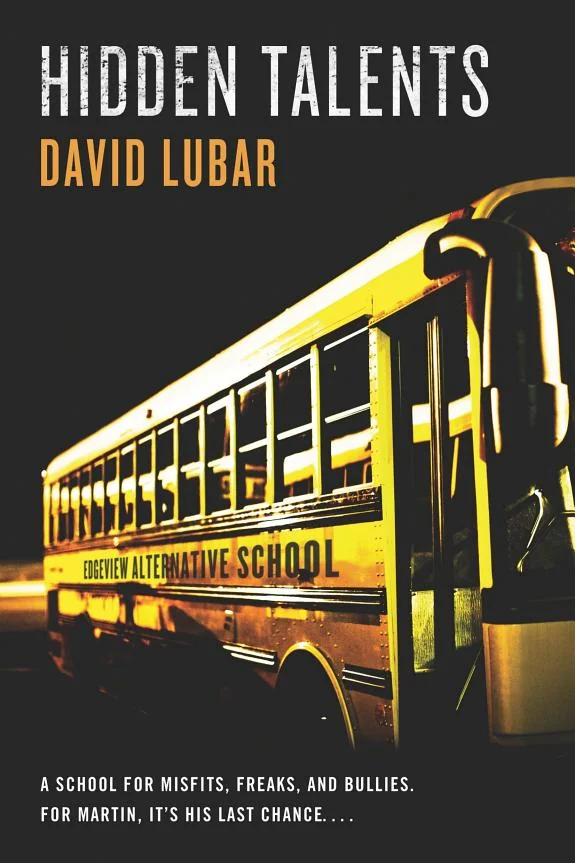
Hidden Talents
 76
76

Hidden Talents
Lubar's "Hidden Talents" offers a compelling premise: an alternative school for troubled youth where psychic abilities are the norm, not the exception. The narrative hook is strong, immediately drawing the reader into Martin's disorientation and subsequent discovery of his own latent powers. Lubar excels at portraying the awkwardness of adolescence, amplifying it with the added pressure of developing extraordinary gifts. The interactions among the boys, particularly their hesitant camaraderie as they grapple with their abilities, feel authentic. However, the pacing occasionally falters in the middle section, with some character developments feeling slightly rushed. The exploration of the psychic phenomena, while intriguing, could have benefited from a more detailed explanation of their origins or limitations, a point touched upon but not fully explored. Still, the book’s strength lies in its relatable protagonist and the subtle, yet pervasive, sense of wonder it cultivates. "Hidden Talents" is a solid entry for young readers interested in the intersection of the mundane and the extraordinary.
📝 Description
76
### What It Is
David Lubar's "Hidden Talents," first published in 2015, introduces readers to Martin, a thirteen-year-old navigating the challenging waters of adolescence. His arrival at an unconventional school marks a turning point, setting the stage for an exploration of his own latent abilities. The narrative focuses on Martin's integration into a peer group that possesses unusual psychic capacities, hinting at a deeper connection between the characters and the world around them.
### Who It's For
This work is intended for young adult readers who appreciate stories that blend coming-of-age narratives with speculative elements. It will appeal to those interested in exploring themes of self-discovery, friendship, and the potential for extraordinary abilities within ordinary individuals. Readers who enjoy character-driven plots and a touch of mystery will find "Hidden Talents" engaging.
### Historical Context
Published in 2015, "Hidden Talents" emerges in an era saturated with young adult fiction exploring supernatural and fantastical themes. While not directly tied to a specific historical movement, its premise of discovering hidden powers echoes earlier works like those by Ursula K. Le Guin or Madeleine L'Engle, which often featured young protagonists with unique gifts. The book's focus on an alternative school setting also taps into a trend seen in educational fiction, but with a distinct paranormal twist.
### Key Concepts
The central concept revolves around the manifestation of psychic abilities, often referred to as 'talents' within the narrative. These are not presented as mere parlor tricks but as integral aspects of the characters' identities and interactions. The school itself functions as a crucible, designed to foster these abilities in students who might otherwise be marginalized. The narrative explores how these powers influence social dynamics and individual self-perception.
💡 Why Read This Book?
• Understand the subtle development of latent psychic abilities, as seen through Martin's initial uncertainty and growing confidence, offering a unique perspective on self-discovery beyond typical adolescent challenges. • Experience the dynamics of an unconventional educational setting, the "alternative school," which serves as a unique backdrop for fostering extraordinary talents, contrasting with traditional academic environments. • Explore the concept of 'talents' as integral to identity, examining how the characters' psychic powers shape their interactions and self-perception, providing a distinct lens on personal growth.
⭐ Reader Reviews
Honest opinions from readers who have explored this book.
❓ Frequently Asked Questions
What is the main character's name in Hidden Talents?
The main character in David Lubar's "Hidden Talents" is a thirteen-year-old boy named Martin. His arrival at an alternative school sets the plot in motion as he discovers his own hidden abilities.
What kind of school does Martin attend in Hidden Talents?
Martin attends an alternative school specifically designed for misfits and students considered 'problem students.' This unique environment becomes the setting for him to discover and develop his psychic powers.
When was Hidden Talents by David Lubar first published?
David Lubar's "Hidden Talents" was first published on June 16, 2015. This places it within the contemporary young adult fiction market.
Are the characters in Hidden Talents aware of their psychic powers from the start?
No, the narrative centers on Martin discovering his own psychic powers upon arriving at the school. He then falls in with a group of boys who already possess such abilities, suggesting a gradual revelation for many.
What genre does Hidden Talents fall into?
Hidden Talents falls primarily into the young adult fiction genre, with strong elements of speculative fiction and a focus on coming-of-age themes, particularly the discovery of extraordinary abilities.
Does Hidden Talents explore themes beyond psychic powers?
Yes, beyond the exploration of psychic powers, the book delves into themes of self-discovery, acceptance, friendship, and navigating the challenges of adolescence within a non-traditional social structure.
🔮 Key Themes & Symbolism
Latent Abilities and Self-Discovery
The core of "Hidden Talents" lies in the exploration of latent abilities. Martin's journey from an ordinary, perhaps overlooked, student to one discovering extraordinary psychic powers mirrors the adolescent quest for identity. The book suggests that such potential often lies dormant, waiting for the right environment or catalyst to surface. This theme is crucial for young readers grappling with their own sense of self and place in the world, offering a narrative where hidden strengths can be unearthed and embraced.
The Misfit School Environment
The alternative school serves as more than just a setting; it is a character in itself. Designed for 'misfits and problem students,' it paradoxically becomes a sanctuary where unique abilities, like psychic powers, are not only accepted but potentially cultivated. This contrasts sharply with conventional schooling, highlighting how environments can shape an individual's development. The school's role in fostering these 'hidden talents' suggests a critique of traditional educational models that may overlook or suppress individual potential.
Camaraderie Among the Gifted
The narrative emphasizes the formation of bonds between students who share extraordinary gifts. Martin's integration into a group of boys with psychic powers illustrates the power of shared experience in forging connections. This theme speaks to the universal need for belonging, particularly for individuals who feel different. The interactions between these characters explore how shared secrets and abilities can lead to mutual support, trust, and a collective understanding that transcends ordinary friendships.
The Nature of 'Talents'
The book presents 'talents' not as mere supernatural tricks but as intrinsic aspects of the characters. These abilities are woven into their personalities and interactions, influencing how they perceive themselves and others. The work prompts consideration of what constitutes a 'talent' and how societal perceptions might define or limit such gifts. By focusing on psychic powers, Lubar invites readers to ponder the spectrum of human potential and the ways in which extraordinary capabilities might manifest.
💬 Memorable Quotes
“He fell in with a group of boys with psychic powers.”
— This concise statement encapsulates the central premise of Martin's integration into the school's unique social fabric. It marks his entry into a world where the extraordinary is commonplace and hints at the self-discovery that will follow.
“Martin arrives at an alternative school for misfits and problem students.”
— This sets the stage for the narrative, establishing the unconventional setting and the protagonist's initial status as an outsider or someone perceived as difficult, creating immediate intrigue.
“He discovers something surprising about himself.”
— This hints at the core arc of the story – Martin's journey of self-discovery. It implies a revelation of hidden potential or abilities that will redefine his understanding of his own identity.
“The boys had psychic powers.”
— A direct and impactful statement highlighting the supernatural element central to the plot. It immediately signals the genre and the unique challenges and opportunities faced by the characters.
“He found himself at a school for those who didn't fit.”
— This rephrasing emphasizes the theme of belonging and the nature of the school as a refuge for individuals who don't conform to societal norms, setting a tone of acceptance for difference.
🌙 Esoteric Significance
Tradition
While "Hidden Talents" does not explicitly align with a single esoteric tradition like Hermeticism or Gnosticism, it taps into a broader, archetypal interest in latent human potential and psychic phenomena that permeates various spiritual and occult philosophies. Its focus on 'talents' can be seen as a secularized interpretation of spiritual gifts or innate powers explored in traditions emphasizing inner development. The narrative's departure from established dogma allows for a more personal and accessible exploration of the extraordinary, fitting within a modern, eclectic approach to spirituality.
Symbolism
The 'alternative school' functions as a potent symbol, representing a liminal space or threshold where individuals are guided through a transformative process. It symbolizes a departure from the mundane and an entry into a realm of heightened awareness and potential. The 'hidden talents' themselves symbolize untapped inner resources, the inherent power within individuals often suppressed by societal norms or self-doubt. Their gradual revelation suggests a journey of awakening, mirroring alchemical processes of purification and transformation.
Modern Relevance
In contemporary discourse, "Hidden Talents" resonates with discussions around neurodiversity and the spectrum of human cognitive abilities. The idea of 'misfits' possessing unique strengths finds parallels in modern movements advocating for the acceptance and cultivation of diverse talents. Thinkers and practitioners interested in transpersonal psychology, which explores states of consciousness and human potential beyond the ego, might find the book’s premise relevant. Furthermore, its exploration of innate abilities aligns with contemporary interests in mindfulness and personal development, albeit framed within a fictional, speculative context.
👥 Who Should Read This Book
• Young adult readers seeking coming-of-age stories with a speculative twist, particularly those intrigued by the idea of discovering hidden psychic abilities. • Individuals interested in explorations of self-discovery and identity formation, where characters navigate unusual circumstances to understand themselves better. • Readers who appreciate narratives set in unconventional educational environments that challenge traditional notions of schooling and personal growth.
📜 Historical Context
Published in 2015, "Hidden Talents" entered a literary landscape already rich with young adult fiction exploring supernatural and speculative themes. The early 2010s saw continued popularity for series like 'The Hunger Games' and 'Divergent,' though Lubar's work leans more towards internal discovery than dystopian conflict. While not directly aligned with a specific intellectual movement like the New Age spiritualism of the 1970s, its exploration of psychic abilities echoes enduring interests in parapsychology and human potential that have surfaced periodically since the late 19th century. Contemporary authors like Cassandra Clare and Veronica Roth were dominating the YA supernatural genre, often with more action-oriented plots. Lubar's focus on the nuanced development of abilities within an educational setting offers a distinct, albeit less overtly sensational, approach compared to many of his peers, potentially appealing to readers seeking character-driven narratives over high-stakes external threats.
📔 Journal Prompts
Martin's initial feelings upon entering the alternative school.
The dynamics within the group of boys with psychic powers.
How the 'alternative school' environment facilitates the discovery of 'talents'.
The surprising aspects Martin discovers about himself.
The potential societal implications of widespread 'hidden talents'.
🗂️ Glossary
Alternative School
An educational institution designed for students who do not thrive in traditional academic settings, often catering to those with behavioral issues, learning differences, or unique talents.
Misfits
Individuals who do not conform to societal norms or expectations, often feeling out of place in conventional social groups or institutions.
Problem Students
A designation for students whose behavior or academic performance deviates significantly from the norm, leading to disciplinary or special attention from educators.
Psychic Powers
Abilities that are believed to transcend the known laws of nature, such as telekinesis, telepathy, precognition, or other forms of extrasensory perception.
Talents
In the context of the book, 'talents' refers to the specific psychic abilities possessed by the characters, often implying a natural, innate gift.
Self-Discovery
The process by which an individual comes to understand their own character, motivations, and potential, often through experience, reflection, and interaction with their environment.
Latent
Present but not yet visible, apparent, or actualized; hidden or dormant, referring to abilities or potential that exists but has not yet manifested.