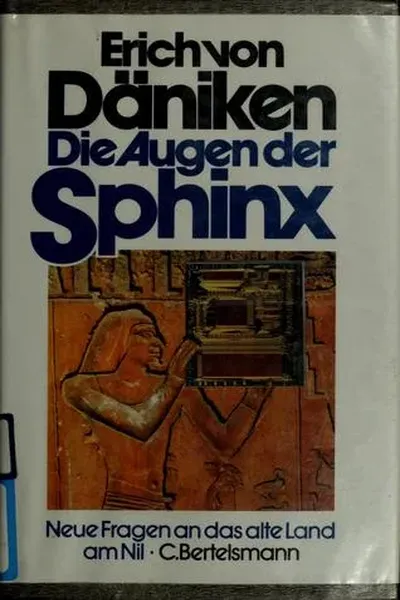
Erscheinungen

 84
84

Erscheinungen
Erich von Däniken's "Erscheinungen" continues his established pattern of presenting archaeological anomalies and religious texts as undeniable proof of ancient alien visitation. The book’s strength lies in its relentless compilation of suggestive material, forcing readers to confront uncomfortable questions about historical records and human origins. Von Däniken’s analysis of the Book of Ezekiel, for instance, offers a vivid, if speculative, reinterpretation of divine visions as technological encounters.
However, the work’s limitation is its persistent reliance on conjecture rather than verifiable evidence. The leap from "unexplained" to "extraterrestrial" is often presented as self-evident, bypassing critical examination of alternative, more grounded explanations. The author’s conviction occasionally overshadows rigorous scholarly debate, leading to a persuasive but ultimately unproven argument. "Erscheinungen" remains a provocative collection of ideas, but its conclusions demand a significant suspension of disbelief.
📝 Description
84
Erich von Däniken's 1975 book, 'Erscheinungen,' reexamines ancient texts and artifacts through an ancient astronaut lens.
Published in 1975, Erich von Däniken's 'Erscheinungen' revisits his theories about ancient astronaut visits to Earth. The book collects more evidence and case studies to argue that extraterrestrials influenced early human civilizations and religions. Von Däniken proposes that many ancient myths, religious texts, and large constructions are literal records of encounters with advanced alien visitors, not allegories.
This work targets readers interested in alternative historical interpretations, archaeology, and the origins of religion. It appeals to those who question mainstream academic views and are open to speculative ideas about humanity's past. Readers interested in ufology, ancient mysteries, and potential extraterrestrial contact will find 'Erscheinungen' a noteworthy, if debated, read.
Erscheinungen is part of the broader paleocontact or ancient astronaut theory tradition, which gained public attention in the mid-20th century. This tradition suggests that ancient myths and monumental structures are evidence of advanced extraterrestrial visitors interacting with early humans. Von Däniken's work, including this 1975 publication, became a significant voice in this field, popularizing the idea that divine figures and advanced technologies described in ancient texts were alien in origin. It entered a period of significant public interest in UFOs and alternative historical narratives.
💡 Why Read This Book?
• Gain an understanding of how Erich von Däniken reinterprets specific biblical passages, such as the visions described in the Book of Ezekiel, by framing them as encounters with advanced technology, a perspective distinct from traditional theological exegesis. • Explore von Däniken's analysis of ancient artifacts and artwork, presented as visual evidence of extraterrestrial presence, offering a different lens through which to view historical cultural expressions. • Consider the 1975 publication context and its place within the burgeoning ancient astronaut theory movement, understanding how this book contributed to a specific wave of speculative historical inquiry.
⭐ Reader Reviews
Honest opinions from readers who have explored this book.
❓ Frequently Asked Questions
What is the central thesis of Erich von Däniken's "Erscheinungen"?
The book's central thesis is that Earth was visited by extraterrestrial beings in ancient times, and these visitors influenced human religion, technology, and culture. Von Däniken argues that many ancient myths are literal accounts of these encounters.
When was "Erscheinungen" first published?
"Erscheinungen" was first published in 1975, continuing the themes explored in von Däniken's earlier popular works on ancient astronauts.
Does "Erscheinungen" offer new theories compared to von Däniken's previous books?
While building on his established framework, "Erscheinungen" presents additional case studies and re-examines evidence, aiming to further bolster his arguments for extraterrestrial influence on ancient civilizations.
What kind of evidence does von Däniken present in "Erscheinungen"?
He presents evidence from religious texts (like the Bible), ancient myths from various cultures, archaeological sites, and interpretations of ancient art and artifacts, all viewed through the lens of potential alien contact.
How was "Erscheinungen" received by the academic community?
Like von Däniken's other works, "Erscheinungen" was largely met with skepticism and criticism from mainstream archaeologists, historians, and religious scholars, who often pointed to the lack of empirical evidence and reliance on speculative interpretation.
What historical periods or cultures does "Erscheinungen" primarily focus on?
The book examines various ancient cultures and historical periods, with significant attention given to biblical narratives, ancient Near Eastern civilizations, and other early human societies where monumental structures or complex religious systems emerged.
🔮 Key Themes & Symbolism
Extraterrestrial Influence on Religion
Von Däniken posits that many foundational religious narratives, particularly within Abrahamic traditions, are not divine revelations but rather distorted accounts of encounters with technologically advanced alien beings. He reinterprets figures like prophets and deities as alien visitors whose advanced knowledge and technology were perceived as supernatural by early humans. The book examines how these 'gods' left behind 'instructions' and artifacts that shaped early human worship and belief systems.
Anomalous Ancient Artifacts and Structures
A significant portion of "Erscheinungen" is dedicated to analyzing archaeological evidence that von Däniken believes cannot be explained by the technological capabilities of ancient peoples. This includes discussing ancient sites like pyramids and Nazca Lines, as well as interpreting certain artworks and artifacts as depicting spacecraft or alien beings. He challenges mainstream archaeology by suggesting these are remnants of extraterrestrial intervention.
Reinterpreting Ancient Texts
The work meticulously dissects ancient texts, most notably the Bible, seeking interpretations that align with the ancient astronaut hypothesis. Von Däniken scrutinizes descriptions of celestial chariots, flying beings, and divine encounters, arguing for a literal, technological explanation over a purely spiritual or allegorical one. This approach aims to uncover a hidden history of alien contact embedded within humanity's oldest records.
Humanity's Cosmic Origins
Beyond specific instances of contact, "Erscheinungen" explores the broader implication of extraterrestrial influence on humanity's evolutionary path and cultural development. Von Däniken suggests that aliens may have played a role in seeding life on Earth or guiding human progress, questioning the conventional narrative of human development and proposing a more cosmic origin story.
💬 Memorable Quotes
“The gods came from the stars.”
— This concise statement encapsulates von Däniken's core argument: that ancient deities and religious figures were, in fact, extraterrestrial visitors whose advanced nature led early humans to perceive them as divine beings.
“The biblical descriptions of Ezekiel's vision portray advanced technology.”
— This refers to von Däniken's controversial interpretation of Ezekiel's prophetic visions, where he argues that the 'wheel within a wheel' and 'flying chariot' are descriptions of alien spacecraft.
“Ancient peoples possessed knowledge beyond their apparent capabilities.”
— This highlights von Däniken's recurring theme: questioning how ancient civilizations could construct megalithic structures or possess sophisticated astronomical knowledge without external, advanced assistance, suggesting alien intervention.
“Myths are the fossilized remnants of ancient astronaut encounters.”
— This paraphrase suggests that von Däniken views global myths and legends not as pure fantasy, but as corrupted or symbolic records of actual interactions between humans and extraterrestrial visitors.
“We must reconsider our history from a cosmic perspective.”
— This emphasizes the book's call for a paradigm shift in understanding human history, urging readers to look beyond terrestrial explanations and consider the possibility of off-world influences shaping our past.
🌙 Esoteric Significance
Tradition
While not strictly adhering to a single esoteric lineage, von Däniken's work taps into a modern esoteric current that seeks hidden knowledge beyond mainstream understanding. It shares thematic similarities with Theosophy's concept of 'root races' and ancient, advanced civilizations, as well as Gnostic ideas of external, superior beings influencing humanity. However, von Däniken's approach is less about spiritual evolution and more about a literal, technological interpretation of ancient events, making it a unique, secularized form of esoteric speculation.
Symbolism
The book frequently reinterprets religious symbols. For instance, the 'fiery chariot' described in biblical texts is seen not as a divine conveyance but as a literal spacecraft. Similarly, depictions of beings with large heads or unusual forms in ancient art are interpreted as representations of extraterrestrial visitors, stripping them of their original cultural or spiritual context and assigning them an alien origin.
Modern Relevance
Von Däniken's ideas continue to resonate within contemporary ufology, ancient astronaut communities, and certain fringe historical circles. Modern thinkers exploring topics like consciousness studies and the nature of reality sometimes reference his work as a catalyst for questioning established narratives. The ongoing fascination with unexplained phenomena and the search for extraterrestrial intelligence ensures that his speculative framework remains a point of reference, albeit often debated.
👥 Who Should Read This Book
• Readers interested in alternative historical theories: Those who question conventional explanations for ancient wonders and religious origins will find "Erscheinungen" a compelling, albeit controversial, exploration of the ancient astronaut hypothesis. • Enthusiasts of ufology and ancient mysteries: Individuals fascinated by UFO phenomena and unexplained historical anomalies will appreciate von Däniken's extensive compilation of 'evidence' supporting extraterrestrial visitation. • Skeptics of established paradigms: Those who enjoy challenging mainstream narratives and are open to speculative interpretations of history and religion will find this book a source of provocative ideas.
📜 Historical Context
Published in 1975, "Erscheinungen" landed amidst a fertile period for speculative theories about ancient mysteries and extraterrestrial contact. This era saw a surge in public fascination with UFOs, pyramids, and lost civilizations, partly fueled by von Däniken's own earlier successes like "Chariots of the Gods?" (1968). The intellectual climate was receptive to alternative histories, often clashing with established archaeological and anthropological views. Competing with this was the burgeoning field of pseudoarchaeology, which offered explanations often based on misinterpretations or fabrications. While mainstream scholars like Carl Sagan engaged with the broader topic of extraterrestrial life, they largely dismissed von Däniken's specific claims as lacking scientific rigor. The book's reception was polarized, with immense popular appeal but significant academic condemnation.
📔 Journal Prompts
The interpretation of Ezekiel's celestial chariot as advanced technology.
Ancient myths as fossilized accounts of alien encounters.
The construction of megalithic sites without conventional tools.
The concept of 'gods' originating from the stars.
Reconsidering biblical 'divine' figures as extraterrestrial visitors.
🗂️ Glossary
Ancient Astronaut Theory
The pseudoscientific hypothesis that extraterrestrial beings visited Earth in antiquity and influenced human culture, technology, and religion. Erich von Däniken is a prominent proponent of this theory.
Paleocontact
A synonym for the ancient astronaut theory, referring to the idea of ancient contact between humans and extraterrestrials.
Megalithic Sites
Large structures constructed from massive stones, such as Stonehenge or the Egyptian pyramids. Von Däniken questions the ability of ancient peoples to build these without advanced assistance.
Book of Ezekiel
A book in the Hebrew Bible and Old Testament. Von Däniken famously reinterprets the prophet Ezekiel's visions of divine encounters as descriptions of alien spacecraft and technology.
Anomalous Artifacts
Objects found in archaeological contexts that appear out of place or suggest technological capabilities beyond the presumed understanding of the era they belong to. Von Däniken uses these as evidence for alien intervention.
Mythology
The collection of myths, legends, and beliefs belonging to a particular people or culture. Von Däniken analyzes various mythologies for evidence of extraterrestrial influence.
Theosophy
A spiritual philosophy originating in the late 19th century that explores divine wisdom and the nature of the universe. While distinct, von Däniken's work shares a lineage of seeking hidden histories and non-mainstream explanations for human origins.