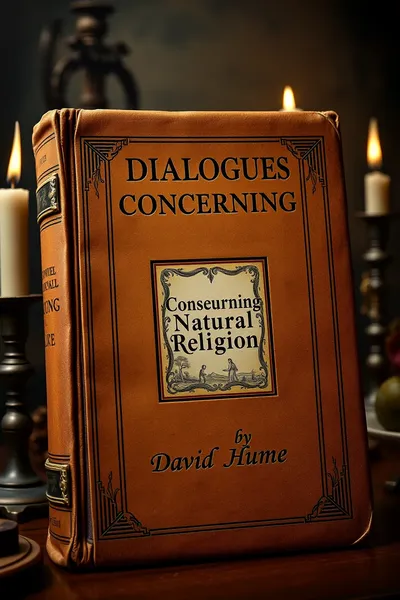
Dialogues Concerning Natural Religion

 72
72

Dialogues Concerning Natural Religion
Hume's "Dialogues Concerning Natural Religion" remains a pivotal text in the philosophical dissection of theological claims. The conversational format, while potentially slow for some, effectively allows for a nuanced exploration of competing viewpoints on God's existence. Philo's relentless skepticism is the work's undeniable strength, systematically dismantling the intuitive appeal of the argument from design. A notable limitation, however, is the somewhat dated presentation of theological positions, which might feel less challenging to contemporary readers accustomed to more sophisticated apologetics. The passage where Philo suggests the universe might be more akin to a vegetable or an animal, rather than a clockwork mechanism, starkly illustrates the critique of anthropomorphic analogies for creation. Despite its age, the work's rigorous examination of evidence and reason in matters of faith is indispensable.
📝 Description
72
### What It Is David Hume's "Dialogues Concerning Natural Religion" presents a philosophical examination of arguments for the existence and attributes of God, primarily through the lens of design. The work, posthumously published in 1779, unfolds as a conversation between three characters: Demea, who argues for God based on abstract reasoning and divine perfection; Philo, a skeptic who systematically critiques empirical arguments for God's existence; and Cleanthes, who champions the argument from design, likening the universe to a complex artifact created by an intelligent designer.
### Who It's For This text is essential for students and scholars of philosophy, theology, and the history of ideas. It appeals to those interested in the foundational debates surrounding faith, reason, and empirical evidence in religious belief. Readers seeking to understand the historical development of skeptical thought and its challenges to traditional theological frameworks will find significant value here. It is also for individuals curious about the limits of human knowledge when applied to metaphysical questions.
### Historical Context Hume penned these dialogues during the height of the Scottish Enlightenment, a period of intense intellectual ferment in the mid-18th century. This era saw groundbreaking work in philosophy, science, and economics from thinkers like Adam Smith and his fellow members of the Philosophical Society of Edinburgh. Hume's "Dialogues" directly engaged with the prevailing "argument from design," popularized by William Paley's later "Natural Theology" (1802), though Hume's critique predates Paley's detailed exposition. The work's challenging nature led to its delayed publication, appearing only after Hume's death in 1779, reflecting the era's sometimes contentious relationship between philosophical inquiry and established religious doctrine.
### Key Concepts The central focus is the argument from design, which posits that the apparent order and complexity of the universe imply an intelligent creator. Hume, primarily through the character Philo, dissects this argument, questioning whether an analogy between human artifacts and the cosmos is valid. He explores the problem of evil, the limitations of empirical inference for divine matters, and the possibility of an imperfect or multiple-creator deity. The work also touches upon the nature of religious belief itself, distinguishing between natural religion (discoverable by reason) and revealed religion (based on faith and scripture).
💡 Why Read This Book?
• Understand the philosophical critique of the argument from design, learning how Hume, via Philo, questions the inference of a perfect creator from a flawed universe. • Grasp the limitations of empirical evidence for proving divine existence, a concept explored through detailed dialogues contrasting natural theology with skepticism. • Engage with the historical context of the Scottish Enlightenment, specifically Hume's engagement with theological debates that shaped 18th-century thought and influenced later philosophers.
⭐ Reader Reviews
Honest opinions from readers who have explored this book.
❓ Frequently Asked Questions
When was David Hume's "Dialogues Concerning Natural Religion" first published?
Although written earlier, David Hume's "Dialogues Concerning Natural Religion" was first published posthumously in 1779, several years after his death.
What is the primary philosophical argument examined in Hume's "Dialogues"?
The primary argument is the argument from design, which suggests the universe's complexity implies an intelligent designer, a concept Hume systematically critiques through his characters.
Who are the main characters involved in the "Dialogues"?
The main interlocutors are Demea, who favors a priori reasoning for God's existence; Cleanthes, the proponent of the argument from design; and Philo, the skeptic who examines and challenges their positions.
How does Hume's "Dialogues" relate to the concept of natural religion?
The work explores natural religion, which seeks to establish the existence and attributes of God through reason and observation of the natural world, questioning the validity of such endeavors.
What is the significance of Philo's character in the "Dialogues"?
Philo represents Hume's own skeptical philosophical stance, systematically analyzing and deconstructing the arguments for God's existence presented by Demea and Cleanthes.
Did Hume intend for "Dialogues Concerning Natural Religion" to be published during his lifetime?
Hume reportedly had reservations about publishing the "Dialogues" during his lifetime due to its controversial nature and potential societal backlash, leading to its posthumous release.
🔮 Key Themes & Symbolism
Critique of the Argument from Design
The core of the "Dialogues" lies in its rigorous dismantling of the argument from design. Through the skeptical voice of Philo, Hume questions the analogy between human-made objects and the universe. He probes whether the observed order necessitates a benevolent, intelligent, and singular creator, suggesting alternative hypotheses such as an imperfect designer, multiple deities, or even natural processes. This theme challenges the intuitive leap from perceived complexity to divine craftsmanship, urging a more cautious and empirically grounded approach to metaphysical claims.
Limits of Human Reason
Hume consistently emphasizes the boundaries of human understanding, particularly when applied to matters beyond empirical verification. The "Dialogues" explore the inadequacy of reason to definitively prove or disprove the existence of a deity. Philo highlights how our experiences are limited to this world and cannot reliably inform us about a supernatural realm or its architect. This theme underscores Hume's empiricist philosophy, advocating for skepticism regarding claims that transcend observable phenomena and testable hypotheses.
Nature of Religious Belief
The work probes the foundations of religious belief itself, distinguishing between natural religion, accessible through reason and observation, and revealed religion, based on faith and scripture. Hume, through his characters, examines the psychological and social factors that contribute to belief in God. The "Dialogues" implicitly question whether belief in God is primarily a matter of rational conviction or a product of tradition, emotion, and societal conditioning, inviting readers to consider the origins and justification of their own faith.
The Problem of Evil
While not the central focus, the "Dialogues" touch upon the age-old problem of evil: how can a benevolent and omnipotent God permit suffering and imperfection in the world? The characters grapple with reconciling the existence of natural calamities, disease, and human cruelty with the traditional attributes of a divine being. This theological quandary serves as a significant challenge to the argument from design, as the evident flaws in the world seem to contradict the notion of a perfect creator.
💬 Memorable Quotes
“A very small part of this world may afford us a reasonable foundation for the most extensive, and therefore the wildest, conclusions.”
— This statement encapsulates Hume's skepticism about extrapolating grand conclusions about the universe from limited human observation. It highlights the danger of drawing sweeping metaphysical claims from a tiny sample of reality.
“The whole chorus of atheists, ancient and modern, has not been able to produce a single argument, which is not either readily resolved, or has not been repeatedly exposed.”
— Philo, often seen as Hume's mouthpiece, asserts the perceived weakness of atheistic arguments. This suggests that while he critiques theological claims, he also views the opposing stance as lacking robust philosophical grounding.
“The world, for aught we know, is very remote in time, or very defective in its contrivance.”
— This interpretation of the universe, offered by Philo, directly challenges the notion of a perfect, recent creation. It suggests that geological time scales or inherent flaws in creation undermine the standard argument from design.
“To say that God gave laws to nature, and that he imposed on her his fetters, is to suppose that he first created her, and then gave her laws.”
— This quote explores the relationship between divine will and natural law. It questions whether natural laws are inherent to creation or externally imposed, touching upon the nature of causality and divine intervention.
“It is not unreasonable to imagine, that this universe is a machine, which is to the author an engine, of so slight contrivance, of so weak materials, that we cannot but suppose him to have been very easily tired, in finishing it.”
— Philo uses this analogy to suggest that the universe might reflect a creator of limited capacity or patience, rather than an omnipotent, perfect being. It's a direct jab at the traditional conception of God.
🌙 Esoteric Significance
Tradition
While Hume's work is primarily situated within Western philosophical empiricism and skepticism, its deep engagement with the limits of human knowledge and the nature of ultimate reality can be viewed through an esoteric lens. It implicitly questions the possibility of direct, verifiable access to divine truths, a pursuit central to many esoteric traditions. The "Dialogues" can be seen as a rigorous, albeit unintentional, exploration of the epistemological barriers that esotericists often seek to overcome through mystical experience or hidden knowledge, thus framing the very *need* for such esoteric paths.
Symbolism
The "Dialogues" do not rely on explicit esoteric symbolism in the manner of Hermetic or Kabbalistic texts. However, the central motif of the universe as a 'design' or 'machine' functions symbolically. Cleanthes' analogy of the universe to a watch, for instance, represents a mechanistic, anthropocentric view of creation. Philo's counter-arguments, suggesting the universe is more akin to a living organism or a product of brute chance, symbolize alternative cosmologies that challenge divinely ordained order. The very act of dialogue itself symbolizes the search for truth through reasoned discourse, a method that, while not mystical, seeks to illuminate hidden realities.
Modern Relevance
Hume's rigorous skepticism regarding claims about divine existence and attributes continues to inform contemporary philosophical theology and the philosophy of religion. Thinkers in analytic philosophy of religion frequently engage with Hume's arguments when discussing the evidential status of religious belief and the problem of evil. Furthermore, in broader intellectual circles, his emphasis on the limitations of human reason and the importance of empirical evidence remains a cornerstone of critical thinking, influencing debates in science, ethics, and cognitive psychology.
👥 Who Should Read This Book
• Students of philosophy and theology: To understand foundational arguments for and against God's existence and the historical development of skeptical thought. • Readers interested in the Enlightenment: To explore the intellectual currents of 18th-century Scotland and Hume's critical contributions to debates on religion and reason. • Skeptics and critical thinkers: To engage with a classic text that systematically questions intuitive assumptions about faith, design, and the limits of human knowledge.
📜 Historical Context
David Hume's "Dialogues Concerning Natural Religion" emerged from the vibrant intellectual milieu of the Scottish Enlightenment in the mid-18th century. This era, marked by a spirit of critical inquiry, saw thinkers challenging established norms across philosophy, science, and theology. Hume, a central figure, engaged directly with prevailing arguments for God's existence, particularly the argument from design, which was gaining traction. His contemporaries included figures like Adam Smith, who shared a commitment to empirical observation and rational analysis. The work's critical stance towards traditional religious arguments likely contributed to its delayed publication; it only appeared in 1779, after Hume's death, due to its potentially controversial nature. This cautious release reflects the delicate balance between philosophical freedom and societal expectations regarding religious discourse during the period. Hume's probing questions would later be taken up and expanded upon by thinkers such as Immanuel Kant.
📔 Journal Prompts
The universe as a mechanism or organism: explore the implications of Cleanthes' analogy versus Philo's alternatives.
Limits of reason: Reflect on areas where human knowledge is inherently bounded, as discussed by Philo.
The problem of evil: Consider how the existence of suffering challenges the concept of a benevolent designer.
Natural religion versus revealed faith: Articulate the distinction and its significance for belief.
Philo's skeptical arguments: Analyze the core critiques leveled against the argument from design.
🗂️ Glossary
Argument from Design
A philosophical argument that posits the apparent order, complexity, and purpose in the natural world as evidence for an intelligent creator or designer.
Natural Religion
The belief in God or the divine based on reason, observation of the natural world, and human experience, as opposed to doctrines derived from religious texts or divine revelation.
Empiricism
The philosophical theory that all knowledge is derived from sense-experience, emphasizing observation and experimentation over innate ideas or speculation.
Skepticism
A philosophical approach that questions or doubts the possibility of certain knowledge, particularly concerning metaphysical or theological claims that cannot be empirically verified.
A priori
Reasoning or knowledge that proceeds from theoretical deduction rather than from observation or experience; knowledge independent of sensory input.
Theism
The belief in the existence of a god or gods, specifically a god who is actively involved in the world and human affairs.
Atheism
Disbelief or lack of belief in the existence of God or gods.