David Hume
David Hume was a Scottish philosopher whose empiricism and skepticism challenged established ideas about knowledge, reason, and the self.
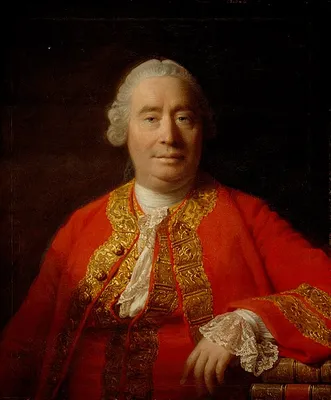
David Hume, born in Scotland in 1711, was a prominent philosopher, historian, economist, and essayist. He is renowned for his influential system of empiricism, which posits that all knowledge originates from sensory experience, rejecting the notion of innate ideas. Hume also advanced philosophical skepticism, questioning the certainty of human knowledge, and metaphysical naturalism, advocating for naturalistic explanations of phenomena. His early work, 'A Treatise of Human Nature,' aimed to establish a scientific understanding of human psychology based on observation and experience.
Hume's philosophy critically examined concepts like causality and induction, arguing that our belief in cause-and-effect arises from custom and habit rather than empirical proof. He contended that reason is subservient to emotions, stating that "Reason is, and ought only to be the slave of the passions." Hume also proposed that ethics are founded on sentiment rather than abstract principles and articulated the is-ought problem. His ideas profoundly impacted subsequent philosophical thought, influencing figures like Immanuel Kant and various intellectual fields.
Philosophical Foundations: Empiricism and Skepticism
David Hume's philosophical system is deeply rooted in empiricism, asserting that all human knowledge stems from sensory experience. He followed John Locke in dismissing the concept of innate ideas, placing him among key empiricist thinkers. Hume's skepticism led him to question the foundations of inductive reasoning and our understanding of causality. He argued that we observe only the consistent association of events, not a necessary causal link, and that our belief in future events mirroring past ones is a habit rather than a logically demonstrable certainty. This perspective challenged rationalist viewpoints, which emphasized reason as the primary source of knowledge.
The Nature of Mind and Morality
Hume proposed a radical view of the self, suggesting that individuals do not possess a continuous, unified sense of self but rather experience a fleeting collection of perceptions and sensations. He termed this the "bundle theory" of the self. Furthermore, Hume contended that human behavior is primarily governed by emotions and passions, famously stating that "Reason is, and ought only to be the slave of the passions." In ethics, he was a sentimentalist, believing that moral judgments are based on emotional responses rather than abstract reasoning. He is also credited with first clearly articulating the "is-ought problem," highlighting the difficulty of deriving moral obligations from factual statements alone.
Writings and Reception
Hume's early major work, 'A Treatise of Human Nature,' published between 1739 and 1740, was intended as a comprehensive study of human nature using an experimental method. Despite its later recognition as a foundational text in Western philosophy, it was initially met with indifference, described by critics as "abstract and unintelligible." Hume later sought to make his ideas more accessible through his 'Enquiries,' viewing them as his more significant achievements. He also found success as an essayist and historian, with his multi-volume 'The History of England' becoming a bestseller and establishing him as a leading interpreter of English history for decades. Despite his philosophical critiques, particularly concerning religion and miracles, his intellectual legacy proved immense, influencing numerous fields and thinkers.
Key Ideas
- Empiricism: All knowledge derives from sensory experience.
- Philosophical Skepticism: Questioning the certainty of knowledge and belief.
- Causality as Custom: Belief in cause-and-effect arises from habit, not logical necessity.
- Reason as Slave of Passions: Emotions govern human behavior more than intellect.
- Bundle Theory of Self: The self is a collection of perceptions, not a unified entity.
- Is-Ought Problem: Fact statements cannot logically lead to normative (ought) conclusions.
Notable Quotes
“Reason is, and ought only to be the slave of the passions.”
“there is nothing to be be learnt from a Professor, which is not to be met with in Books”
Books by David Hume
2 free public domain books · Read online or download