CIA Reading Room 00501557: 30 MARCH 1979 LETTER FROM HSCA STAFF DIRECTOR.
 79
79

CIA Reading Room 00501557: 30 MARCH 1979 LETTER FROM HSCA STAFF DIRECTOR.



Lorelei Sage, Contemplative Literature Editor — This declassified correspondence from the HSCA Staff Director is a tantalizing artifact for those attuned to the esoteric underpinnings of institutional power. The explicit mention of agreements regarding the destruction of draft reports and comments, and their subsequent exclusion from FOIA, illuminates a sophisticated practice of knowledge control, akin to ancient methods of safeguarding arcane secrets. The implied struggle over narrative and historical record resonates with themes of Gnosticism, where access to true knowledge is paramount. This document, though seemingly procedural, offers a potent metaphor for the suppression and selective revelation of hidden truths, making it essential reading for students of occult philosophy and clandestine operations.
📝 Description
79
Unveiling the cryptic whispers from the shadows of power, CIA Reading Room 00501557 presents a pivotal correspondence dated March 30, 1979. This document, a direct missive from the HSCA Staff Director, acts as a veiled portal into the labyrinthine machinations and clandestine agreements that govern the dissemination of sensitive information. Beyond its bureaucratic veneer lies a profound exploration of truth, memory, and the deliberate construction of historical narratives. The letter hints at protocols designed to obscure, to control the flow of knowledge, and to maintain a carefully curated reality. It speaks to the esoteric art of information management, where the very act of recording or destroying becomes a powerful ritual. This is not merely a historical artifact; it is a testament to the hidden currents that shape our understanding of events, a piece of the grand tapestry woven by unseen hands. For the discerning seeker of hidden truths and the scholar of power dynamics, this document offers a rare glimpse into the mechanisms of control, inviting contemplation on the nature of verifiable fact and the elusive pursuit of genuine gnosis.
✍️ Author

CIA Reading Room
The Central Intelligence Agency (CIA) is a civilian foreign intelligence service of the federal government of the United States tasked with advancing national security through collecting and analyzing intelligence from around the world and conducting cover…
💡 Why Read This Book?
This document offers a rare, unvarnished glimpse into the mechanics of information control within powerful institutions. It reveals the esoteric practice of shaping historical narratives through deliberate redaction and destruction, challenging conventional notions of truth. Ideal for seekers of hidden knowledge, scholars of power, and those interested in the philosophical implications of governmental secrecy.
⭐ Reader Reviews
Honest opinions from readers who have explored this book.
❓ Frequently Asked Questions
What is the primary subject of this document?
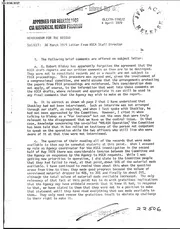
The primary subject is a letter from the HSCA Staff Director concerning agreements about the destruction and non-record status of HSCA draft reports and written comments, impacting FOIA accessibility.
Who is G. Robert Blakey mentioned in the document?
G. Robert Blakey was the Chief Counsel to the House Select Committee on Assassinations (HSCA). The letter references a potential disagreement or oversight regarding agreed-upon procedures involving him.
What does 'FOIA' stand for and why is it relevant here?
FOIA stands for the Freedom of Information Act. Its relevance lies in the document's discussion of how certain documents were deliberately made 'not subject to FOIA proceedings' through agreed-upon destruction protocols.
What is the significance of the 'agreement' mentioned?
The significance lies in the attempt to prevent certain internal documents from becoming public records, thereby controlling the narrative and access to information related to the HSCA's work.
What does 'APPROVED FOR RUT' likely refer to?
'APPROVED FOR RUT' likely refers to a classification or handling instruction within the CIA, possibly indicating the document's approval for a specific review or declassification process, such as 'Review Under Threat' or a similar internal designation.
🔮 Key Themes & Symbolism
The Esoteric Art of Information Control
This document delves into the subtle yet powerful art of information control, a practice deeply rooted in esoteric traditions where knowledge is often guarded and selectively disseminated. The HSCA's agreement to destroy draft reports and comments, making them exempt from public scrutiny, mirrors ancient methods of safeguarding forbidden lore. It suggests that the very act of documentation and its subsequent obliteration can be a ritualistic process, shaping perception and dictating the flow of 'truth.' This theme explores how institutions, much like ancient orders, employ specific protocols to manage what is known and what remains concealed, thereby influencing collective consciousness and historical understanding.
Veiled Truths and Constructed Realities
The correspondence implicitly addresses the construction of reality through curated information. The directive to treat certain documents as non-records, effectively erasing them from the annals of public knowledge, highlights the deliberate creation of a particular narrative. This echoes Gnostic philosophies, which posit that our perceived reality is often a veil obscuring a deeper, more fundamental truth. The document serves as a case study in how 'truth' can be manipulated, not necessarily through outright falsehoods, but through the strategic omission and destruction of counter-evidence. It prompts readers to question the narratives presented to them and to seek out the 'unseen' elements that shape historical accounts.
The Power of Secrecy and Declassification
This artifact speaks volumes about the power inherent in secrecy and the carefully managed process of declassification. The existence of such a letter, now accessible, signifies a controlled unveiling, a strategic release of information that may serve a particular purpose. The document raises questions about what remains perpetually hidden and what is deemed safe for public consumption, reflecting a tiered system of knowledge akin to initiatory degrees in esoteric orders. It invites contemplation on the ethical implications of withholding information and the responsibility that accompanies the act of revealing, prompting a deeper understanding of the symbiotic relationship between secrecy and disclosure in shaping collective understanding.
💬 Memorable Quotes
“They were not to constitute records.”
— This phrase signifies a deliberate effort to erase the trace of certain communications, rendering them invisible to public inquiry and historical record-keeping.
“and as a result are not subject to FOIA proceedings.”
— This highlights the practical application of information control, ensuring that specific avenues of public access to knowledge are deliberately obstructed.
“This procedure was agreed an”
— Implies a clandestine pact or understanding, a formalization of secretive practices to manage and restrict the flow of information.
“G. Robert Blakey has apparently forgotten the agreement”
— Suggests a potential breach in a carefully constructed system of secrecy, hinting at internal friction or oversight in the management of sensitive information.
“Our written comments on them are to be destroyed.”
— A direct instruction for the obliteration of critical dialogue and analysis, aiming to present a sanitized or singular version of events.
🌙 Esoteric Significance
Tradition
This document resonates with the principles of hermeticism and Gnosticism, where the pursuit of hidden knowledge and the understanding of veiled truths are paramount. The deliberate act of destroying records to prevent scrutiny mirrors the esoteric practice of safeguarding sacred texts and teachings from the uninitiated, ensuring that only those deemed worthy can access deeper understanding. The emphasis on 'not constituting records' suggests a manipulation of the mundane world of information to conceal a more profound reality, a concept central to Gnostic cosmology where material existence is seen as a shadow of true spiritual knowledge.
Symbolism
The 'agreement' to destroy documents symbolizes the 'Veil of Isis,' a metaphor for concealment and the deliberate obscuring of truth. The HSCA Staff Director's letter acts as a key, hinting at the mechanisms behind this veil. The act of destruction itself is a powerful symbol of erasure and control, akin to alchemical processes of purification or dissolution. FOIA, conversely, represents the secular pursuit of objective truth, and its circumvention here highlights the tension between outer appearances and inner realities, a core theme in esoteric thought. The 'forgotten agreement' can symbolize the fallibility of even carefully guarded systems.
Modern Relevance
In an age saturated with information and disinformation, the principles illustrated in this document are profoundly relevant. The clandestine management of information, the creation of curated narratives, and the strategic omission of inconvenient facts are ongoing challenges in contemporary society. Understanding how institutions have historically operated to control perception provides a critical lens through which to analyze modern media, political discourse, and the declassification of sensitive materials. This document serves as a potent reminder for individuals to critically assess the information they consume and to recognize the potential for hidden agendas shaping the narratives presented to them.
👥 Who Should Read This Book
This document is essential for seekers of hidden knowledge and practitioners of critical inquiry, particularly those interested in the intersection of power, information, and esotericism. Scholars of political science, history, and philosophy will find it invaluable for understanding institutional behavior and the construction of historical narratives. Beginners interested in the occult and metaphysical aspects of governmental operations will find it an accessible entry point into the complex world of information control. Practitioners of investigative journalism and those involved in archival research will appreciate its insights into the deliberate manipulation of records.
📜 Historical Context
The late 1970s marked a period of intense scrutiny and public questioning of governmental institutions in the United States, particularly in the wake of the Watergate scandal and various congressional investigations. The House Select Committee on Assassinations (HSCA), established to reinvestigate the assassinations of John F. Kennedy and Martin Luther King Jr., operated within this climate of skepticism. This document, dated March 30, 1979, emerges from the final stages of the HSCA's work. The directive regarding the destruction of draft reports and comments speaks to the intricate dance between transparency and secrecy that characterized these investigations. It reflects a broader societal tension regarding the accessibility of information and the potential for governmental agencies to control narratives, a theme that continues to resonate in contemporary discussions about declassification and the public's right to know.
📔 Journal Prompts
How does the concept of 'not constituting records' relate to personal memory and how we curate our own life stories?
In what ways can institutions today employ similar strategies to control public perception and historical understanding?
Reflect on a time when you felt information was deliberately withheld from you. How did that affect your perception of truth?
Consider the ethical implications of destroying or suppressing information, even if agreed upon. What responsibility do we have to preserve knowledge?
How can the principles of critical thinking and esoteric discernment help us navigate the complex landscape of information in the 21st century?
🗂️ Glossary
HSCA
House Select Committee on Assassinations. A U.S. congressional committee established to reinvestigate the assassinations of Presidents John F. Kennedy and Martin Luther King Jr.
FOIA
Freedom of Information Act. A U.S. federal law that grants the public the right to request access to records from any federal agency.
Declassified
The process of removing security classification from documents, making them available for public access, often after a specific period or review.
Narrative
The way in which a story or event is told or presented, which can shape understanding and perception.
Gnosis
In esoteric traditions, refers to spiritual knowledge or insight, often understood as direct, intuitive apprehension of truth.