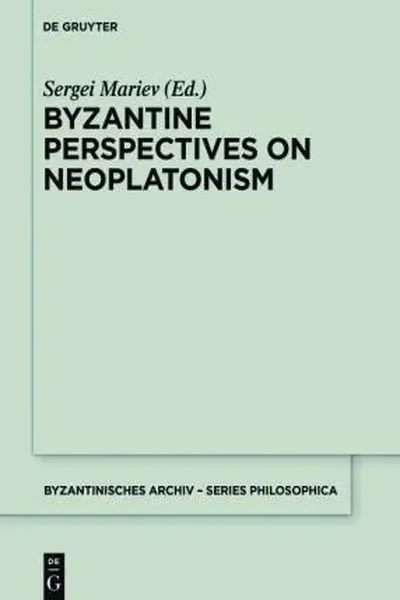
Byzantine Perspectives on Neoplatonism
 78
78

Byzantine Perspectives on Neoplatonism
Sergei Mariev's Byzantine Perspectives on Neoplatonism offers a valuable, if dense, examination of a vital intellectual bridge. Mariev meticulously traces the lineage of Neoplatonic thought as it was absorbed and recontextualized within the Christian framework of Byzantium, a process far more dynamic than simple preservation. The strength lies in its detailed analysis of how concepts like 'emanation' were either adapted or rejected to align with Christian theology, particularly in the engagement with figures like Michael Psellos. A limitation for the casual reader might be the highly academic tone and reliance on primary source exegesis, demanding significant prior knowledge. The discussion on the reception of Porphyry's *On the Soul* by Byzantine commentators, for instance, is illuminating but requires careful attention. Overall, it is a significant contribution for specialists in late antique and Byzantine philosophy.
📝 Description
78
### What It Is Byzantine Perspectives on Neoplatonism, first published in 2017 by Sergei Mariev, is a scholarly exploration of how the philosophical currents of Neoplatonism were received, interpreted, and transformed within the distinct intellectual landscape of the Byzantine Empire. It moves beyond a simple reception history to analyze the creative engagement of Byzantine thinkers with the complex metaphysical and cosmological ideas inherited from figures like Plotinus and Porphyry.
### Who It's For This work is aimed at academics, postgraduate students, and serious independent researchers in the fields of philosophy, theology, and classical studies. It will particularly appeal to those interested in the transmission of ancient thought and its adaptation in new cultural and religious contexts, specifically the Christian East. Readers should possess a foundational understanding of Neoplatonic concepts and early Christian thought.
### Historical Context The Byzantine Empire, from its roots in the Eastern Roman Empire through the medieval period, served as a crucial conduit for preserving and reinterpreting classical philosophy. While Western Europe experienced periods of philosophical decline, Byzantine scholars in centers like Constantinople engaged with Greek texts, including those of the Neoplatonists. This engagement was often framed within a Christian theological context, leading to unique syntheses and polemical critiques. The 2017 publication by Mariev situates these historical discussions within modern scholarship.
### Key Concepts The book examines concepts such as the One, emanation, the intellect (nous), the soul, and the hierarchy of being as they were understood and debated by Byzantine authors. It investigates how these Neoplatonic ideas interacted with Christian doctrines of God, creation, and salvation, often leading to subtle distinctions or outright rejections. The work also considers the influence of specific Neoplatonic texts and commentaries on Byzantine intellectual life.
💡 Why Read This Book?
• Gain a nuanced understanding of how Neoplatonic metaphysics, specifically the concept of 'the One,' was debated and reinterpreted within the theological framework of the Byzantine Empire, moving beyond simplistic appropriations. • Explore the specific intellectual milieu of Byzantine scholars like Michael Psellos and their engagement with classical philosophical traditions, as detailed in the book's analysis of 11th-century philosophical schools. • Discover the intricate ways ancient philosophical terms and concepts were translated and adapted into Christian discourse, revealing the creative synthesis present in Byzantine thought.
⭐ Reader Reviews
Honest opinions from readers who have explored this book.
❓ Frequently Asked Questions
When was Sergei Mariev's "Byzantine Perspectives on Neoplatonism" first published?
The book "Byzantine Perspectives on Neoplatonism" by Sergei Mariev was first published in 2017, contributing to contemporary scholarship on the subject.
What philosophical tradition does this book primarily analyze within the Byzantine context?
The book primarily analyzes the reception and interpretation of Neoplatonism, a significant philosophical tradition originating with Plotinus, within the Byzantine intellectual landscape.
Which Byzantine scholars or figures are discussed in relation to Neoplatonism?
The work often engages with prominent Byzantine intellectuals such as Michael Psellos, examining their specific contributions to the dialogue between Neoplatonic philosophy and Christian theology.
Does the book focus on the influence of specific Neoplatonic texts?
Yes, the book explores the influence of specific Neoplatonic texts and commentaries, detailing how their ideas were integrated or contested by Byzantine thinkers.
What is the main focus of the book's examination of Neoplatonic concepts?
The book's main focus is on how concepts like 'the One,' 'emanation,' and the hierarchy of being were understood, debated, and sometimes transformed by Byzantine philosophers within a Christian framework.
Is prior knowledge of Neoplatonism required to read this book?
While a foundational understanding of Neoplatonic concepts and early Christian thought is beneficial, the book's detailed analysis aims to illuminate these connections for serious researchers.
🔮 Key Themes & Symbolism
Neoplatonic Metaphysics in Christian Byzantium
This theme investigates how core Neoplatonic doctrines, such as the concept of the transcendent 'One' and the process of 'emanation' from the divine source, were engaged by Byzantine thinkers. It delves into the challenges and creative solutions employed to reconcile these metaphysical frameworks with established Christian theology, exploring how Byzantine scholars like Psellos navigated these complex philosophical waters to maintain intellectual integrity within a monotheistic creed.
The Soul and the Hierarchical Cosmos
The book examines the Neoplatonic understanding of the soul's nature, its descent, and potential ascent, as interpreted within Byzantium. This includes how the hierarchical structure of reality, from the ultimate divine principle down to the material world, was either adopted, modified, or critiqued by Byzantine philosophers and theologians. The discussion often centers on the soul's place within this divinely ordered cosmos and its path toward spiritual purification.
Reception and Polemics
A significant aspect explored is the varied reception of Neoplatonic philosophy across different periods and intellectual circles in Byzantium. This theme covers instances where Neoplatonism was embraced as a tool for theological explication, as well as periods of intense criticism and polemic against its perceived pagan or heterodox elements. The work highlights the dynamic tension between philosophical inquiry and religious orthodoxy.
Commentarial Traditions
The book sheds light on the crucial role of commentaries in transmitting and shaping philosophical ideas. It analyzes how Byzantine scholars engaged with and commented upon the works of Neoplatonic masters and their ancient interpreters, such as Porphyry. This process of commentary was not merely preservation but an active reinterpretation, adapting the philosophical legacy for contemporary Byzantine intellectual concerns and debates.
💬 Memorable Quotes
“The Byzantine engagement with Neoplatonism was not passive reception but an active philosophical dialogue.”
— This highlights that Byzantine thinkers didn't just copy ancient ideas; they critically analyzed, adapted, and sometimes transformed Neoplatonic concepts to fit their own intellectual and theological landscape.
“The concept of 'emanation' posed a significant theological challenge to Christian doctrines of creation.”
— This points to the core tension between Neoplatonism's idea of the universe flowing necessarily from the divine and Christianity's emphasis on a deliberate, volitional act of creation by God.
“Michael Psellos sought to synthesize Platonic philosophy with Christian dogma.”
— This interpretation focuses on Psellos's specific effort to harmonize the philosophical insights of Plato and the Neoplatonists with the theological tenets of Eastern Christianity, a key aspect of Byzantine intellectual history.
“The hierarchy of being provided a framework for understanding both the divine order and the structure of reality.”
— This suggests that the Neoplatonic model of a structured cosmos, descending from the highest principle, offered Byzantine thinkers a conceptual tool to articulate their own understanding of God's creation and its inherent order.
“Commentaries on ancient texts were vital for preserving and reinterpreting philosophical legacies.”
— This emphasizes the crucial role of scholarly annotation and interpretation in the transmission of knowledge, showing how Byzantine scholars actively shaped the understanding of classical philosophy for their own era.
🌙 Esoteric Significance
Tradition
While Neoplatonism itself is a foundational philosophical system with esoteric implications, its integration into Byzantine thought represents a unique development within the broader context of Western Esotericism's historical lineage. It’s not strictly Hermetic or Kabbalistic, but rather a philosophical predecessor whose concepts of divine unity, emanation, and the ascent of the soul influenced later esoteric schools that engaged with classical metaphysics. This work illuminates how these ideas were mediated through a specific, highly influential religious and intellectual culture.
Symbolism
Key symbolic concepts explored include 'The One,' representing an ultimate, ineffable divine principle that transcends being itself, and 'Emanation,' symbolizing the necessary outpouring of existence from this source, often depicted as a cascade of light or being. The hierarchy of intellect (Nous) and soul (Psyche) also functions symbolically, representing distinct levels of consciousness and reality in the unfolding cosmos, crucial for understanding the Neoplatonic worldview.
Modern Relevance
Contemporary esoteric practitioners and scholars of comparative religion continue to draw upon the Neoplatonic tradition as a source of metaphysical understanding. Thinkers influenced by figures like René Guénon and Julius Evola, who sought to recover perennial philosophies, often reference Neoplatonic concepts of hierarchy and divine unity. Modern philosophical explorations of consciousness and cosmology also find resonance in the structured, emanationist models first articulated by Plotinus and his successors.
👥 Who Should Read This Book
['• Academic researchers in philosophy and theology: To gain detailed insights into the specific transmission and adaptation of Neoplatonic thought within the Byzantine intellectual tradition.', '• Students of classical philosophy: To understand how a major ancient philosophical school was interpreted and utilized centuries after its inception in a new cultural context.', '• Scholars of religious studies: To explore the intricate relationship between classical pagan philosophy and early Christian theology in the Eastern Roman Empire.']
📜 Historical Context
The Byzantine Empire, spanning from the 4th to the 15th century, served as a critical nexus for the preservation and transformation of classical Greek philosophy. While Western Europe experienced periods of intellectual fragmentation, Byzantine scholars in centers like Constantinople and Athens meticulously copied, studied, and commented upon ancient texts, including those of Neoplatonism. This intellectual environment was deeply intertwined with Orthodox Christianity, leading to a complex relationship with pagan philosophical traditions. Figures like Proclus, a key Neoplatonist, and his commentaries remained influential. Byzantine thinkers, notably from the 11th century onwards with figures like Michael Psellos, actively engaged with Neoplatonic ideas on metaphysics, cosmology, and the soul, often seeking to harmonize them with Christian doctrine or to critique them from a theological standpoint. This engagement occurred against the backdrop of theological debates and the broader intellectual currents of the Eastern Mediterranean.
📔 Journal Prompts
The Byzantine interpretation of 'the One': How did this concept differ from its original Neoplatonic formulation?
Reflect on the challenges posed by 'emanation' to Christian creation doctrines, as explored in the text.
Analyze the role of Michael Psellos in synthesizing Neoplatonic ideas with Christian theology.
Consider the concept of the soul's hierarchy as presented in Byzantine perspectives.
Examine the significance of commentarial traditions for preserving and transforming philosophical legacies.
🗂️ Glossary
Neoplatonism
A philosophical system originating with Plotinus in the 3rd century CE, which interprets Plato's philosophy through a metaphysical lens, emphasizing a transcendent 'One' from which all reality emanates.
Byzantine Empire
The Eastern Roman Empire, which lasted from the 4th century CE to the fall of Constantinople in 1453 CE, characterized by its Greek language, Orthodox Christian faith, and distinct cultural and intellectual traditions.
The One
In Neoplatonism, the ultimate, absolute, and ineffable principle of reality, beyond being and thought, from which all existence derives through a process of emanation.
Emanation
The Neoplatonic concept of the necessary outflow or generation of reality from the divine source (the One), often compared to light radiating from a source or water flowing from a spring.
Nous
Greek for 'intellect' or 'mind.' In Neoplatonism, it is the second hypostasis, emanating from the One, containing the Platonic Forms and serving as the realm of divine thought.
Psyche
Greek for 'soul.' In Neoplatonism, the soul is a mediating principle between the intelligible realm (Nous) and the material world, capable of ascent and return to the divine.
Michael Psellos
A prominent 11th-century Byzantine philosopher, historian, and courtier who wrote extensively on philosophy, theology, and science, engaging deeply with Platonic and Neoplatonic traditions.