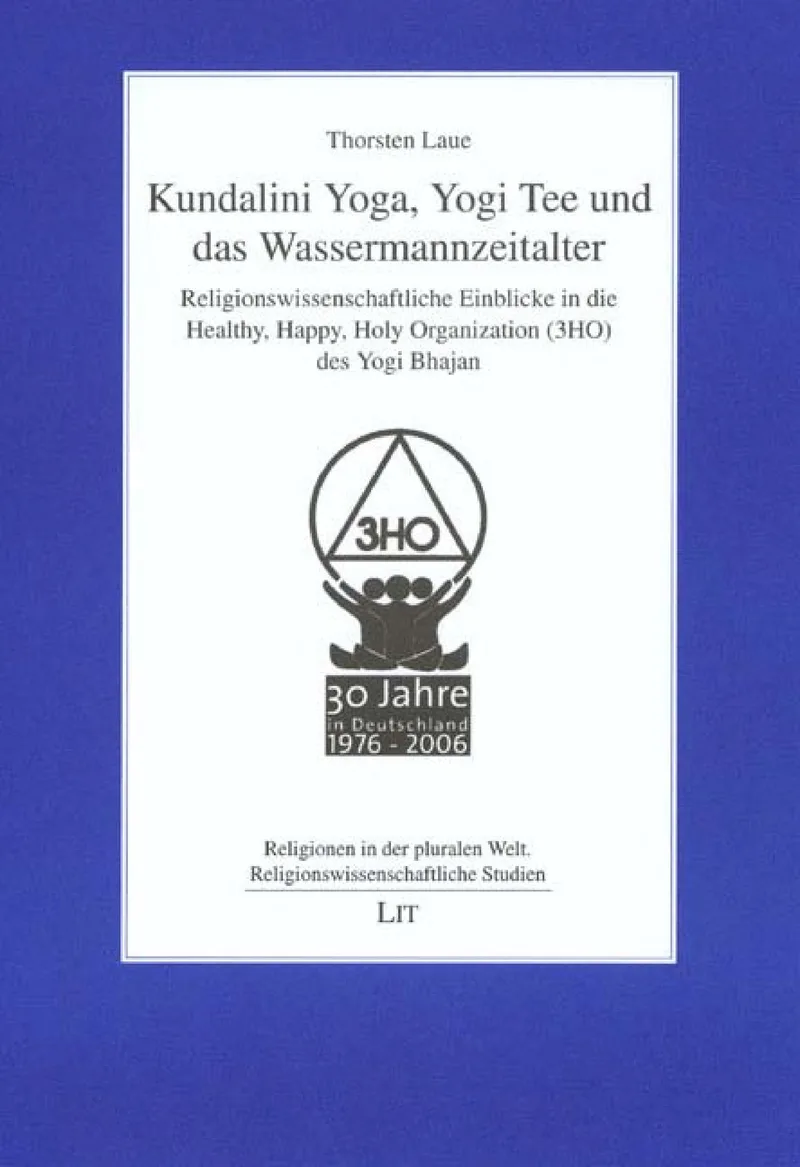
Kundalini Yoga, Yogi Tee und das Wassermannzeitalter
 81
81

Kundalini Yoga, Yogi Tee und das Wassermannzeitalter
Thorsten Laue's "Kundalini Yoga, Yogi Tee und das Wassermannzeitalter" attempts to bridge the practical aspects of Kundalini Yoga with its theoretical, almost prophetic, connections to the Aquarian Age. The strength of the book lies in its earnest attempt to contextualize a potent yogic technology within a framework of cosmic evolution, a concept deeply embedded in esoteric thought since the early 20th century. Laue’s focus on Yogi Bhajan’s teachings provides a concrete anchor for understanding the specific lineage of Kundalini Yoga he discusses. However, the book sometimes struggles to maintain critical distance, occasionally leaning into the more speculative elements of Aquarian Age prophecy without robust counterpoint. A particularly insightful section explores the precise energetic mechanics attributed to the awakening of Kundalini, linking it directly to vibrational shifts expected in the new astrological era. While the ambition is admirable, the execution could benefit from greater analytical rigor in differentiating established yogic philosophy from speculative astrological interpretations. The work offers a valuable, if sometimes uncritical, perspective for those already immersed in these specific currents of thought.
📝 Description
81
Thorsten Laue's 2007 book connects Kundalini Yoga to the Aquarian Age.
Published in 2007, Kundalini Yoga, Yogi Tee und das Wassermannzeitalter by Thorsten Laue examines the esoteric roots of Kundalini Yoga and its relationship with the concept of the Aquarian Age. The book goes beyond physical yoga to investigate the energetic and consciousness-altering aspects of this practice. It aims to place Kundalini Yoga within a larger framework of spiritual development, particularly as it relates to ideas about the Aquarian Age.
This work is for Kundalini Yoga practitioners seeking theoretical and historical context. It also appeals to students of esoteric traditions, New Age philosophy, and comparative spirituality interested in the fusion of Eastern yoga with Western esoteric thought, especially concerning astrological ages and shifts in consciousness. Those curious about the origins and deeper meanings of terms like 'Aquarian Age' and 'Kundalini' will find material here.
The early 21st century saw growing global interest in Eastern spiritual practices, and Kundalini Yoga became more prominent outside India. Laue's book appeared during a time when concepts like the 'Aquarian Age,' popularized by figures like Alice Bailey and Dane Rudhyar, were discussed widely in esoteric circles. This period was characterized by an increased blending of spiritual traditions and a focus on personal transformation and global consciousness, often viewed through astrological perspectives.
This book situates itself within the Western esoteric tradition, particularly its intersection with Eastern spiritual practices. It draws upon concepts like the 'Aquarian Age,' a notion popularized in the mid-20th century, which suggests a coming era of heightened consciousness and spiritual evolution often linked to astrological cycles. The work also engages with the understanding of Kundalini as a potent, latent spiritual force, a concept central to Tantric traditions and yogic philosophy. Laue connects these ideas to a broader New Age discourse that seeks personal transformation through esoteric knowledge and spiritual practices.
💡 Why Read This Book?
• Gain a structured understanding of Kundalini Yoga's energetic principles, specifically how techniques are designed to awaken the Kundalini force as described in the book's exploration of Yogi Bhajan's system. • Grasp the esoteric concept of the Aquarian Age, learning how its predicted consciousness shifts are theorized to align with the transformative effects of Kundalini Yoga practice, as detailed in the text's historical context. • Discover the potential role of Kundalini Yoga in preparing individuals for perceived global spiritual and energetic transitions, connecting the practice to a specific astrological epoch discussed in the book.
⭐ Reader Reviews
Honest opinions from readers who have explored this book.
❓ Frequently Asked Questions
What is the primary focus of "Kundalini Yoga, Yogi Tee und das Wassermannzeitalter"?
The book primarily focuses on the esoteric and philosophical aspects of Kundalini Yoga, particularly as taught by Yogi Bhajan, and connects its practices to the concept of the Aquarian Age and its associated consciousness shifts.
When was Thorsten Laue's book originally published?
Thorsten Laue's "Kundalini Yoga, Yogi Tee und das Wassermannzeitalter" was first published in 2007.
Who is Yogi Bhajan and why is he mentioned in the title?
Yogi Bhajan (Harbhajan Singh Khalsa) was a prominent figure who introduced Kundalini Yoga to the Western world starting in the late 1960s. His teachings form a significant part of the specific Kundalini Yoga tradition discussed in the book.
What does the 'Aquarian Age' refer to in the context of this book?
The Aquarian Age is an astrological concept referring to a coming era, often associated with the precession of the equinoxes, predicted to bring about changes in human consciousness, society, and spirituality, which the book links to Kundalini Yoga's effects.
Is this book suitable for beginners in yoga?
While it discusses Kundalini Yoga, the book leans heavily into esoteric theory and astrological concepts, making it more suitable for practitioners or students of spirituality seeking deeper theoretical context rather than introductory physical instruction.
What is the main esoteric lineage explored in relation to Kundalini Yoga?
The book explores a synthesis of Indian yogic traditions with Western esoteric concepts, particularly those related to astrological ages and consciousness transformation, heavily influenced by the teachings of Yogi Bhajan's Kundalini Yoga.
🔮 Key Themes & Symbolism
Kundalini Energy Dynamics
The book elaborates on the concept of Kundalini as a potent, dormant spiritual energy located at the base of the spine. It details how specific yogic techniques, particularly those emphasized in Yogi Bhajan's system, are designed to awaken this energy. The exploration goes beyond physical exertion, focusing on breathwork, mantra, and meditation as tools to stimulate and guide Kundalini upward, leading to profound energetic and psychological transformations. This awakening is presented not merely as a personal experience but as a crucial step in spiritual evolution.
The Aquarian Age Transition
Central to Laue's thesis is the notion of the Aquarian Age, an astrological epoch characterized by heightened consciousness, humanitarianism, and technological integration. The work posits that the current era represents a significant shift from previous ages, demanding a corresponding evolution in human awareness. It frames Kundalini Yoga as a practice particularly suited for navigating and facilitating this transition, aligning individual energetic development with the predicted collective shifts of the new age.
Yogi Bhajan's System
Thorsten Laue places considerable emphasis on the teachings and practices introduced to the West by Yogi Bhajan. The book examines the specific kriyas (sets of exercises), meditations, and philosophical tenets that constitute Bhajan's lineage of Kundalini Yoga. This focus provides a concrete framework for understanding how the esoteric concepts of Kundalini and the Aquarian Age are applied in a practical, albeit specific, yogic methodology.
Consciousness and Energetic Evolution
The work explores the interconnectedness of individual consciousness and broader energetic shifts. It suggests that the awakening of Kundalini is intrinsically linked to humanity's collective evolution towards higher states of awareness, as prophesied by the advent of the Aquarian Age. This theme positions Kundalini Yoga as a vital tool for both personal spiritual advancement and participation in a global transformation, moving towards a more enlightened existence.
💬 Memorable Quotes
Direct passages from the work, attributed to the author.
“Kundalini is the coiled energy at the base of the spine, awaiting awakening.”
— This succinctly defines the core concept of Kundalini energy as a fundamental, yet latent, power within the human system, emphasizing its potential for activation through yogic practices.
“Yogi Bhajan's Kundalini Yoga prepares the practitioner for higher energetic frequencies.”
— This highlights the specific approach to Kundalini Yoga discussed, framing its practices as a preparatory technology for adapting to the energetic shifts associated with astrological epochal changes.
“The awakening of Kundalini is seen as a catalyst for spiritual transformation.”
— This emphasizes the lasting impact of Kundalini activation, positioning it as a key event that initiates deep personal growth and spiritual realization.
“Astrological ages influence human consciousness and societal development.”
— This statement underpins the book's foundational premise, linking the slow, grand cycles of celestial movements to tangible changes in human psychology and the structure of societies.
💡 Key Ideas
Editorial paraphrase of the work's core concepts — not direct quotes.
The Aquarian Age heralds a time of expanded consciousness and global unity.
This paraphrase captures the optimistic vision of the astrological Aquarian Age, portraying it as an era of significant positive change for humanity on both individual and collective levels.
🌙 Esoteric Significance
Tradition
The work sits within the broad stream of modern esoteric thought, synthesizing elements of Indian Tantric Yoga (specifically Kundalini Yoga as popularized by Yogi Bhajan) with Western astrological and New Age concepts concerning epochal shifts. It draws from the lineage of teachers who sought to integrate Eastern yogic technologies with Western esotericism, aiming to provide a framework for understanding personal spiritual evolution within a larger cosmic unfolding.
Symbolism
Key symbols include the coiled serpent (Kundalini) representing dormant spiritual potential, the spine as the central axis of energetic flow, and the lotus chakras as energy centers. The transition to the Aquarian Age itself functions as a potent symbol of collective awakening and a new paradigm for human existence, with the 'Yogi Tee' potentially symbolizing the integration of spiritual practice into daily life.
Modern Relevance
Contemporary practitioners of Kundalini Yoga, particularly those following Yogi Bhajan's lineage, continue to engage with the ideas presented in this book. Thinkers exploring the intersection of consciousness studies, quantum physics, and spiritual practices may find its conceptual framework relevant. It also appeals to circles focused on astrological cycles and their impact on human development and societal change.
👥 Who Should Read This Book
• Dedicated Kundalini Yoga practitioners seeking to deepen their theoretical understanding of the practice's energetic and spiritual implications, beyond the physical postures. • Students of New Age philosophy and comparative spirituality interested in the intersection of Eastern yogic traditions with Western esoteric concepts like astrological ages. • Individuals exploring the concept of consciousness evolution and seeking to understand how practices like Kundalini Yoga are proposed to facilitate personal and collective transformation in the 21st century.
📜 Historical Context
Thorsten Laue's "Kundalini Yoga, Yogi Tee und das Wassermannzeitalter," published in 2007, emerged during a period of sustained global interest in Eastern spiritual practices and New Age philosophies. The concept of the Aquarian Age, popularized in the mid-20th century by figures like Alice Bailey and Dane Rudhyar, was a prevalent theme in esoteric discourse, predicting profound shifts in human consciousness and societal structures. This era saw a significant influx of Westerners engaging with yoga and meditation, often seeking transformative experiences beyond conventional spiritual paths. Laue’s work situates itself within this milieu, attempting to synthesize the energetic practices of Kundalini Yoga, particularly as taught by Yogi Bhajan, with these overarching astrological and consciousness-based theories. It arrived in a landscape where other esoteric schools, such as Theosophy and various branches of Western Hermeticism, had already laid groundwork for interpreting spiritual evolution through symbolic and cosmological lenses. The reception of such works typically involved enthusiastic engagement from dedicated practitioners and circles familiar with these concepts, while mainstream academic or skeptical circles might view them as speculative.
📔 Journal Prompts
Reflect on the symbolism of the coiled serpent in relation to your own dormant potentials.
Consider the predicted characteristics of the Aquarian Age and how they might manifest in your life.
Analyze the specific techniques of Kundalini Yoga mentioned and their potential energetic effects.
Explore the concept of 'Yogi Tee' as a metaphor for integrating spiritual discipline into daily routines.
How does the idea of energetic frequencies align with your understanding of spiritual growth?
🗂️ Glossary
Kundalini
A primordial, divine cosmic energy believed to be coiled at the base of the spine, often depicted as a serpent. Its awakening is central to yogic traditions aiming for spiritual enlightenment.
Aquarian Age
An astrological epoch associated with the precession of the equinoxes, predicted to be characterized by advancements in technology, humanitarianism, and a shift towards higher consciousness and global unity.
Yogi Bhajan
Harbhajan Singh Khalsa, also known as Yogi Bhajan, who introduced Kundalini Yoga to the Western world starting in 1969, establishing a specific lineage and methodology for its practice.
Chakras
Energy centers within the subtle body, traditionally understood as points where spiritual energy (like Kundalini) flows and transforms. There are typically considered to be seven main chakras.
Kriya
A specific set of yogic exercises, postures, breathwork, and meditations designed to achieve a particular energetic or spiritual outcome, commonly used in Kundalini Yoga.
Mantra
A sacred sound, word, or phrase repeated during meditation or chanting to focus the mind and invoke specific spiritual or energetic effects.
Prana
The vital life force or energy that permeates the universe and sustains all living beings, often associated with breath (pranayama).