Sergei Mariev
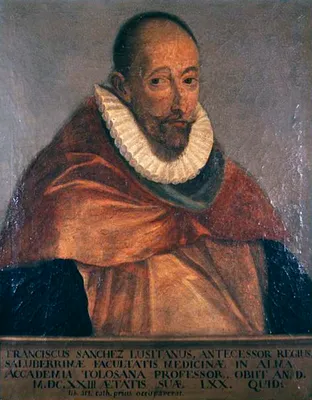
Francisco Sanches was a Hispano-Portuguese skeptic, philosopher, and physician known for his work on the limits of human knowledge.
Francisco Sanches, born around 1550, was a philosopher and physician of Sephardi Jewish heritage. He was born possibly in Tui, Spain, or more likely in Braga, Portugal, where he was baptized and raised. Due to his Jewish origins, even as a convert, he was legally classified as a New Christian. Sanches pursued his education in Portugal and later in France, eventually becoming a professor of philosophy and medicine at the University of Toulouse. His intellectual contributions centered on skepticism, particularly concerning the attainability of absolute scientific certainty. He argued that true knowledge, in the Aristotelian sense of understanding necessary causes, is impossible due to infinite regressions and the circularity of syllogistic reasoning. Sanches also posited that the nature of objects and human limitations, including sensory fallibility, prevent perfect comprehension. Despite these conclusions, he advocated for the pursuit of limited, imperfect knowledge gained through experience and observation, a concept that influenced later thinkers.
Early Life and Education
Francisco Sanches was born circa 1550, with his origins possibly in Tui, Spain, though more probably in Braga, Portugal. His parents, Antonio Sanches and Filipa de Sousa, were a Spanish physician and a Portuguese woman, respectively. Sanches' family had Sephardi Jewish roots, and he was baptized and grew up in Portugal, where he was considered a New Christian under legal statutes. He began his studies in Braga until the age of 12, after which his family relocated to Bordeaux, France, to escape the Portuguese Inquisition. There, he continued his education at the College de Guyenne. His academic pursuits led him to study medicine in Rome in 1569, and later in Montpellier and Toulouse in France. By 1575, he had established himself as a professor of both philosophy and medicine at the University of Toulouse.
Philosophical Skepticism
Sanches' most significant philosophical contribution is found in his work "Quod nihil scitur" (That Nothing Is Known), published in 1581. In this text, he employed classical skeptical arguments to challenge the possibility of achieving scientific knowledge as understood by Aristotle—that is, knowledge of necessary reasons or causes. He argued that the pursuit of causes leads to an infinite regress, thus precluding certainty. Furthermore, Sanches critiqued the logical structure of syllogisms, asserting that they are circular and do not genuinely advance understanding because the conclusion is implicitly contained within the premises. He believed that true, perfect knowledge would require an intuitive grasp of each individual thing, a feat he deemed beyond human capacity.
Limits of Human Knowledge
Elaborating on the limitations of human understanding, Sanches contended that the inherent nature of objects—their interconnectedness, vast number, and constant flux—makes them unknowable in an ultimate sense. He also pointed to the limitations of human perception, drawing on his medical experience to illustrate the unreliability of sensory input. For Sanches, our senses primarily grant us knowledge of appearances, not of underlying realities. While initially suggesting that ultimate truth might be found in faith, he also proposed a more constructive approach: even if ultimate knowledge is unattainable, humans should still strive for limited, imperfect understanding derived from observation, experience, and judgment. This concept of 'mitigated skepticism' proved influential for later scientific thinkers.
Key Ideas
- Science, in the Aristotelian sense of understanding necessary causes, is unattainable due to infinite regress.
- Syllogistic reasoning is circular and does not lead to new knowledge.
- The nature of objects (interconnected, numerous, changing) and human limitations (sensory unreliability) prevent perfect knowledge.
- Advocacy for pursuing limited, imperfect knowledge through observation and experience (mitigated skepticism).
Books by Sergei Mariev
3 free public domain books · Read online or download