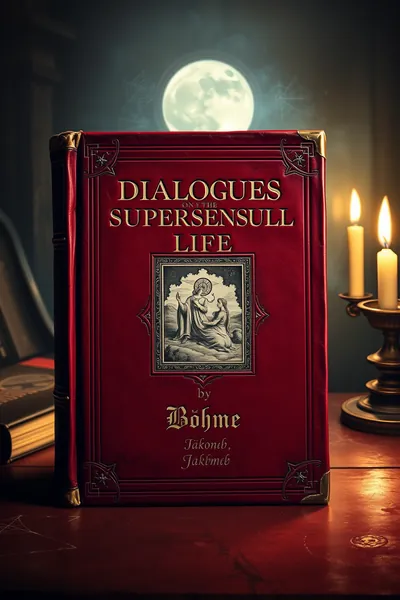
The works of Jacob Behmen, the Teutonic theosopher ..

 71
71

The works of Jacob Behmen, the Teutonic theosopher ..
Boehme's collected works offer an unfiltered encounter with a mind that perceived the divine not as static perfection but as a dynamic, often agonizing, process of becoming. The sheer density of his thought, particularly his idiosyncratic terminology for cosmic forces, presents a significant barrier. Reading passages describing the 'Seven Properties' or the 'birth of the Light-World' feels akin to deciphering an alien scripture, demanding sustained concentration. One striking concept is the 'Sigh of God,' which Boehme posits as the initial impulse of creation, a profound exhalation that brings forth being from the primal abyss. While the 1976 edition provides access to these challenging ideas, the lack of extensive scholarly annotation for the modern reader can be a drawback, leaving the novice to navigate the labyrinthine prose without a reliable guide. Ultimately, Boehme’s writings are not for the faint of heart but offer unparalleled access to a foundational voice in Western esotericism.
📝 Description
71
This 1976 collection presents the writings of 17th-century German mystic Jacob Boehme.
This compilation gathers the writings of Jacob Boehme, a 17th-century German mystic whose theological and philosophical ideas significantly shaped later esoteric thought. The texts address the nature of God, creation, the fall of humanity, and the process of spiritual renewal. Boehme's prose is often allegorical and dense, reflecting his direct visionary experiences rather than academic scholarship.
This volume is aimed at serious students of Western esotericism, particularly those interested in the origins of German idealism, Theosophy, and various Christian mystical traditions. It will appeal to readers who appreciate original philosophical systems and are prepared to engage with archaic language and complex symbolic frameworks. Scholars of religious history, philosophy of religion, and comparative mysticism will also find substantial material within these pages.
Jacob Boehme (1575-1624) wrote during a period of significant religious and intellectual change in Europe, influenced by Pietism, Neoplatonism, and alchemical traditions. His work, often at odds with religious authorities, explored a unique cosmology diverging from mainstream Christianity. His ideas on divine nature and creation, particularly the concept of the Ungrund, provided a distinct voice within the broader landscape of early modern mysticism.
💡 Why Read This Book?
• Grasp Boehme's unique concept of the *Ungrund*, understanding his view of God as a dynamic, evolving force rather than a static entity, a perspective distinct from many orthodox theological systems. • Explore the intricate cosmology of the 'Seven Properties' and their role in the creation and fall, providing a symbolic map of spiritual reality unlike that found in standard philosophical texts. • Witness the origins of ideas that later influenced figures like William Blake and the German Idealists, offering direct insight into a pivotal, though often obscure, intellectual lineage.
⭐ Reader Reviews
Honest opinions from readers who have explored this book.
❓ Frequently Asked Questions
When did Jacob Boehme live and when were his works first collected and published in this edition?
Jacob Boehme lived from 1575 to 1624. This specific compilation of his works was first published in 1976, making his complex writings accessible to a later generation of scholars and mystics.
What is the central philosophical concept Boehme explores in his writings?
A central concept is the *Ungrund*, or abyss, from which God and all of creation emerge. Boehme posits a dynamic, often dialectical, process within the divine itself, leading to the manifestation of both light and darkness.
How did religious authorities react to Jacob Boehme's work during his lifetime?
Boehme faced significant opposition. His early work, *Aurora*, was suppressed by the Dresden consistory in 1624, leading to his temporary exile from Görlitz, highlighting the controversial nature of his theological views.
Which esoteric or philosophical movements were influenced by Jacob Boehme?
Boehme's ideas profoundly influenced later esoteric traditions, including German Pietism, Rosicrucianism, and Theosophy. His work also left a mark on philosophers and artists such as Schelling, Hegel, and William Blake.
What kind of language does Boehme use to describe his mystical experiences?
Boehme employs highly symbolic, allegorical, and often archaic language. He uses terms drawn from alchemy, biblical exegesis, and his own visionary insights to describe complex spiritual and cosmic processes.
Is this edition of Jacob Boehme's works suitable for beginners in esoteric studies?
While invaluable, this edition is challenging for absolute beginners due to Boehme's dense prose and complex theological system. It is best suited for those with some prior exposure to mystical or philosophical texts.
🔮 Key Themes & Symbolism
The Ungrund and Divine Genesis
Boehme's cosmology begins with the *Ungrund*, a concept representing the unmanifest, primordial abyss from which God's will and subsequently all creation arise. This is not a passive void but an active, dynamic principle pregnant with potential. The divine nature, in Boehme's view, is characterized by a series of internal tensions and resolutions, often described through the 'Seven Properties.' These properties represent the unfolding of God's essence, moving from a primal state of unity through a process that involves the emergence of contraries like light and darkness, spirit and matter. This dynamic view of divinity is central to understanding his unique theological system.
The Fall and Spiritual Reintegration
The manifestation of the material world is intrinsically linked to the concept of the Fall. Boehme interprets the fall of Lucifer and, subsequently, humanity, not merely as a moral failing but as a cosmic event rooted in the interplay of divine forces. The disruption of the harmonious unfolding of the Seven Properties leads to the separation of spirit and matter, and the experience of suffering and limitation. His works extensively detail the process of spiritual reintegration, a journey of the soul back to its divine origin through understanding and embracing the divine will, often through a process of inner alchemy and purification.
Alchemy and Symbolism
Boehme extensively employs alchemical symbolism and terminology to describe spiritual processes. Concepts like the 'philosophical Mercury,' 'Sulphur,' and 'Salt' are used not in a literal material sense but as metaphors for divine principles and the stages of spiritual transformation. The fiery, transformative processes of alchemy mirror the soul's journey from its fallen state back to divine unity. His writings suggest that the material world itself is a manifestation of divine secrets, and that through proper understanding and spiritual discipline, one can unlock these hidden meanings, akin to an alchemist discovering the elixir of life.
The Nature of God and Revelation
Unlike scholastic theologians, Boehme presents God as a living, dynamic being undergoing a process of self-manifestation. He emphasizes direct, intuitive knowledge of God gained through inner experience rather than solely through scripture or reason. His concept of divine revelation is deeply personal, stemming from visions and a profound inner illumination. This approach places him within a lineage of Christian mystics but with a unique cosmological framework that posits a complex divine life preceding and encompassing all of creation, influencing later mystical and philosophical thought.
💬 Memorable Quotes
Direct passages from the work, attributed to the author.
“The whole creation is but a word, a visible speech of God.”
— This interpretation highlights Boehme's view that the universe is not a random occurrence but a direct expression of the divine mind and will. Creation is understood as a divine utterance, making the natural world a text to be read for spiritual insight.
“The Light-World is born out of the fiery wrath.”
— This paradoxical statement points to Boehme's concept of the 'Seven Properties,' where even the manifestation of divine light and goodness arises from a dynamic interplay that includes primal, fiery forces, suggesting creation involves a tension between opposing principles.
“The outward man is the image of the inward man.”
— This statement reflects Boehme's dualistic yet interconnected view of human nature. It suggests that the physical body and external life are reflections or manifestations of the soul's inner state, spiritual condition, and divine potential.
“Nature is the visible body of God.”
— This concept underscores Boehme's belief in the divine immanence within the natural world. The physical universe is seen as a tangible expression or 'body' of the divine essence, implying that spiritual truths can be discovered through the study of nature.
💡 Key Ideas
Editorial paraphrase of the work's core concepts — not direct quotes.
In the abyss, all things are one, before they are distinguished.
This paraphrased concept refers to Boehme's idea of the *Ungrund*, the primordial state before differentiation. It emphasizes a pre-creational unity where distinct forms and beings do not yet exist, existing solely as potential within the divine ground.
🌙 Esoteric Significance
Tradition
Boehme's work is a core part of Western esoteric tradition, particularly within Christian mysticism and the lineage often termed 'Teutonic Theosophy.' While drawing on Christian scripture and Neoplatonic concepts, he synthesized them into a unique cosmological system. His emphasis on the internal divine life, the dialectical nature of creation, and the process of spiritual rebirth positions him as a bridge between medieval mysticism and later Hermetic, Rosicrucian, and Theosophical movements. He departs from purely orthodox theology by presenting a God who is not static but dynamically involved in the process of creation and fall.
Symbolism
Key symbols in Boehme's work include the *Ungrund* (primordial abyss), the 'Seven Properties' (cosmic forces/principles), and alchemical elements like Sulphur, Mercury, and Salt. The *Ungrund* represents the unmanifest potential before creation. The Seven Properties describe the unfolding of divine will and the manifestation of dualities (like light/darkness, love/fire) that form the basis of reality. Alchemical symbols are employed metaphorically to illustrate the soul's transformative journey, mirroring the cosmic processes of purification and reintegration, turning the base elements of the fallen self into spiritual gold.
Modern Relevance
Boehme's influence persists in various contemporary esoteric circles. His ideas on the dynamic nature of God and the inherent spiritual potential within all creation resonate with modern Gnostic revivalists and pantheistic thinkers. His complex cosmology and symbolic language continue to inspire artists and writers, most notably William Blake, whose visionary art and poetry echo Boehme's themes. Students of comparative mysticism and Western esotericism frequently engage with Boehme to understand the development of ideas that shaped later occult philosophies and spiritual movements of the 19th and 20th centuries.
👥 Who Should Read This Book
• Students of Western Esotericism: Those seeking to understand the roots of movements like Theosophy or the influence on figures like William Blake will find Boehme's foundational cosmology essential. • Mystics and Contemplatives: Individuals interested in non-dualistic or process-oriented views of divinity and creation will appreciate Boehme's unique theological explorations and emphasis on inner experience. • Philosophers of Religion: Scholars examining the intersection of theology, mysticism, and early modern philosophy will gain insight into a distinct visionary system that challenged contemporary orthodoxies.
📜 Historical Context
Jacob Boehme wrote in the early 17th century, a period marked by the Thirty Years' War and intense theological debate following the Protestant Reformation. His mystical theology, emerging from a Lutheran background, diverged sharply from orthodox doctrines. His concept of God as a dynamic, developing being, and his intricate cosmology involving the 'Seven Properties,' were deeply unsettling to established religious authorities. In 1624, his work *Aurora* was suppressed by the Dresden consistory, leading to his temporary exile. This hostility reflects the climate of religious intolerance and suspicion towards unconventional spirituality. Boehme's ideas nonetheless circulated widely in manuscript and print, influencing figures like the Cambridge Platonists and later German Idealists. He stands apart from the more scholastic approaches to theology prevalent at the time, offering a visionary alternative rooted in direct experience, often expressed through alchemical and Neoplatonic symbolism.
📔 Journal Prompts
Reflect on the concept of the *Ungrund* and its implications for understanding divine potential.
Consider the role of the 'Seven Properties' in your own experiences of duality.
How does Boehme's interpretation of the Fall differ from traditional theological accounts?
Explore the use of alchemical symbolism in describing spiritual transformation.
Analyze the relationship between Boehme's inner illumination and external creation.
🗂️ Glossary
Ungrund
The primordial abyss or ground of being from which God and all creation emerge. It represents an unmanifest, dynamic potentiality preceding all differentiation and existence.
Seven Properties
A core concept in Boehme's cosmology, referring to a series of seven principles or forces that govern the divine nature and the process of creation, often involving a dialectic of opposing qualities.
Aurora
Boehme's first major work, detailing his visions of the divine genesis and the creation of the world. It was controversial and led to his temporary persecution.
Theosophy
In Boehme's context, a direct, intuitive knowledge of God and divine things, often gained through mystical experience, as opposed to purely rational or scholarly theology.
Light-World
The field of divine manifestation, spirit, and goodness, understood as arising from the dynamic interplay of cosmic forces, including those Boehme terms 'fire' or 'wrath'.
Inner Alchemy
The spiritual process of transforming the soul's base elements (passions, ego) into higher, divine qualities, often paralleled with the transformative processes described in material alchemy.
Image of God
Boehme's concept that the human being is created in the likeness of God, not just in essence but in potential for divine consciousness and creative expression.
🔮 Readers Also Liked
Browse all →




More by Jacob Boehme
All books →





More Free Mysticism & Contemplation Books
View all →