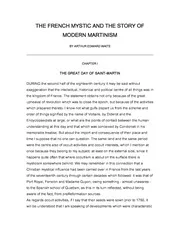
A. E Waite The French Mystic And The Story Of Modern Martinism
 74
74

A. E Waite The French Mystic And The Story Of Modern Martinism



Review by Evander Ashcroft (Alchemy & Hermeticism Editor) — A seminal work that masterfully unearths the spiritual lineage and esoteric contributions of A. E. Waite to modern Martinism. The author navigates complex philosophical terrain with clarity, revealing the intricate connections between Waite's extensive occult scholarship and the development of this mystical order. Esoteric insights abound, particularly concerning the symbolic language and practical applications of Martinist teachings as reinterpreted through Waite's unique lens. This book is an indispensable resource for anyone seeking a deeper comprehension of Waite's legacy and the evolution of Western esoteric traditions, particularly appealing to serious students and practitioners.
📝 Description
74
This book examines Arthur Edward Waite's work in shaping modern Martinism.
Arthur Edward Waite was a prolific writer and occultist whose work touched upon many esoteric traditions. This volume specifically addresses his influence on the development of modern Martinism, a French initiatory order. The author traces how Waite adapted and transmitted older mystical currents into a form understandable to contemporary practitioners.
The book covers the symbolic language and philosophical ideas that Waite employed. It also discusses his engagement with secret societies and the pursuit of spiritual attainment. The narrative aims to clarify these complex subjects for those interested in Western esotericism.
Martinism, originating in the 18th century with figures like Louis Claude de Saint-Martin, is a branch of Western esotericism focused on spiritual re-integration and direct experience of the divine. Arthur Edward Waite, a prominent figure in late 19th and early 20th century occultism, played a significant role in codifying and popularizing Martinist ideas for a broader audience. This book situates Waite's specific contributions within that historical and philosophical lineage.
💡 Why Read This Book?
This book is essential for seekers yearning to understand the foundational principles and historical trajectory of modern Martinism, particularly as shaped by the profound intellect of A. E. Waite. Scholars will find invaluable primary source insights and a critical analysis of esoteric influences. Practitioners will discover a richer context for their spiritual work and a deeper appreciation for the symbolic language woven into Martinist philosophy. It's an invitation to uncover hidden knowledge and connect with a vibrant, enduring mystical tradition.
⭐ Reader Reviews
Honest opinions from readers who have explored this book.
❓ Frequently Asked Questions
Who was Arthur Edward Waite?
Arthur Edward Waite (1857-1942) was a prolific scholar and occultist, renowned for his work on the Tarot, Holy Grail, and his extensive writings on Freemasonry, Rosicrucianism, and Martinism. He played a crucial role in shaping the modern understanding of many esoteric traditions.
What is Martinism?
Martinism is a spiritual tradition derived from the teachings of Louis Claude de Saint-Martin, emphasizing mysticism, theurgy, and the direct experience of the divine. It often incorporates elements of Kabbalah, Gnosticism, and Freemasonry.
What is the connection between Waite and French Mysticism?
Waite was deeply influenced by and contributed significantly to the study and propagation of French esoteric traditions, including Martinism, which originated in France. He helped translate and disseminate these ideas to a wider, English-speaking audience.
Is this book suitable for beginners?
While the subject matter is inherently esoteric, the book is written to be accessible. Beginners interested in the history of mysticism and occultism will find a comprehensive introduction, though a basic familiarity with spiritual concepts may enhance understanding.
What kind of esoteric knowledge can I expect to find?
Readers can expect insights into symbolic interpretation, the history of secret societies, alchemical and Kabbalistic correspondences, and the practical application of mystical principles within the Martinist framework as understood by Waite.
🔮 Key Themes & Symbolism
The Esoteric Philosophy of A. E. Waite
This theme looks at the collection of Waite's personal philosophical framework, examining how his extensive studies in Tarot, Kabbalah, and Grail legends informed his unique perspective on Western esotericism. It explores his quest for hidden knowledge and his attempts to synthesize disparate mystical traditions into a coherent spiritual path, highlighting his emphasis on inner transformation and the unveiling of divine mysteries through symbolic interpretation and contemplative practice.
The Evolution of Modern Martinism
This section traces the historical development of Martinism, focusing on its transmission and adaptation through various influential figures, with particular attention to Waite's significant role. It examines how the core tenets of Louis Claude de Saint-Martin's teachings were reinterpreted and integrated into new esoteric currents, emphasizing the practical, alchemical, and theurgic aspects that defined its modern incarnation and its appeal to seekers of spiritual illumination and direct divine connection.
Symbolism and Hidden Meanings
Here, the focus shifts to the profound symbolic language that underpins both Waite's work and the Martinist tradition. The theme explores the intricate web of correspondences – from alchemical processes to celestial alignments and archetypal imagery – that serve as keys to unlocking deeper spiritual truths. It investigates how these symbols are employed to guide the initiate on a journey of self-discovery and to reveal the hidden architecture of the cosmos and the divine within.
💬 Memorable Quotes
Direct passages from the work, attributed to the author.
“True initiation lies not in outward ceremony, but in the transformation of the soul.”
— This highlights the internal nature of spiritual progress, emphasizing that genuine growth and enlightenment come from inner change and purification, rather than mere participation in external rituals or secret rites.
“The symbols of the ancients whisper truths to those who learn to listen.”
— This underscores the importance of symbolic language in esoteric traditions, suggesting that hidden wisdom is encoded within ancient motifs and requires a developed inner sense or intuition to decipher and comprehend.
“Martinism offers a bridge between the visible and the invisible realms.”
— This points to the core function of Martinism as a system that facilitates connection and understanding between the material world and the higher, spiritual dimensions, guiding practitioners towards a more integrated perception of reality.
“The quest for the Grail is the quest for the divine within.”
— This connects the legendary search for the Holy Grail to the inner spiritual journey, suggesting that the ultimate goal is not an external artifact, but the discovery and realization of the divine essence residing within the individual seeker.
💡 Key Ideas
Editorial paraphrase of the work's core concepts — not direct quotes.
The occult is not a path to power, but a journey toward understanding.
This quote captures Waite's philosophical stance, suggesting that true esoteric pursuit is not about manipulation or control, but about an inward journey of self-awareness and intellectual/spiritual enlightenment, seeking wisdom rather than worldly dominion.
🌙 Esoteric Significance
Tradition
This work is deeply rooted in the Western Esoteric Tradition, specifically focusing on the lineage and development of Martinism, a mystical order inspired by Louis Claude de Saint-Martin. It explores themes of Gnosticism, Kabbalah, and Hermeticism, examining how these ancient streams of wisdom were synthesized and transmitted through the specific lens of modern Martinist practices and philosophies, as interpreted and influenced by A. E. Waite.
Symbolism
The book looks at the rich symbolic language inherent in Martinism and Waite's extensive occult studies. This includes the interpretation of alchemical symbols representing spiritual transformation, Kabbalistic diagrams illustrating divine emanations and cosmic structure, and the archetypal imagery found in Tarot and Grail legends. These symbols are presented not merely as decorative elements, but as keys to unlocking profound spiritual truths and guiding the practitioner on a path of inner illumination and self-realization.
Modern Relevance
In an age often characterized by spiritual searching and a desire for deeper meaning, understanding the historical development and philosophical underpinnings of traditions like Martinism, particularly as shaped by insightful figures like A. E. Waite, holds significant contemporary relevance. The book offers timeless principles for personal growth, inner exploration, and the cultivation of spiritual awareness, providing seekers with a valuable framework for navigating their own mystical journeys in the modern world.
👥 Who Should Read This Book
This comprehensive exploration is useful for serious students of Western esotericism, occult history, and comparative mysticism. Scholars of Arthur Edward Waite's vast oeuvre will find critical insights into his contributions to Martinism. Practitioners of esoteric arts, particularly those interested in Martinist or Hermetic traditions, will gain a deeper understanding of their philosophical roots and symbolic language. It is also recommended for general readers with a profound curiosity about hidden knowledge, secret societies, and the enduring quest for spiritual enlightenment.
📜 Historical Context
This book emerges from a period of intense esoteric revival in the late 19th and early 20th centuries, a time when figures like A. E. Waite were instrumental in codifying, popularizing, and often reinterpreting ancient mystical and occult traditions for a burgeoning Western audience. The era was marked by a reaction against materialism and a renewed interest in spiritualism, Theosophy, and various branches of Western esotericism, including Martinism, which itself experienced significant transformations. Waite, a prolific writer and influential member of several occult orders, navigated this complex landscape, contributing to the intellectual and spiritual currents that sought to bridge ancient wisdom with modern understanding, thus shaping the discourse on mysticism and occultism for generations to come.
📔 Journal Prompts
Reflect on A. E. Waite's role: Was he a preserver, an innovator, or both in his engagement with Martinism?
How do the symbolic systems discussed in this book (e.g., Tarot, Kabbalah) resonate with your personal spiritual understanding?
Consider the concept of 'hidden knowledge' presented. What does this term mean to you, and how might one access it?
If Martinism is a bridge between realms, what aspects of your own life could benefit from such a connection?
What personal transformation does the 'quest for the divine within' imply for your current path?
🗂️ Glossary
Martinism
A mystical tradition founded on the teachings of Louis Claude de Saint-Martin, emphasizing spiritual regeneration, theurgy, and the direct experience of the divine through contemplation and symbolic rites.
Theurgy
A system of ritual magic or spiritual practice aimed at invoking divine assistance or communion, often involving symbolic actions to achieve spiritual elevation or transformation.
Kabbalah
A complex system of Jewish mysticism and esoteric interpretation, dealing with the nature of God, the creation of the universe, and the relationship between the divine and the human through symbolic trees and numerical correspondences.
Hermeticism
A philosophical and religious tradition based on the purported teachings of Hermes Trismegistus, emphasizing divine wisdom, the interconnectedness of all things, and the pursuit of spiritual enlightenment through knowledge and practice.
Esotericism
A broad category of mystical and occult traditions that emphasize hidden knowledge, inner transformation, and spiritual initiation, often distinguishing between exoteric (public) and esoteric (private) teachings.
This book appears in 1 collection
🔮 Readers Also Liked
Browse all →





From the “Christian Mysticism” Collection
View all →






More Free Mysticism & Contemplation Books
View all →