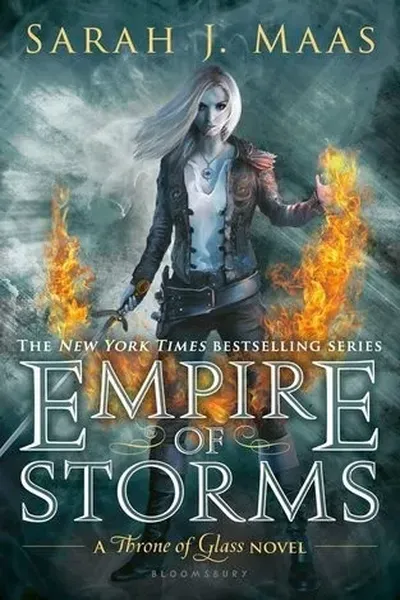
Empire of Storms

 78
78

Empire of Storms
Sarah J. Maas’s Empire of Storms is a direct continuation of the escalating stakes from its predecessors, offering a dense, action-packed chapter in Aelin Galathynius’s saga. The sheer scope of the narrative, weaving together multiple character perspectives and vast geographical landscapes from Erilea, is impressive. Maas excels at crafting visceral combat sequences and moments of intense emotional turmoil. One particular strength lies in the development of secondary characters, whose own complex motivations and relationships are given significant space to breathe amidst the overarching conflict.
However, the sheer volume of plot threads and character introductions can feel overwhelming. At times, the pacing falters under the weight of exposition and the need to set up future conflicts, occasionally sacrificing the momentum established in earlier parts of the series. The exploration of Aelin’s burgeoning power, while central, sometimes feels less about internal struggle and more about external manifestations of immense force.
Read more ↓
Empire of Storms delivers the high-octane fantasy expected by its established readership, even if its ambition occasionally strains its structure.
📝 Description
78
### What It Is
Empire of Storms, published in 2016 by Sarah J. Maas, is the fifth installment in the Throne of Glass series. This epic fantasy novel continues the sprawling narrative of Aelin Galathynius, a young queen wrestling with her destiny, immense power, and the looming threat of war.
The work plunges readers into a world teetering on the brink of cataclysm, where ancient magic, political intrigue, and personal sacrifice collide. It chronicles Aelin’s journey as she strives to unite her kingdom and confront the forces seeking to enslave her people.
### Who It's For
This book is intended for readers who have followed the Throne of Glass saga from its inception. It caters to those who appreciate complex world-building, intricate character arcs, and high-stakes fantasy narratives. Fans of epic quests, morally gray characters, and the exploration of power dynamics will find much to engage with.
### Historical Context
Published in 2016, Empire of Storms emerged within a landscape of burgeoning adult fantasy series that emphasized intricate lore and character-driven plots. Maas's work sits alongside contemporary authors like Leigh Bardugo and V.E. Schwab, who were also reshaping the genre with their ambitious world-building and focus on female protagonists. The year also saw continued interest in fantasy as an escapist genre, particularly for young adults and new adults seeking complex narratives.
### Key Concepts
The narrative explores the concept of Fae magic, the ancestral powers wielded by certain bloodlines, and its connection to the land. It also delves into the nature of destiny versus free will, as Aelin grapples with prophecies and her own choices. The theme of sacrifice, both personal and political, is central as characters make difficult decisions to protect those they love and secure a future for their realms.
💡 Why Read This Book?
• Learn about the intricate Fae bloodlines and their ancient magic, as depicted through Aelin’s lineage and her struggle to master her abilities, offering a unique perspective on inherited power. • Experience the political machinations and kingdom-building challenges faced by Aelin as she attempts to forge alliances before the invasion of Erilea, providing concrete examples of leadership under duress. • Understand the theme of sacrifice in the face of overwhelming odds, particularly through the choices made by characters like Rowan and Manon in the lead-up to the war with Erawan, showcasing the personal cost of conflict.
⭐ Reader Reviews
Honest opinions from readers who have explored this book.
❓ Frequently Asked Questions
When was Empire of Storms first published?
Empire of Storms was first published in 2016, marking the fifth significant release in the popular Throne of Glass series.
What is the primary conflict in Empire of Storms?
The primary conflict involves Queen Aelin Galathynius preparing her kingdom and allies for an inevitable war against the dark forces led by Erawan, while also confronting her own immense magical power.
Who are the main protagonists in Empire of Storms?
The central protagonist is Aelin Galathynius, but the narrative also heavily features characters such as Rowan Whitethorn, Lysandra, Aedion Ashryver, and Manon Blackbeak, among others.
What magical elements are explored in Empire of Storms?
The book extensively explores Fae magic, elemental powers, the Valg curse, and the ancient powers tied to Aelin's bloodline, often presented as both a gift and a dangerous burden.
Does Empire of Storms require reading previous books in the series?
Yes, Empire of Storms is a direct continuation of the Throne of Glass series and is not intended to be read as a standalone novel. Prior knowledge of characters and plot is essential.
What is the significance of the Valg in the series?
The Valg are ancient, demonic entities from another realm, serving as the primary antagonists seeking to conquer Erilea. Their influence and threat are central to the overarching plot of Empire of Storms.
🔮 Key Themes & Symbolism
Destiny and Choice
The narrative intensely scrutinizes the weight of destiny, particularly for Aelin Galathynius, who is prophesied to either save or destroy her world. The book presents her struggle to reconcile preordained paths with her personal will and the choices she makes, showcasing how even individuals marked by fate must actively shape their own futures. This theme is crucial as Aelin grapples with her powerful Fae heritage and the responsibilities it entails, questioning whether her lineage dictates her actions or if she can forge a unique path.
The Nature of Power
Empire of Storms examines power not just as a physical or magical force, but as a corrupting influence and a tool for liberation. Aelin’s immense, barely controlled magic is a central focus, highlighting the internal battle required to wield such abilities responsibly. The book contrasts different forms of power—royal authority, military might, magical prowess, and the strength derived from alliances and loyalty—exploring their costs and consequences.
Sacrifice and Loyalty
The impending war forces characters to confront profound sacrifices, both personal and collective. Loyalty is tested as individuals must choose between their own safety, their loved ones, and the greater good of Erilea. The narrative illustrates how deep bonds of friendship and chosen family become vital sources of strength, enabling characters to endure immense hardship and make the ultimate sacrifices in defense of their world and their ideals.
Ancestral Magic and Identity
The Fae bloodline and the ancient magic it carries are fundamental to the story. Aelin’s identity is inextricably linked to her heritage, which she must learn to understand and control. The book explores how ancestral powers shape an individual, influencing their capabilities, their burdens, and their place in the world. This connection to lineage provides a spiritual and mystical undercurrent, linking characters to the history and magic of their realm.
💬 Memorable Quotes
“She was a fire-breathing dragon, and she would not be caged.”
— This declaration encapsulates Aelin's indomitable spirit and her refusal to be controlled by external forces, whether they be political enemies or her own overwhelming magical power. It signifies her fierce independence and determination to fight for her freedom and her kingdom.
“Power like that doesn’t come without a price. It never has. It’s not free.”
— This statement underscores the central theme of sacrifice inherent in wielding significant power, particularly magical power. It suggests that great abilities are never without consequence, demanding a personal cost from those who possess them, often in the form of hardship or difficult choices.
“War was coming. And she was going to be ready.”
— This reflects Aelin's proactive stance in the face of overwhelming threat. Despite the immense challenges and the destructive potential of her enemy, she resolves to prepare and confront the impending conflict head-on, demonstrating her commitment to her role as queen and protector.
“She was the queen who had burned kingdoms to the ground. And she would do it again.”
— This quote highlights Aelin's willingness to embrace her destructive capabilities when necessary for survival or justice. It speaks to her pragmatism and her evolution into a warrior queen, unafraid to use extreme measures to achieve her goals.
“The world was broken, and she was going to try to fix it.”
— This expresses Aelin's overarching ambition to restore order and heal the fractured world of Erilea. It frames her epic journey not just as a personal quest for survival, but as a mission to mend the damage caused by conflict and dark magic.
🌙 Esoteric Significance
Tradition
While not explicitly rooted in a single esoteric tradition, Empire of Storms draws heavily on archetypal fantasy elements that resonate with broader mystical and Gnostic themes. The concept of a chosen one (Aelin) burdened with immense, world-altering power, facing a primordial evil (Erawan), echoes Gnostic narratives of a divine spark trapped in a flawed material world, needing to awaken to its true potential. The emphasis on bloodlines and inherited magic also touches upon concepts found in various lineage-based magical systems, though presented through a fictional lens.
Symbolism
The primary symbols revolve around fire and light, intrinsically linked to Aelin’s Fae heritage and her role as the ‘Salt Queen’ and ‘Queen of Ash and Fire.’ Fire represents both destructive potential and purifying force, mirroring Aelin’s struggle to control her power. The recurring motif of the Fae queen and the ancient pacts between races symbolizes the deep, often forgotten, connections between the mortal and magical realms. The Valg, as entities from a realm of darkness, embody primal chaos and the antithesis of creation, a common symbolic representation of adversarial forces.
Modern Relevance
Contemporary fantasy literature continues to explore themes of inherited power, destiny versus free will, and the moral complexities of leadership that Empire of Storms champions. Readers and writers are drawn to its depiction of female agency in a patriarchal fantasy setting and its nuanced portrayal of the psychological toll of immense power. The series’s exploration of diverse magical systems and its blend of political intrigue with personal journeys influence current trends in character-driven epic fantasy, where protagonists often grapple with immense responsibilities.
👥 Who Should Read This Book
• Fans of the Throne of Glass series seeking the continuation of Aelin Galathynius's epic journey and the resolution of long-standing plotlines. • Readers of high fantasy who appreciate complex world-building, intricate magic systems, and character-driven narratives with significant stakes. • Those interested in explorations of destiny, the nature of power, and the personal sacrifices required of leaders in times of crisis.
📜 Historical Context
Published in 2016, Sarah J. Maas’s Empire of Storms arrived amidst a golden age for young adult and new adult fantasy literature. The genre had seen significant growth in complexity and scope, with authors increasingly focusing on intricate world-building, mature themes, and morally ambiguous characters. Maas's Throne of Glass series, by this point, had garnered a substantial following, positioning Empire of Storms as a highly anticipated release. It was a period where authors like Leigh Bardugo (Six of Crows, 2015) and V.E. Schwab (A Darker Shade of Magic, 2015) were also exploring vast magical worlds and complex protagonists, creating a competitive yet fertile ground for epic fantasy. The reception of Empire of Storms was largely positive among its established fanbase, who eagerly consumed the next chapter in Aelin Galathynius’s saga, though some critics noted the series's expansive plotlines and the sheer number of characters requiring attention.
📔 Journal Prompts
Aelin’s mastery over her fire magic, as she learns to control its destructive and creative potential.
The strategic alliances formed between disparate kingdoms to face the common threat of Erawan.
Rowan’s loyalty to Aelin, and how it shapes his actions and sacrifices throughout the narrative.
The burdens of leadership, as experienced by Aelin and other rulers navigating the impending war.
Manon Blackbeak's evolving role from antagonist to reluctant ally, and her internal conflicts.
🗂️ Glossary
Fae
An ancient, powerful race with magical abilities, often possessing long lifespans and a deep connection to the land. Aelin Galathynius is of Fae descent, a crucial element of her identity and power.
Valg
Demonic entities from another realm that seek to conquer and enslave the world of Erilea. They are the primary antagonists and represent a corrupting, destructive force.
Erilea
The primary continent and world setting for the Throne of Glass series, comprising various kingdoms, cultures, and magical landscapes.
Wyrdmarks
Mystical symbols or runes associated with ancient magic and destiny, often used for divination or to bind magical energies. They represent a deep, often dangerous, connection to the unseen forces of the world.
A Court of Assassins
A notorious group of skilled killers and spies, often operating in the shadows, whose allegiances and methods are crucial to the political landscape of Erilea.
The Wyrdkeys
Ancient artifacts of immense power, capable of opening rifts between worlds and manipulating reality. Their control is a significant plot driver.
Terrasen
A significant kingdom within Erilea, the ancestral homeland of Aelin Galathynius, and a central focus of her efforts to reclaim her throne.