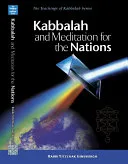
Kabbalah and Meditation for the Nations
 81
81

Kabbalah and Meditation for the Nations
Yitsḥaḳ Ginzburg’s *Kabbalah and Meditation for the Nations* attempts a bold reconciliation of esoteric Jewish mysticism with a global, interfaith vision. Its strength lies in its earnest desire to find common spiritual ground, particularly in its explication of how Kabbalistic concepts of unity can inform a more harmonious world. Ginzburg’s interpretation of the *Sefirot* as archetypal divine emanations accessible to all, regardless of religious affiliation, is an interesting angle. However, the work occasionally struggles to fully integrate the intricate Kabbalistic terminology with its universalist aspirations, sometimes feeling more like a series of related essays than a cohesive argument. The section on meditation, while practical, could benefit from more direct engagement with comparative meditative traditions beyond the Kabbalistic framework. The book's ambition to foster peace through spiritual understanding is commendable, but its execution sometimes falters in bridging the highly specific language of Kabbalah with a truly universal audience. It is a valuable contribution for those already familiar with Kabbalistic concepts seeking a broader application.
📝 Description
81
### What It Is
Kabbalah and Meditation for the Nations, first published in 2007 by Yitsḥaḳ Ginzburg, offers a unique synthesis of Kabbalistic thought and contemplative practice. It aims to bridge the perceived divides between religious traditions and individuals by exploring the universal underpinnings of spiritual experience.
### Who It's For
This work is intended for those seeking a deeper understanding of Kabbalah beyond its traditional mystical interpretations, particularly individuals interested in its application to interfaith dialogue and global harmony. It appeals to students of comparative religion, contemplative practitioners, and anyone grappling with the challenges of religious fundamentalism.
### Historical Context
Emerging in the early 21st century, a period marked by increasing globalization and persistent inter-religious tensions, Ginzburg's book addresses a contemporary need for spiritual unity. The work engages with the broader discourse on universalism in spirituality, which saw figures like Karen Armstrong advocating for shared religious values.
### Key Concepts
The book unpacks complex Kabbalistic ideas, such as the nature of Divine unity and the soul's journey, reframing them within a universalist paradigm. It explores how meditative techniques, derived from Kabbalistic principles, can foster empathy and mutual understanding across diverse belief systems, moving beyond sectarian interpretations of the Divine.
💡 Why Read This Book?
• Gain a unique perspective on Kabbalistic principles, understanding how concepts like the *Sefirot* can be interpreted universally, as explored in the book's initial chapters. • Discover practical meditative techniques rooted in Kabbalistic wisdom, potentially enhancing your contemplative practice and fostering inner peace as detailed in the book's later sections. • Engage with a framework for interfaith dialogue that draws from the esoteric tradition, offering a novel approach to understanding shared spiritual aspirations, a central theme from the 2007 publication.
⭐ Reader Reviews
Honest opinions from readers who have explored this book.
❓ Frequently Asked Questions
What is the core message of Kabbalah and Meditation for the Nations?
The book's core message is that Kabbalistic teachings, particularly regarding Divine unity and the soul, can serve as a universal language to foster peace and understanding among all nations and religions.
Who is Yitsḥaḳ Ginzburg?
Yitsḥaḳ Ginzburg is the author of Kabbalah and Meditation for the Nations, first published in 2007. He is known for his work in Kabbalah and its application to contemporary spiritual and social issues.
Does this book require prior knowledge of Kabbalah?
While prior knowledge can be helpful, the book aims to explain Kabbalistic concepts in a way that is accessible to a broader audience interested in spiritual unity and meditation.
What kind of meditation practices are discussed?
The book discusses meditative practices derived from Kabbalistic principles, focusing on contemplation of Divine attributes and the structure of reality as understood in Kabbalah.
How does this book relate to interfaith dialogue?
It proposes Kabbalah as a basis for interfaith dialogue by highlighting universal spiritual truths that transcend specific religious doctrines, aiming to unite people rather than divide them.
When was Kabbalah and Meditation for the Nations first published?
The book was first published in 2007, reflecting a contemporary interest in finding spiritual common ground in an increasingly interconnected world.
🔮 Key Themes & Symbolism
Universalism in Kabbalah
The book posits that Kabbalistic teachings, often perceived as exclusively Jewish, contain universal principles applicable to all humanity. It reinterprets concepts like the ten *Sefirot* not merely as divine attributes within Judaism, but as archetypal structures of consciousness and reality that can inform a global spiritual consciousness. This approach seeks to dismantle sectarian barriers by revealing an underlying unity in spiritual seeking across diverse traditions.
Kabbalistic Meditation Techniques
Ginzburg outlines specific meditative practices derived from Kabbalistic sources, designed to facilitate inner transformation and promote a sense of connection with the Divine and with others. These techniques often involve contemplation of divine names, symbolic imagery from the Kabbalistic tree of life, and the cultivation of specific emotional states associated with the *Sefirot*.
Spiritual Foundations for Peace
A central theme is the book's argument that a deeper understanding of spiritual unity, as illuminated by Kabbalah, is essential for achieving global peace. It addresses the threat of religious fundamentalism by offering an alternative vision where shared spiritual aspirations can bridge divides, fostering empathy and mutual respect among different peoples.
The Soul's Journey
The work explores the Kabbalistic understanding of the soul's origin, purpose, and destiny. It presents this journey not as a solitary pursuit, but as intrinsically connected to the broader cosmic order and the collective human experience. This perspective encourages a sense of shared responsibility and interconnectedness in spiritual development.
💬 Memorable Quotes
“Our different relationships and understandings of G-d should not be the cause of division.”
— This highlights the book's core thesis: that variations in religious belief are not inherently divisive but can be seen as different paths to a common spiritual source, suggesting a need for greater interfaith understanding.
“The challenge is either to inhabit our planet harmoniously or not inhabit it at all.”
— This quote underscores the urgency of the book's message, framing global harmony not just as an ideal but as a necessity for collective survival in the modern era, linking spiritual unity to practical well-being.
“The first generation in modern times to understand the truly universal human condition.”
— This statement positions the contemporary era as unique, possessing a newfound capacity for global empathy and a recognition of shared human experiences that transcends historical boundaries and cultural differences.
“Filling our future is the fundamentalism that threatens to pit one religion against another.”
— This points to a significant societal challenge that the book seeks to address: the rise of divisive religious ideologies and the urgent need for spiritual frameworks that promote unity rather than conflict.
“We are faced with the challenge of either inhabiting our planet harmoniously or not inhabiting it at all.”
— This emphasizes the critical juncture humanity faces, where achieving global harmony is presented as an existential imperative, directly linking spiritual cooperation to the future of human civilization.
🌙 Esoteric Significance
Tradition
This work is firmly rooted in the Kabbalistic tradition, specifically drawing from Lurianic Kabbalah and its subsequent interpretations. It departs from some traditional, more insular approaches by emphasizing the universal applicability of Kabbalistic principles. Ginzburg seeks to reinterpret these esoteric teachings for a broader, global audience, framing them as tools for interfaith dialogue and universal spiritual development, rather than solely as a mystical path for Jewish practitioners.
Symbolism
Key symbols explored include the *Ein Sof* (the Infinite), representing the ultimate unknowable Divine, and the *Sefirot*, the ten emanations or attributes through which the Divine manifests. The book interprets these not just within a Jewish cosmological framework but as universal archetypes of consciousness and divine presence, accessible to all seekers. The Tree of Life, as the organizational structure of the *Sefirot*, serves as a map for both cosmic reality and the inner journey of the soul.
Modern Relevance
Contemporary thinkers and practitioners in fields like transpersonal psychology, integral spirituality, and comparative mysticism find resonance in Ginzburg's attempt to synthesize Kabbalistic wisdom with universal humanistic and spiritual aspirations. His work offers a framework for those seeking to integrate esoteric knowledge with practical applications for social harmony and personal growth in a post-traditional spiritual landscape.
👥 Who Should Read This Book
• Students of comparative religion seeking to understand how esoteric traditions can inform interfaith dialogue and promote global unity. • Practitioners of meditation interested in exploring contemplative techniques rooted in the Kabbalistic tradition, as detailed in the book's practical sections. • Individuals grappling with issues of religious division and fundamentalism, looking for spiritual frameworks that emphasize shared humanity and universal connection.
📜 Historical Context
Published in 2007, *Kabbalah and Meditation for the Nations* emerged during a period of heightened global awareness of interconnectedness, yet also of significant geopolitical and inter-religious tension. The early 21st century saw a surge in dialogues aiming to bridge divides, influenced by thinkers like Karen Armstrong who championed comparative religion and shared ethical frameworks. Ginzburg's work engaged with this milieu by proposing Kabbalah as a source for universal spiritual understanding, countering the forces of religious fundamentalism that were increasingly polarizing societies. While Western esoteric traditions have a long history, this specific application sought to address a modern crisis of division, offering a contemplative path towards global harmony. The book’s reception was largely within circles interested in Kabbalah and comparative spirituality, contributing to ongoing discussions about universalism in mysticism.
📔 Journal Prompts
The concept of *Sefirot* as universal archetypes: How do these divine emanations manifest in your understanding of the world?
The challenge of fundamentalism: Reflect on the book's assertion that understanding Divine unity can counter divisive religious ideologies.
Meditative practice: Explore the connection between Kabbalistic contemplation and cultivating inner peace, as suggested by the book's approach.
Universal human condition: Consider how the book's perspective on shared spiritual seeking applies to your own experiences or observations.
The role of G-d in interfaith dialogue: How can diverse understandings of the Divine foster connection rather than separation?
🗂️ Glossary
Ein Sof
The Kabbalistic term for the Infinite, Unbounded, or Absolute Godhead, considered beyond all conception or description, the ultimate source of all existence.
Sefirot
The ten divine emanations or attributes described in Kabbalah, forming the structure of the Tree of Life, through which the Infinite manifests and interacts with creation.
Tree of Life (Etz Chaim)
A central diagram in Kabbalah representing the structure of the universe and the human soul, composed of the ten Sefirot connected by paths.
Kabbalah
A system of Jewish mysticism and esoteric teaching that seeks to understand the nature of God, the universe, and humanity's place within it, often through symbolic interpretation of scripture.
Fundamentalism
A movement or attitude stressing strict and literal adherence to a set of basic principles, often applied in religion to rigidly defined doctrines that can lead to intolerance.
Universalism
The philosophical or theological doctrine that some essential truth or virtue is universal, applying to all people regardless of their specific religious or cultural background.
Contemplation
The act of deep, reflective thought or spiritual meditation, often focused on divine mysteries or inner states of being, as practiced in various mystical traditions.