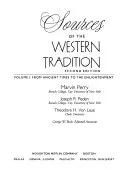
Sources of the Western Tradition: From ancient times to the Enlightenment
 79
79

Sources of the Western Tradition: From ancient times to the Enlightenment
Marvin Perry's "Sources of the Western Tradition" offers an unvarnished look at the intellectual scaffolding of Western civilization. Its strength lies in the sheer breadth of primary materials presented, allowing direct confrontation with historical arguments rather than relying solely on secondary interpretations. The inclusion of introductory essays and review questions is a practical concession to pedagogical needs, though at times these feel like necessary scaffolding for the raw material. A particular strength is the careful selection of documents that highlight shifts in thought, such as the transition from medieval scholasticism to early modern empiricism. However, the sheer volume can be daunting, and the editor's framing, while helpful, occasionally imposes a specific narrative that might overshadow alternative readings of the sources. The emphasis on 'ideas' sometimes sidelines the material realities that fueled or constrained these intellectual movements. Despite these minor reservations, it remains a vital resource for serious students of history and philosophy. It is an essential, if demanding, compilation for anyone seeking to understand the intellectual DNA of the West.
📝 Description
79
### What It Is Sources of the Western Tradition is a foundational primary source reader, first published in 1990 by Marvin Perry. This extensive collection, typically presented in two volumes, compiles approximately 300 historical documents. Each source is accompanied by an introductory essay from the editor and a set of review questions, designed to foster deeper engagement with the material. The reader's primary focus is on the evolution of Western thought and ideas.
### Who It's For This reader serves as an indispensable resource for students enrolled in Western Civilization courses. It functions exceptionally well as a supplementary text, offering direct access to the original writings that shaped historical discourse. It is particularly recommended as a companion to Marvin Perry's own works, such as "Western Civilization" (7th Edition) or "Western Civilization: A Brief History."
### Historical Context Perry's compilation emerged during a period of significant academic re-evaluation of historical narratives. The Sixth Edition, for instance, actively incorporated more voices of women and addressed social and cultural issues, reflecting a broader trend in historical scholarship to diversify perspectives beyond traditional political and intellectual elites. This approach aimed to present a more nuanced understanding of Western development.
### Key Concepts The work emphasizes the history of ideas, tracing intellectual currents from antiquity through the Enlightenment. It presents a curated selection of primary texts, allowing readers to encounter foundational philosophical, religious, political, and scientific writings directly. The reader highlights how dominant paradigms and counter-movements developed over centuries, influencing subsequent epochs and shaping the modern world.
💡 Why Read This Book?
• Gain direct exposure to pivotal documents like Plato's "Republic" or Locke's "Second Treatise of Government," understanding the Enlightenment's intellectual roots firsthand, which offers a depth of comprehension distinct from secondary summaries. • Engage with approximately 300 primary sources, enabling a comparative analysis of philosophical and political shifts across centuries, a process impossible to replicate through textbook summaries alone. • Benefit from Perry's introductory essays and review questions, which provide crucial context for understanding the historical significance of texts like those from the Protestant Reformation, enhancing your analytical framework.
⭐ Reader Reviews
Honest opinions from readers who have explored this book.
❓ Frequently Asked Questions
What is the primary focus of "Sources of the Western Tradition"?
The book's primary focus is on the history of ideas, presenting a collection of approximately 300 primary source documents from ancient times to the Enlightenment, each with an introduction and review questions.
How many volumes does "Sources of the Western Tradition" typically come in?
The reader is usually presented in two volumes, offering a comprehensive collection of primary source materials for the study of Western civilization.
What makes the Sixth Edition of "Sources of the Western Tradition" notable?
The Sixth Edition features additional sources by and about women, and increased attention to documents dealing with social and cultural issues, reflecting a broader scope in historical scholarship.
Is "Sources of the Western Tradition" suitable for self-study?
Yes, its structure with introductory essays and review questions makes it suitable for self-study, particularly for individuals seeking to deepen their understanding of Western intellectual history.
What historical periods does "Sources of the Western Tradition" cover?
The reader covers a vast span of Western history, from ancient times through to the Enlightenment, providing foundational texts from these critical eras.
Who is the author of "Sources of the Western Tradition"?
The author is Marvin Perry, who first published this collection in 1990. The reader is often used in conjunction with his other works on Western Civilization.
🔮 Key Themes & Symbolism
Evolution of Political Thought
The reader traces the development of political philosophy and governance from ancient Greek city-states through to the Enlightenment's emphasis on individual rights and popular sovereignty. It includes seminal texts that established concepts of democracy, republicanism, and the social contract, offering a direct lineage to modern political structures and debates. Examining thinkers like Machiavelli alongside Enlightenment philosophers reveals crucial shifts in how power and legitimacy were understood.
Religious and Philosophical Shifts
Perry's compilation highlights the profound transformations in religious and philosophical outlooks across Western history. From the monotheistic foundations of Judaism and early Christianity to the rationalism of the Enlightenment, the reader presents texts that defined eras. It allows for an examination of how metaphysical questions, ethics, and epistemology evolved, including the impact of the Renaissance and the Reformation on established thought systems.
The Human Condition Across Eras
By presenting primary sources that grapple with fundamental human experiences—justice, freedom, morality, suffering—the reader offers a comparative view across different historical epochs. It showcases how societies and thinkers understood humanity's place in the cosmos, the nature of the self, and the pursuit of knowledge. The inclusion of diverse voices, especially in later editions, enriches this exploration of enduring human concerns.
The Enlightenment's Intellectual Legacy
A significant portion of the reader is dedicated to the Enlightenment, presenting its key thinkers and their contributions to reason, science, and individual liberty. Texts from this period critically examine traditional authority and champion empirical observation and critical inquiry. This section is vital for understanding the intellectual underpinnings of modern Western societies and their ongoing debates about progress and secularism.
💬 Memorable Quotes
“The collection allows readers to confront the original arguments that shaped Western thought.”
— This highlights the book's core pedagogical value: direct engagement with primary texts, fostering independent analysis rather than reliance on secondary interpretations of historical ideas.
“Emphasis on the history of ideas from antiquity to the Enlightenment.”
— This signifies the reader's scope, tracing intellectual evolution through foundational philosophical, political, and religious texts that form the bedrock of Western intellectual tradition.
“The Sixth Edition features additional sources by and about women.”
— This indicates an effort to broaden the historical narrative beyond traditionally male-dominated perspectives, acknowledging and integrating previously marginalized voices into the study of Western civilization.
“Each source is accompanied by an introductory essay and review questions.”
— This describes the reader's structure, designed to guide students through complex historical documents by providing context and prompting critical reflection on the material presented.
“This reader works as an accompaniment to any Western Civilization course.”
— This positions the book as a versatile educational tool, adaptable to various curricula while serving as a primary resource for understanding the historical development of Western thought.
🌙 Esoteric Significance
Tradition
While "Sources of the Western Tradition" is primarily an academic survey, its extensive collection of primary texts implicitly touches upon various esoteric lineages by including foundational philosophical and religious documents that informed later esoteric movements. For instance, Neoplatonic ideas present in ancient texts influenced Hermeticism and Gnosticism, while Kabbalistic concepts, though not always explicitly labeled as such, resonate within mystical interpretations of scripture. The reader provides the raw material from which esoteric practitioners can trace the historical development and cross-pollination of mystical thought within the broader Western tradition.
Symbolism
The work, by presenting foundational texts, indirectly engages with profound symbols that underpin Western esotericism. For example, the concept of the 'Logos' found in Greek philosophy and early Christian theology serves as a potent symbol of divine reason and creative principle, which later esoteric traditions explored extensively. Similarly, the recurring motif of the 'Great Chain of Being,' prominent from antiquity through the Enlightenment, represents a hierarchical cosmic order that esoteric systems often sought to understand and navigate, linking the material and spiritual realms.
Modern Relevance
Contemporary esoteric thinkers and practitioners, particularly those engaged in Western Hermeticism, ceremonial magic, and comparative mysticism, draw upon the historical foundations laid out in Perry's reader. Scholars and students exploring the roots of figures like Aleister Crowley or the Hermetic Order of the Golden Dawn find essential source material within its pages. The reader's comprehensive approach to intellectual history provides a crucial backdrop for understanding how esoteric ideas evolved and adapted through different philosophical and cultural epochs.
👥 Who Should Read This Book
• Students of Western Civilization courses seeking direct engagement with primary historical documents, offering a foundation for understanding intellectual evolution beyond secondary interpretations. • Independent scholars and researchers interested in tracing the development of philosophical, political, and religious ideas from antiquity through the Enlightenment, providing a broad overview of foundational texts. • Individuals curious about the intellectual underpinnings of Western societies, looking to contextualize modern thought by examining the core arguments and debates from pivotal historical periods.
📜 Historical Context
Marvin Perry's "Sources of the Western Tradition," first published in 1990, emerged during a period of increasing academic scrutiny of canonical historical narratives. The late 20th century saw a growing demand for more inclusive histories, challenging the traditional focus on elite male figures. Perry's decision to include more documents by and about women, and to address social and cultural issues, reflects this broader intellectual current, moving away from a purely political and intellectual history. This contrasted with earlier, more traditional survey texts that might have focused solely on figures like Aristotle or Locke without extensive contextualization of social impact. The reader's approach aimed to provide students with direct access to the primary voices, allowing them to engage with the intellectual debates of thinkers like Machiavelli and Rousseau in their original contexts, thereby fostering critical analysis of the Western intellectual tradition.
📔 Journal Prompts
The concept of the 'Logos' as presented in early philosophical texts and its subsequent interpretations.
Compare and contrast the political theories of Plato in "The Republic" with those of John Locke.
Analyze the impact of the Protestant Reformation on the concept of individual conscience and authority.
Reflect on how the Enlightenment's emphasis on reason challenged earlier metaphysical frameworks.
Consider the evolving representation of women's roles and contributions across the selected historical periods.
🗂️ Glossary
Enlightenment
An 18th-century intellectual and cultural movement emphasizing reason, individualism, and skepticism towards traditional authority, advocating for scientific inquiry and human rights.
Primary Source
An original document or artifact created during the time period being studied, offering firsthand testimony or direct evidence of events, people, or ideas.
Social Contract Theory
A philosophical concept positing that individuals implicitly or explicitly consent to surrender some of their freedoms and submit to the authority of a ruler or government in exchange for protection of their remaining rights.
Renaissance
A period in European history (roughly 14th-16th centuries) marked by a revival of classical art, literature, and learning, fostering humanism and new scientific inquiry.
Humanism
An intellectual movement during the Renaissance that focused on human potential, achievements, and interests, often emphasizing classical studies and secular values.
Empiricism
The philosophical stance that knowledge comes primarily from sensory experience and observation, central to scientific methodology and Enlightenment thought.
Scholasticism
A medieval philosophical and theological method that employed dialectical reasoning to resolve contradictions and to harmonize Christian teachings with classical philosophers like Aristotle.