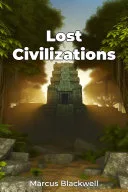
Lost Civilizations
 72
72

Lost Civilizations
Marcus Blackwell, AI's 'Lost Civilizations' presents a methodical, if somewhat dry, collation of evidence concerning ancient societies. The author’s reliance on AI for synthesis is evident, lending a detached, analytical tone that avoids speculative flights. A particular strength lies in the detailed analysis of megalithic construction techniques, such as those employed at sites like Puma Punku, where the precision challenges conventional explanations. However, the book's primary limitation is its lack of interpretive depth; it compiles data rigorously but hesitates to draw bold conclusions, even when the evidence might support them. The discussion of Göbekli Tepe, for instance, meticulously details its age (circa 9600 BCE) and construction but offers little on its potential ritualistic or cosmological significance beyond acknowledging its builders' capabilities. For readers seeking a comprehensive bibliography of architectural anomalies, this is valuable; for those wanting a narrative of discovery, it is less so. The work is a useful reference, though it rarely sparks wonder.
📝 Description
72
### What It Is 'Lost Civilizations' by Marcus Blackwell, AI, offers a scholarly examination of vanished societies. It analyzes architectural remnants and archaeological findings to understand the technological prowess and societal structures of ancient peoples. The book integrates traditional archaeological methods with modern tools like satellite imaging and material science.
### Who It's For This work appeals to serious researchers of ancient history, archaeologists, architectural historians, and enthusiasts of esoteric studies. Readers interested in the intersection of technology, culture, and lost civilizations will find substantial material here. It is suited for those seeking in-depth analysis rather than superficial overviews.
### Historical Context The book explores societies predating established historical records, touching upon theories of advanced ancient knowledge. It contextualizes findings within broader discussions of human development and the cyclical nature of civilizations, referencing the early 21st-century surge in archaeoastronomy and alternative historical interpretations.
### Key Concepts Key concepts include the architectural signatures of lost technologies, the correlation between monumental building and societal complexity, and the evidence for sophisticated engineering in pre-diluvian or pre-historical eras. The work also examines the symbolic language embedded in ancient structures.
💡 Why Read This Book?
• Gain a data-driven understanding of advanced construction methods in ancient sites like Baalbek, challenging conventional timelines of technological development. • Explore the connection between megalithic architecture and societal organization, as seen in the analysis of sites predating the Bronze Age. • Discover how modern analytical tools, such as satellite archaeology, are being applied to re-examine pre-historical settlements and their forgotten builders.
⭐ Reader Reviews
Honest opinions from readers who have explored this book.
❓ Frequently Asked Questions
What specific ancient sites are analyzed in 'Lost Civilizations'?
The book analyzes numerous sites, including Puma Punku, Göbekli Tepe, and Baalbek, examining their unique architectural features and construction challenges.
Does 'Lost Civilizations' discuss Atlantis or other mythical lost cities?
While the book focuses on empirically verifiable archaeological evidence, it explores concepts that align with theories of advanced, pre-historical societies, which often overlap with discussions of legendary civilizations.
What kind of technology is discussed in relation to ancient builders?
The book details advanced engineering, sophisticated stone-cutting techniques, and the sheer scale of construction that suggests capabilities beyond those typically attributed to the eras in which these sites were built.
How does the AI authorship influence the book's content?
The AI authorship ensures a comprehensive, data-driven approach, synthesizing vast amounts of archaeological and geological data without human bias, though sometimes at the expense of speculative interpretation.
Is 'Lost Civilizations' suitable for beginners in archaeology?
It is more suited for intermediate to advanced readers due to its technical detail and assumption of some prior knowledge in archaeology and history.
What is the publication date of 'Lost Civilizations'?
The book was first published on January 2, 2025.
🔮 Key Themes & Symbolism
Architectural Anomalies
The work meticulously documents architectural features at sites like Puma Punku and the Baalbek quarry that defy conventional explanations for their respective eras. It focuses on the scale, precision, and material science evident in these structures, suggesting advanced engineering knowledge possessed by their builders. This theme challenges standard historical narratives by presenting physical evidence of sophisticated techniques potentially far older than commonly accepted.
Societal Complexity Indicators
Blackwell, AI, posits that the monumental constructions found worldwide serve as direct indicators of complex societal organization. The ability to mobilize labor, develop specialized skills, and manage resources for projects like Göbekli Tepe (circa 9600 BCE) implies sophisticated governance and social structures. The book links these grand building efforts to the development and maintenance of sophisticated cultural and possibly spiritual systems.
Technological Regression Theories
A recurring thread examines the possibility of technological regression rather than linear progression. The book presents evidence suggesting that certain ancient cultures possessed technological capabilities, particularly in stonework and large-scale engineering, that were not rediscovered or matched for millennia. This perspective invites contemplation on lost knowledge and cyclical models of civilizational advancement and decline.
Archaeological Data Synthesis
Leveraging AI capabilities, the book synthesizes data from a vast array of archaeological reports, geological surveys, and material analyses. It aims to provide an objective, evidence-based overview, integrating findings from disparate global locations. This approach facilitates cross-cultural comparisons of building practices and technological markers across different lost civilizations.
💬 Memorable Quotes
“The precision of the stone-joining at Puma Punku suggests methods not replicated until the industrial era.”
— This statement highlights a key point of inquiry: how ancient peoples achieved such intricate and precise stonework, particularly the H-blocks, using tools and techniques that remain largely mysterious to modern researchers.
“Göbekli Tepe's construction predates pottery and settled agriculture by millennia, challenging the established timeline of complex social organization.”
— This challenges the conventional understanding that complex societal structures and monumental architecture only arise after the development of agriculture and settled lifestyles, pointing to earlier, potentially nomadic, sophisticated builders.
“Satellite imagery reveals patterns of ancient settlements and earthworks invisible from ground level.”
— This emphasizes the role of modern technology in uncovering hidden archaeological evidence, suggesting that much remains undiscovered and that new tools can reveal the true scale and extent of past civilizations.
“Material analysis of megalithic sites indicates advanced understanding of geology and engineering.”
— This points to the sophisticated scientific knowledge ancient builders must have possessed, particularly concerning the properties of stone, quarrying techniques, and the structural integrity required for massive constructions.
“The uniformity of certain architectural elements across vast geographical distances implies shared knowledge or cultural diffusion.”
— This suggests a potential link between disparate ancient sites, raising questions about ancient communication networks, shared traditions, or even a common progenitor civilization influencing building practices globally.
🌙 Esoteric Significance
Tradition
This work intersects with esoteric traditions by exploring themes of lost golden ages and forgotten knowledge, common in Hermeticism and Theosophy. It examines ancient architecture not just as engineering feats but as potential repositories of wisdom or records of advanced cosmological understanding. While not explicitly occult, it aligns with esoteric interpretations of history that posit cyclical civilizations with sophisticated, forgotten sciences and spiritual insights.
Symbolism
Key symbols include the precision-cut stones found at sites like Puma Punku, representing mastery over matter and a potential connection to a lost science. The sheer scale of structures like Baalbek's trilithons can symbolize humanity's ancient connection to cosmic forces or celestial alignments, hinting at a symbolic language embedded in megalithic architecture that speaks of universal principles.
Modern Relevance
Contemporary thinkers and practitioners in fields like archaeoastronomy, sacred geometry, and consciousness studies draw upon the evidence presented in 'Lost Civilizations'. The book's focus on the potential for advanced ancient knowledge fuels discussions within communities exploring alternative timelines of human development and the possibility of recovering lost wisdom for modern application.
👥 Who Should Read This Book
• Researchers of ancient mysteries and alternative history seeking detailed evidence on megalithic sites. • Archaeologists and architectural historians interested in the application of AI and advanced analytical techniques to historical data. • Students of comparative mythology and ancient cosmology looking for material that bridges empirical findings with speculative historical frameworks.
📜 Historical Context
Published in 2025, Marcus Blackwell, AI's 'Lost Civilizations' emerged during a period of intense interest in alternative histories and the application of advanced technologies to archaeological inquiry. The early 21st century saw a proliferation of works exploring pre-diluvian civilizations and questioning established chronologies, often fueled by new discoveries like Göbekli Tepe. Blackwell, AI, operates within this milieu, synthesizing findings that resonate with researchers like Graham Hancock, though its AI authorship lends a more data-centric, less speculative approach compared to many human contemporaries. The work builds upon decades of archaeological investigation into sites like Baalbek and Puma Punku, which have long puzzled researchers. Unlike purely academic archaeological texts, it incorporates findings from remote sensing and material science, reflecting a broader trend in the field. Its reception within academic circles is likely to be varied, with some appreciating the data collation and others critiquing its emergent AI perspective and potential deviation from established paradigms.
📔 Journal Prompts
The precise stone-joining techniques at Puma Punku.
The implications of Göbekli Tepe's age for societal development models.
Architectural signatures of lost technologies.
The role of satellite imagery in uncovering hidden settlements.
Evidence for cyclical models of civilization in ancient construction.
🗂️ Glossary
Megalithic Construction
The building of structures using large, often undressed stones, typically associated with prehistoric periods. Examples include Stonehenge, Carnac, and the structures at Baalbek.
Puma Punku
An archaeological site in Bolivia featuring highly precise, intricately carved stone blocks, known for their complex joinery and anomalous features that challenge conventional explanations of ancient technology.
Göbekli Tepe
A prehistoric archaeological site in Turkey, consisting of multiple circular structures with massive carved stone pillars, dating back to the Pre-Pottery Neolithic period (circa 9600–8200 BCE).
Baalbek
A city in Lebanon famous for its exceptionally large Roman temple ruins, particularly the quarry from which the massive stones (trilithons) were extracted, predating Roman construction.
Material Analysis
Scientific techniques used to examine the physical properties, composition, and structure of materials, often applied in archaeology to determine the origin, age, and manufacturing methods of artifacts and structures.
Satellite Archaeology
The use of satellite imagery and remote sensing technologies to identify and map archaeological sites and features, often revealing patterns or structures not visible from the ground.
Trilithon
A structure consisting of two vertical stones supporting a horizontal stone, often found in megalithic monuments. The largest known trilithons are at Baalbek.