Lost Civilizations
 78
78

Lost Civilizations
Cottrell’s approach in Lost Civilizations is less about the esoteric mysteries of these cultures and more about the methodical unveiling of their existence. He details the painstaking work, for instance, of excavating sites like Çatalhöyük, emphasizing the ground-level discoveries that slowly piece together a picture of Neolithic life. While this focus on the archaeological process is a strength, providing a grounded perspective, it sometimes overshadows the deeper spiritual or philosophical aspects that might appeal to a more occult-minded reader. The description of Howard Carter’s meticulous cataloging of Tutankhamun’s tomb, though fascinating from a discovery standpoint, might leave those seeking hidden knowledge wanting more. Cottrell’s work stands as a solid, factual account of archaeological achievement, but its esoteric value is secondary to its historical reporting.
📝 Description
78
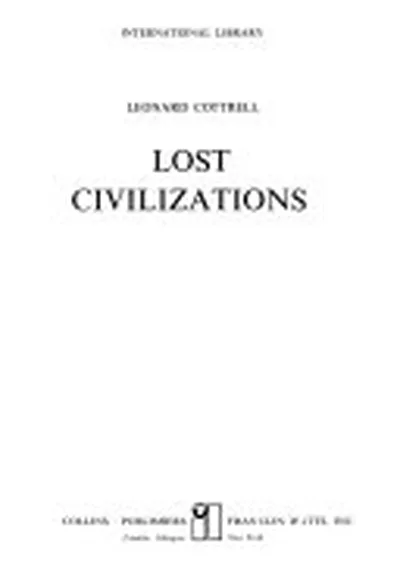
### What It Is Lost Civilizations by Leonard Cottrell, first published in 1974, offers an archaeological exploration of seven early societies. It details how their existence was unearthed through careful excavation and interpretation of material evidence. The book focuses on the process of discovery, highlighting the methods and findings that brought these ancient cultures back into historical consciousness.
### Who It's For This work is for anyone intrigued by the detective work of archaeology and the tangible remnants of vanished peoples. Readers seeking an introduction to how historical knowledge is constructed from physical evidence, rather than purely textual sources, will find value here. It appeals to those interested in the dawn of civilization and the human drive to understand our distant past.
### Historical Context Published in 1974, Cottrell's book emerged during a period of significant advancement in archaeological techniques and a growing public fascination with ancient mysteries. The discipline itself was solidifying its scientific methodologies, moving beyond earlier, more speculative approaches. This era saw renewed interest in sites like Çatalhöyük, which had been gaining attention in the preceding decade, and the ongoing decipherment of ancient scripts continued to unlock previously inaccessible historical narratives.
### Key Concepts The book emphasizes the interplay between archaeological evidence and historical reconstruction. It explores how fragmented artifacts, architectural remains, and inscriptions serve as primary sources for understanding societal structures, beliefs, and daily life. Cottrell illustrates how meticulous fieldwork, combined with scholarly analysis, can reveal the contours of civilizations that left no written accounts accessible to modern readers, or whose records were previously misunderstood.
💡 Why Read This Book?
• Understand the foundational archaeological methods used to uncover early societies, such as the stratigraphic analysis applied to sites like the Minoan civilization, providing insight into how historical narratives are built from physical remains. • Gain appreciation for the specific challenges and triumphs of early 20th-century archaeology, like the discovery of Tutankhamun's tomb by Howard Carter in 1922, illustrating the tangible results of persistent fieldwork. • Explore how scholars interpret material culture—pottery shards, architectural layouts, and tools—to reconstruct the lives and beliefs of people from civilizations predating written records, such as the Indus Valley.
⭐ Reader Reviews
Honest opinions from readers who have explored this book.
❓ Frequently Asked Questions
What specific early civilizations does Leonard Cottrell's 'Lost Civilizations' cover?
The book examines seven distinct early civilizations. These include the Minoans on Crete, the Mycenaeans in Greece, the ancient Egyptians, the inhabitants of the Indus Valley, the Shang Dynasty of China, the Hittites in Anatolia, and the city of Çatalhöyük in modern-day Turkey.
How does 'Lost Civilizations' explain the discovery of these societies?
Cottrell details the archaeological expeditions and key figures involved in each discovery. He focuses on the excavation process, the artifacts unearthed, and how these findings contributed to understanding these cultures, such as the work done at Knossos by Sir Arthur Evans.
Is 'Lost Civilizations' primarily about the esoteric or occult aspects of these ancient cultures?
No, the book's primary focus is on the archaeological and historical discovery of these civilizations. While the cultures themselves had rich spiritual lives, Cottrell emphasizes the scientific process of uncovering their existence and understanding their material culture.
What makes Cottrell's account different from other books on ancient civilizations?
Cottrell distinguishes his work by focusing on the narrative of discovery itself – the 'how' and 'who' behind unearthing these lost peoples, rather than solely presenting their history or mythology. He highlights the detective work involved.
When was 'Lost Civilizations' originally published and what was its impact?
Originally published in 1974, the book contributed to the public's understanding of archaeology during a time of growing interest in ancient history. It presented complex discoveries in an accessible manner, making the process of archaeological revelation engaging.
Does the book discuss specific archaeological sites in detail?
Yes, Cottrell provides detailed accounts of significant archaeological sites associated with each civilization. Examples include Mycenae for the Mycenaean civilization and the city of Mohenjo-daro for the Indus Valley.
🔮 Key Themes & Symbolism
The Archaeology of Revelation
This theme centers on the empirical process by which lost civilizations are brought to light. Cottrell details the meticulous excavation techniques, the interpretation of fragmented evidence, and the intellectual leaps required to reconstruct societal histories from ruins and artifacts. It highlights how archaeology acts as a form of historical resurrection, piecing together narratives from the silent testimony of material remains. The work underscores that understanding ancient peoples often begins not with texts, but with the careful uncovering of their physical world.
Bridging the Epochs
Cottrell’s narrative acts as a bridge between the present day and the deep past, focusing on the human endeavor to connect with forgotten epochs. He showcases how discoveries, such as the decipherment of Linear B script by Michael Ventris, opened new windows into civilizations like the Mycenaeans. The book illustrates the ongoing human quest to understand our origins and the continuity of civilization, emphasizing that each discovery reshapes our perception of human history.
The Materiality of Memory
This theme explores how physical objects and structures serve as repositories of collective memory for entire civilizations. Cottrell demonstrates how pottery shards, temple foundations, and burial goods from sites like the Indus Valley civilization are not mere relics but active sources of information. They provide tangible links to the past, allowing archaeologists to infer social structures, religious practices, and daily life, thereby preserving the 'memory' of these societies.
Unearthing Foundational Societies
The book focuses on civilizations that represent foundational stages of human societal development. From the urban planning evident in Mohenjo-daro to the early complex society of the Shang Dynasty, Cottrell examines cultures that established precedents in governance, technology, and social organization. The exploration of these early societies provides context for the trajectory of human civilization and the enduring impact of their innovations.
💬 Memorable Quotes
“The story of archaeology is the story of men digging, patiently and persistently, for the evidence of the past.”
— This statement encapsulates the book's core focus on the practical, often arduous, nature of archaeological discovery. It emphasizes that significant historical revelations are the product of sustained effort and methodical investigation rather than sudden inspiration.
“Howard Carter's meticulous recording of Tutankhamun's tomb revealed not just treasures, but the funerary practices of an entire era.”
— This highlights how archaeological findings, when properly documented, offer more than just material wealth. They provide crucial data for understanding the beliefs, rituals, and social contexts of the people who created them.
“The rediscovery of the Minoan civilization began with the identification of unique pottery shards.”
— This exemplifies the book's theme of 'Materiality of Memory.' It shows how seemingly small, fragmented artifacts can be the crucial starting point for reconstructing an entire lost culture, acting as tangible clues to forgotten histories.
“Deciphering the Indus script remains a challenge, yet the city plans of Mohenjo-daro speak volumes.”
— This points to the multifaceted nature of archaeological evidence. Even where direct textual understanding is lacking, the physical layout and infrastructure of a site can offer profound insights into the society's organization and priorities.
“The Hittite empire's existence was confirmed through the discovery of their capital, Hattusa.”
— This serves as a concrete example of how locating a civilization's primary centers of power and habitation provides irrefutable proof of its historical reality and scale.
🌙 Esoteric Significance
Tradition
While Cottrell’s work is primarily archaeological and historical, its focus on ancient, foundational cultures touches upon themes relevant to many esoteric traditions. The exploration of early societal structures, belief systems, and the very origins of civilization can be seen as an engagement with the 'root races' or 'primal ages' discussed in Theosophical literature. It provides a factual, empirical counterpoint to more mystical interpretations of ancient history, grounding esoteric interests in tangible, verifiable discovery.
Symbolism
The book implicitly engages with symbolism through the artifacts it describes. For example, the precise layouts of cities like Mohenjo-daro can be interpreted as reflecting cosmic order or societal ideals, concepts central to Hermetic and Gnostic thought. The very act of uncovering tombs, such as Tutankhamun’s, and their contents, speaks to ancient beliefs about the afterlife and the journey of the soul, common motifs in mystery traditions.
Modern Relevance
Contemporary interest in ancient civilizations, often fueled by popular documentaries and online forums, finds a solid foundation in works like Cottrell's. Thinkers and practitioners exploring ancient wisdom traditions, comparative mythology, or even speculative history often reference the archaeological discoveries detailed here. It serves as a crucial reminder of the empirical basis for understanding these cultures, providing a baseline against which more esoteric interpretations can be measured.
👥 Who Should Read This Book
• Aspiring archaeologists and history enthusiasts interested in the practical methods of uncovering ancient societies, learning how sites like Hattusa were identified and excavated. • Readers curious about the genesis of civilization and the tangible evidence left behind by cultures such as the Shang Dynasty, providing a factual basis for understanding societal development. • Individuals seeking an accessible introduction to how historical knowledge is constructed from material remains, moving beyond textual sources to explore the detective work involved in discoveries like that of the Indus Valley civilization.
📜 Historical Context
Leonard Cottrell's *Lost Civilizations*, published in 1974, arrived at a pivotal moment for archaeology. The discipline was increasingly embracing scientific methodologies, moving beyond the treasure-hunting phase of the late 19th and early 20th centuries. This era saw significant public engagement with ancient history, partly fueled by popularizers like Cottrell himself and the ongoing revelations from sites like Çatalhöyük, which had gained prominence in the 1960s. Competing with this was a burgeoning interest in pseudoarchaeology and alternative historical theories, against which Cottrell’s grounded approach stood as a defense of empirical research. His work contributed to a broader understanding of how archaeological evidence, from the meticulous excavation of Knossos by Sir Arthur Evans to the discovery of Tutankhamun's tomb by Howard Carter in 1922, reconstructs the past.
📔 Journal Prompts
The meticulous cataloging of Tutankhamun's tomb by Howard Carter.
The unique pottery shards that led to the identification of the Minoan civilization.
The urban planning evident in the city of Mohenjo-daro.
Michael Ventris's decipherment of Linear B script.
The discovery of Hattusa, capital of the Hittite empire.
🗂️ Glossary
Stratigraphy
The study of the layers of soil and rock at an archaeological site. Deeper layers are generally older, allowing archaeologists to date artifacts and understand the sequence of events at a location.
Linear B
A syllabic script used by the Mycenaean civilization of ancient Greece. Its decipherment by Michael Ventris in the 1950s provided crucial insights into Mycenaean administration and language.
Hattusa
The ancient capital city of the Hittite Empire, located in modern-day Turkey. Its excavation has provided significant archaeological evidence of Hittite civilization and history.
Minoan Civilization
A Bronze Age Aegean civilization centered on the island of Crete. Known for its palaces (like Knossos), art, and unique script (Linear A, largely undeciphered).
Indus Valley Civilization
An ancient Bronze Age civilization that flourished in the basins of the Indus River. Known for sophisticated urban planning (e.g., Mohenjo-daro, Harappa) and a yet-undeciphered script.
Shang Dynasty
The first Chinese dynasty with verifiable archaeological evidence, known for its bronze casting, oracle bone script, and early state development.
Çatalhöyük
A very large Neolithic and Chalcolithic settlement in southern Anatolia, existing from roughly 7500 to 5700 BC. It is one of the earliest known urban settlements.