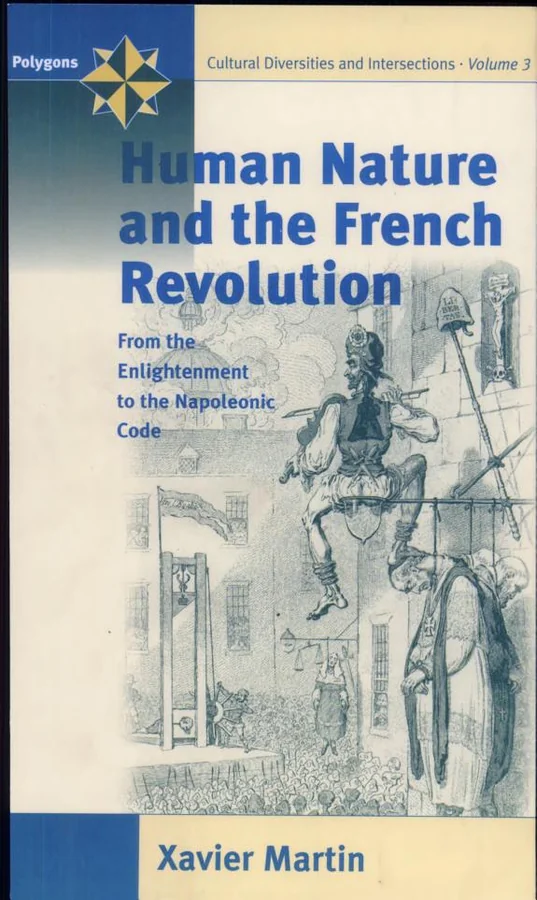
Human Nature and the French Revolution
 77
77

Human Nature and the French Revolution
Xavier Martin's meticulous excavation of the revolutionary conception of man is a formidable undertaking. The book excels in demonstrating that the 'official' discourse of the Revolution, often presented as monolithic, masked a spectrum of deeply divergent views on human nature. Martin’s strength lies in his legal historian’s precision, tracing these ideas through legislative texts and Enlightenment philosophy, particularly the tension between natural rights and the perceived need for societal re-education. A particularly striking aspect is his analysis of how the Napoleonic Code, far from resolving these tensions, codified certain pragmatic, and at times pessimistic, views of human behavior. The work's limitation, however, is its density; the sheer volume of legal and philosophical detail can make it challenging for a non-specialist to fully absorb. The exploration of how the revolutionary state viewed man as fundamentally improvable through external structures, as opposed to inherent virtue, is a crucial takeaway.
This is essential reading for anyone seeking a nuanced understanding of the Revolution's intellectual architecture.
📝 Description
77
### What It Is Xavier Martin's "Human Nature and the French Revolution" examines the foundational concept of 'man' that underpinned the revolutionary ideology. It moves beyond the official pronouncements to uncover the varied and often contradictory views of human nature circulating during the Enlightenment and into the Napoleonic era. The work highlights how these diverse perspectives influenced legislation and societal reconstruction.
### Who It's For This book is for scholars of the French Revolution, legal historians, and those interested in the philosophical underpinnings of political movements. It will also appeal to readers of esoteric thought who seek to understand how prevailing ideas about humanity shape historical events and legal codes, particularly those interested in the Enlightenment's impact on Western thought.
### Historical Context The study is situated within the intellectual ferment of the Enlightenment and the subsequent French Revolution, a period marked by radical shifts in political and social thought. Martin's research engages with figures and ideas prevalent from the mid-18th century through the early 19th century, including the codification of law under Napoleon. The work implicitly contrasts with the more unified, abstract 'Rights of Man' discourse championed by figures like Robespierre, revealing a more fragmented intellectual landscape.
### Key Concepts The central inquiry revolves around the dissonance between the proclaimed universalism of revolutionary ideals and the specific, often conflicting, anthropological assumptions held by its proponents and the legal system that emerged. Martin traces how these notions of 'man'—sometimes natural, sometimes corrupted, sometimes malleable—were inscribed into law and governance, impacting the trajectory of post-revolutionary France and its legal frameworks.
💡 Why Read This Book?
• Gain a granular understanding of the varied anthropological assumptions driving revolutionary legislation, moving beyond abstract ideals. Specifically, examine Martin's analysis of the shift in legal thinking from the Enlightenment salons to the Napoleonic Code. • Uncover how differing views of human nature—such as man as inherently good versus man as inherently corruptible—were translated into concrete laws and societal structures after 1789. • Appreciate the intellectual lineage that informed the French Revolution, tracing concepts from Enlightenment philosophers to the legal codifications of the early 19th century, revealing the complexity behind the 'Rights of Man'.
⭐ Reader Reviews
Honest opinions from readers who have explored this book.
❓ Frequently Asked Questions
What specific Enlightenment thinkers does Xavier Martin reference regarding human nature?
Xavier Martin frequently references thinkers from the Enlightenment era, though the book focuses more on how their ideas were interpreted and applied during the Revolution and Napoleonic period. The work explores how concepts of natural law and human perfectibility, discussed by figures like Rousseau, were contested and re-formed.
How did the Napoleonic Code reflect differing views of human nature?
The Napoleonic Code, published in 1804, is shown to reflect a more pragmatic and sometimes pessimistic view of human nature compared to earlier revolutionary ideals. Martin illustrates how it codified certain aspects of social control and property rights, assuming a degree of self-interest and the need for clear legal boundaries.
Is 'Human Nature and the French Revolution' a primary source document?
No, 'Human Nature and the French Revolution' by Xavier Martin is a secondary source, a historical and legal analysis published in 2003. It interprets and synthesizes primary documents and philosophical writings from the period of the French Revolution and the Enlightenment.
What is the 'official' revolutionary discourse Martin contrasts with other views?
The 'official' revolutionary discourse refers to the widely proclaimed ideals of liberty, equality, and fraternity, often articulated through documents like the Declaration of the Rights of Man and of the Citizen (1789). Martin contrasts this with the less unified, sometimes conflicting, anthropological assumptions present in less public writings and legal deliberations.
Does the book discuss the role of religion in shaping views of human nature during the Revolution?
While the primary focus is on legal and philosophical conceptions of man, the work implicitly addresses the Revolution's attempt to replace traditional religious frameworks with secular ones. The secularization of society and the state's role in moral education are examined as part of the revolutionary project.
What is the primary methodology Xavier Martin employs?
Xavier Martin employs a legal historical methodology. He meticulously examines legal texts, legislative debates, philosophical treatises, and other contemporary documents from the Enlightenment and Revolutionary periods to reconstruct the prevailing and competing conceptions of human nature.
🔮 Key Themes & Symbolism
The Malleable vs. the Natural Man
This theme explores the dichotomy present during the French Revolution regarding human essence. Was man inherently good, requiring liberation, or inherently flawed, needing reform and strict governance? Martin traces how these competing anthropologies manifested in legal codes and revolutionary policies. The 'natural man' concept, rooted in Enlightenment ideals of inherent rights, clashed with views of man as a product of his environment, thus requiring a 'republican' education or even coercion to align with the new social order.
Legality as a Reflection of Anthropology
The work argues that legal systems are not neutral but deeply embed specific assumptions about human behavior and potential. Martin demonstrates how the revolutionary and Napoleonic legal frameworks were constructed upon particular visions of human nature. This includes ideas about property rights, family law, and criminal justice, each reflecting whether man was seen as primarily rational, self-interested, social, or prone to vice, thereby shaping the very structure of society.
Enlightenment Anthropology and Revolutionary Practice
This theme investigates the transmission and transformation of Enlightenment philosophical ideas about human nature into the practical, often brutal, realities of the French Revolution. Martin scrutinizes how abstract concepts concerning human perfectibility, natural rights, and the social contract were interpreted and implemented, leading to divergent legal and political outcomes. The analysis reveals a significant gap between theoretical ideals and their application in law and governance.
The 'Official' vs. the Unspoken Human Nature
Martin highlights the discrepancy between the publicly declared egalitarian and humanist principles of the Revolution and the more varied, often less optimistic, conceptions of humanity found in private writings, legal commentaries, and subsequent codifications. This theme underscores how the Revolution's self-representation obscured a more complex intellectual landscape where differing views on human capacity and motivation coexisted and competed for influence.
💬 Memorable Quotes
“There is no unified view of man within the revolutionary discourse.”
— This core assertion suggests that the French Revolution, often perceived as having a singular ideology regarding humanity, was in fact characterized by internal debates and conflicting perspectives on what constituted human nature.
“The Enlightenment provided a spectrum of anthropological ideas, not a single doctrine.”
— This highlights that the intellectual foundations of the Revolution were diverse, drawing from various philosophers with differing views on human potential, reason, and society, which complicates any monolithic interpretation of the era's thought.
“Legal codes reveal unspoken assumptions about human behavior.”
— This points to the idea that laws are not merely technical rules but are imbued with implicit beliefs about how people act, what motivates them, and what societal structures are necessary to manage them, serving as a window into the era's anthropology.
“The Napoleonic Code integrated pragmatic, sometimes pessimistic, views of man.”
— This suggests that the post-revolutionary legal framework, as codified under Napoleon, moved away from purely idealistic notions, incorporating more realistic or even cynical perspectives on human motivations and the need for order and control.
“The 'Rights of Man' question is rarely raised in its anthropological dimension.”
— This observation implies a critical oversight in historical and philosophical discussions of the Revolution, arguing that a deeper examination of the underlying views of human nature is crucial for understanding the Revolution's true character and legacy.
🌙 Esoteric Significance
Tradition
While not explicitly aligned with a single esoteric tradition, Martin's work touches upon themes resonant with Gnostic and Hermetic thought concerning the inherent nature of humanity and its potential for both corruption and liberation. The exploration of a 'fallen' or 'unformed' human state, contrasted with ideals of perfection or natural law, echoes dualistic frameworks found in various esoteric lineages. His work can be seen as analyzing the secularized, philosophical expressions of these ancient concerns within a pivotal historical moment.
Symbolism
The 'Rights of Man' itself can be interpreted as a secularized symbol for inherent divine or natural potential, a concept explored in Hermeticism's focus on human divinity. The revolutionary act of 're-making' man and society mirrors alchemical processes of transformation and purification. The contrast between the 'natural' individual and the 'social' or 'reformed' individual speaks to the tension between the unmanifest potential (the divine spark) and its manifestation in the material world, subject to societal and karmic laws.
Modern Relevance
Contemporary discussions in transhumanism, consciousness studies, and critical theory often grapple with evolving definitions of 'human nature,' making Martin's historical analysis highly relevant. Thinkers exploring the intersection of technology and humanity, or those re-examining the philosophical underpinnings of social justice movements, can find valuable context in his work. It informs debates on whether societal structures or inherent qualities define human potential and limits.
👥 Who Should Read This Book
• Students of French history and the Enlightenment seeking to understand the philosophical underpinnings of revolutionary change beyond political narratives. • Scholars of legal history interested in how conceptions of human nature shape legal frameworks and jurisprudence, particularly during periods of radical societal transformation. • Readers of esoteric philosophy who wish to trace the historical secularization and reinterpretation of ancient questions about human essence within Western political thought.
📜 Historical Context
Published in 2003, Xavier Martin's work engages directly with the intellectual currents surrounding the French Revolution (1789-1799) and the subsequent Napoleonic era. This period was defined by radical shifts in political philosophy, challenging monarchical and religious authority with Enlightenment ideals of reason, liberty, and popular sovereignty. Martin’s analysis situates itself against the backdrop of thinkers like Rousseau and Montesquieu, whose ideas on human nature and society were both foundational and contested. The book implicitly addresses the legacy of the Declaration of the Rights of Man and of the Citizen (1789), questioning the coherence of the human nature presumed by its universalist claims. It notably engages with the legal and administrative codifications that followed, particularly the Napoleonic Code of 1804, which sought to establish order after revolutionary upheaval. While not explicitly detailing reception, Martin's work serves as a critical re-examination, challenging simpler narratives of revolutionary thought, particularly those focusing solely on abstract rights without considering the underlying anthropological assumptions.
📔 Journal Prompts
The tension between the 'natural man' and the 'reformed man' in revolutionary legislation.
How did the specific anthropological assumptions identified by Martin influence the Napoleonic Code?
Reflect on the 'official' revolutionary discourse versus unspoken anthropological views.
Compare the concept of human perfectibility in Enlightenment thought with its revolutionary application.
Analyze the role of law as a medium for expressing and enforcing views on human nature.
🗂️ Glossary
Anthropology (Philosophical)
In this context, refers to the philosophical study of the nature of human beings, their fundamental characteristics, and their place in the universe, rather than the biological or cultural study of humanity.
Declaration of the Rights of Man and of the Citizen
A fundamental document of the French Revolution, adopted in 1789, proclaiming universal rights for all citizens. Martin examines the underlying assumptions about 'man' upon which this declaration was based.
Napoleonic Code
The French Civil Code established in 1804 under Napoleon Bonaparte. It synthesized various legal traditions and reflected prevailing views on property, family, and individual rights, often pragmatic and less idealistic than earlier revolutionary pronouncements.
Official Revolutionary Discourse
Refers to the publicly proclaimed ideals, slogans, and justifications used by the leaders and institutions of the French Revolution, often emphasizing liberty, equality, and fraternity.
Natural Rights
Philosophical concept, prominent in the Enlightenment, asserting that individuals possess certain inherent rights (like life, liberty, property) not granted by governments but by nature or God, which governments cannot legitimately infringe upon.
Human Perfectibility
The idea, popular during the Enlightenment, that human beings and society can be improved indefinitely through reason, education, and social reform.
Legal History
The academic study of how laws and legal systems have evolved over time, examining their social, political, and intellectual contexts.