All My Relatives
 74
74

All My Relatives
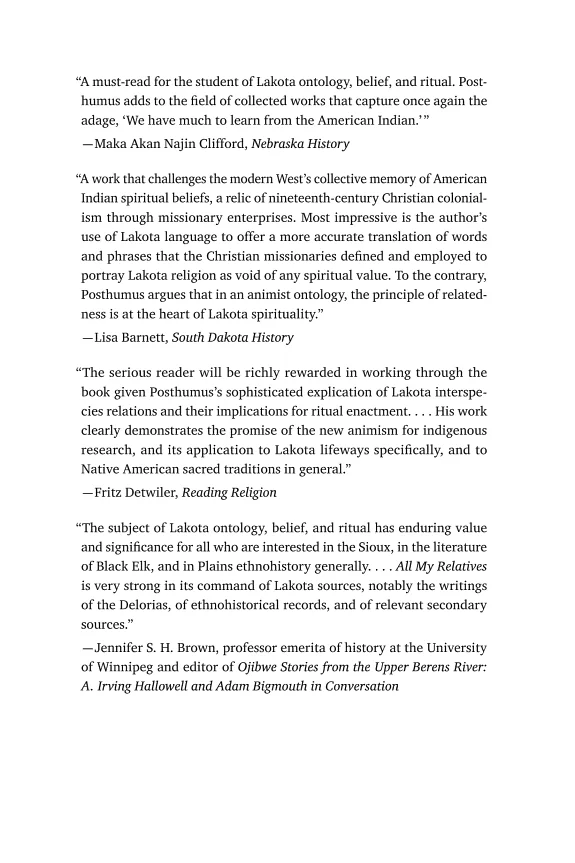
David Posthumus’s *All My Relatives* offers a compelling, albeit dense, re-evaluation of North American Indigenous cultures through an animist lens. The book’s central thesis—that an expanded notion of personhood, encompassing more-than-human beings, is crucial for understanding Lakota ethnography—is rigorously argued. Posthumus successfully challenges the reader to move beyond anthropocentric biases that have long clouded anthropological interpretations. A particular strength lies in his meticulous deconstruction of earlier ethnographic accounts, revealing how a more relational ontology could have illuminated their subjects more accurately. However, the dense theoretical apparatus can sometimes obscure the very cultures it seeks to illuminate, demanding significant reader investment. The exploration of the concept of "relatives" as extending beyond kinship to encompass the natural world is a potent example of the book’s interpretive power. Ultimately, *All My Relatives* is a significant, if challenging, contribution to Indigenous studies and the philosophy of animism.
📝 Description
74
### What It Is
*All My Relatives* by David Posthumus, first published in 2022, is an academic exploration of animist frameworks as applied to North American Indigenous cultures, particularly Lakota ethnography. The book argues for an expanded understanding of personhood to bridge gaps in interpreting historical and cultural records. It utilizes anthropological and philosophical lenses to re-examine existing scholarship and present new interpretive possibilities for understanding Indigenous worldviews and practices. The work aims to offer a more holistic and interconnected perspective than traditional Western analytical methods might allow.
### Who It's For
This book is intended for scholars and students of anthropology, religious studies, Indigenous studies, and philosophy of mind. It will also appeal to readers interested in animism, comparative ethnography, and critical theory concerning the representation of non-Western cultures. Those seeking to understand the philosophical underpinnings of Indigenous cosmologies and how they differ from Western paradigms will find value here. It requires a degree of academic engagement and a willingness to grapple with complex theoretical concepts.
### Historical Context
The early 21st century has seen a resurgence of interest in animism and Indigenous epistemologies within academic circles, partly as a response to perceived limitations in post-structuralist and materialist frameworks. Posthumus's work emerges within this context, building on earlier scholarship by figures like Viveiros de Castro and Descola, who also challenged Western ontological assumptions. The book engages with the ongoing discourse surrounding Indigenous self-determination and the ethical considerations of interpreting and representing cultural knowledge, particularly in the context of colonial histories and the post-2000 academic landscape.
### Key Concepts
Central to *All My Relatives* is the concept of an expanded "personhood," moving beyond anthropocentric definitions to include non-human entities and natural phenomena. This animist framework posits that these entities possess agency and social relations, mirroring human social structures. The book also examines "Lakota ethnography," reinterpreting existing ethnographic data through this expanded lens. It explores how this approach can illuminate previously obscure or disconnected aspects of Lakota spiritual and social life, suggesting that a relational understanding is key to unlocking deeper meaning in cultural practices and historical accounts.
💡 Why Read This Book?
• Understand how an expanded concept of "personhood" radically alters the interpretation of Indigenous cultures, as demonstrated by Posthumus's re-analysis of Lakota ethnography. • Gain insight into the philosophical currents of the early 21st century, particularly the academic resurgence of animism as a counterpoint to Western materialism. • Discover how specific ethnographic data, when viewed through an animist framework, can reveal interconnectedness in Lakota spiritual and social life previously obscured by traditional analytical methods.
⭐ Reader Reviews
Honest opinions from readers who have explored this book.
❓ Frequently Asked Questions
What is the core argument of 'All My Relatives' regarding animism?
The book argues that applying an animist framework, which recognizes non-human entities as possessing personhood and agency, is essential for a deeper understanding of North American Indigenous cultures, particularly Lakota ethnography.
When was 'All My Relatives' first published?
David Posthumus's 'All My Relatives' was first published in May 2022.
Which specific Indigenous culture does the book focus on?
While exploring broader animist principles, the book specifically uses Lakota ethnography as a primary case study to demonstrate its theoretical framework.
What is the significance of 'expanded personhood' in the book?
It refers to a philosophical concept that extends the idea of 'person' beyond humans to include animals, plants, and even natural phenomena, positing they have social relationships and agency.
What academic fields would find 'All My Relatives' most relevant?
The book is highly relevant for scholars and students in anthropology, Indigenous studies, religious studies, philosophy of mind, and comparative ethnography.
Does the book offer practical applications of animist beliefs?
While primarily theoretical, the book demonstrates how an animist perspective can offer new interpretive frameworks for understanding existing ethnographic data and cultural practices.
🔮 Key Themes & Symbolism
Expanded Personhood
The concept of expanded personhood is central, proposing that 'persons' are not limited to humans but include a wide array of non-human entities—animals, plants, and natural forces. This challenges Western anthropocentrism, suggesting that these entities possess agency, consciousness, and engage in social relations. By adopting this animist perspective, Posthumus argues, we can unlock deeper understandings of Indigenous cosmologies, where the distinction between the human and non-human is fluid and relational. This framework reinterprets ethnographic data, revealing interconnectedness previously missed by conventional analyses.
Animist Frameworks
This theme explores the theoretical underpinnings and practical applications of animism as an interpretive tool for understanding cultural and historical phenomena. Posthumus positions animism not merely as a belief system but as a distinct ontological framework that offers an alternative to Western rationalism and materialism. The book demonstrates how this framework can bridge disparate elements of Lakota ethnography, revealing patterns and meanings that are inaccessible through standard analytical approaches. It highlights animism's capacity to foster a more holistic and interconnected worldview.
Lakota Ethnography Reimagined
The book revisits existing ethnographic records of the Lakota people, seeking to reinterpret them through the lens of animist philosophy and expanded personhood. Posthumus critically examines how previous scholarly approaches, often rooted in Western assumptions, may have misinterpreted or overlooked key aspects of Lakota life and belief. By applying his animist framework, he aims to provide a more accurate and respectful representation, revealing the sophistication and depth of Lakota worldviews and their intricate social and spiritual relationships with the non-human world.
Interconnectedness and Relation
A core tenet explored is the fundamental interconnectedness of all beings and phenomena within an animist worldview. The concept of 'relatives' is expanded to encompass the entire living world, emphasizing reciprocal relationships and mutual influence. This perspective challenges notions of isolation and autonomy, suggesting instead a dynamic web of kinship and interaction that defines existence. The book argues that recognizing this profound interconnectedness is crucial for appreciating the holistic nature of Indigenous cultures and their ecological consciousness.
💬 Memorable Quotes
“An expanded notion of personhood serves to connect otherwise disparate and inaccessible elements of Lakota ethnography.”
— This highlights the book's central thesis: that by broadening our definition of 'person' to include non-human entities, we can establish connections and uncover meanings within Lakota cultural practices that have remained obscure due to conventional, human-centered analytical approaches.
“The significance of a new animist framework for understanding North American indigenous culture and history.”
— This statement emphasizes the transformative potential of animism not just as a belief system, but as a fundamental interpretive lens capable of reshaping our comprehension of Indigenous pasts and presents.
“The work explores how non-human entities possess agency and social relations.”
— This points to the book's exploration of animist ontology, where the agency and social lives of animals, plants, and natural phenomena are considered as real and significant as those of humans.
“Reinterpreting ethnographic data through a relational understanding.”
— This suggests a methodological approach where existing anthropological records are re-examined, prioritizing the interconnectedness and reciprocal relationships between humans and the wider natural world.
“Bridging gaps in the interpretation of historical and cultural records.”
— This conveys the book's aim to resolve analytical challenges and fill lacunae in our understanding of Indigenous cultures by employing a novel theoretical perspective.
🌙 Esoteric Significance
Tradition
While not strictly belonging to a single Western esoteric lineage like Hermeticism or Kabbalah, *All My Relatives* intersects with modern esoteric interests in animism, pantheism, and Indigenous spiritualities. It draws from anthropological theory but resonates with esoteric traditions that emphasize the immanence of spirit in nature and the interconnectedness of all life, moving away from purely transcendent or materialist views of reality.
Symbolism
The primary symbolic concept is the 'relative,' extended beyond human kinship to encompass all of nature—animals, plants, landforms, and elements. This symbolic expansion challenges the human/nature binary. Another motif is the notion of 'personhood' itself, which becomes a symbolic key to unlocking deeper layers of meaning in Indigenous cosmologies, representing agency and sociality attributed to the non-human.
Modern Relevance
Contemporary thinkers and practitioners in fields such as ecopsychology, deep ecology, and certain strands of neo-paganism and animistic resurgence draw upon the theoretical groundwork laid by scholars like Posthumus. The book's emphasis on relationality and expanded personhood informs modern discussions on environmental ethics, interspecies communication, and the philosophical underpinnings of decolonial movements seeking to reintegrate human experience with the natural world.
👥 Who Should Read This Book
• Anthropologists and ethnographers seeking new theoretical frameworks for understanding Indigenous cultures beyond Western paradigms. • Philosophers of mind and religion interested in non-Western ontologies, animism, and critiques of anthropocentrism. • Students and researchers in Indigenous Studies aiming to engage with contemporary academic reinterpretations of cultural and historical data.
📜 Historical Context
Published in 2022, *All My Relatives* arrives during a period of heightened academic attention to Indigenous epistemologies and a critical reassessment of Western ontological assumptions. The early 21st century saw scholars like Eduardo Viveiros de Castro and Philippe Descola gaining prominence for their work on perspectivism and animism, challenging Eurocentric notions of nature and culture. Posthumus’s book engages with this intellectual milieu, proposing animism as a vital framework for reinterpreting Indigenous cultures, particularly the extensive ethnographic records of the Lakota. This work emerges within a broader post-2000 trend of decolonizing academic disciplines and centering Indigenous voices and knowledge systems. It implicitly critiques earlier anthropological approaches that, while sometimes well-intentioned, often operated within colonial frameworks and failed to fully grasp the relational cosmologies they documented.
📔 Journal Prompts
The concept of expanded personhood and its implications for your relationship with the non-human world.
Reflecting on specific instances in Lakota ethnography that might be reinterpreted through an animist lens.
How does the idea of 'relatives' extending to the natural world challenge conventional social boundaries?
Identifying symbols of agency and social relation in your local environment.
The ethical considerations of representing non-Western cultural or spiritual frameworks.
🗂️ Glossary
Animism
A worldview or belief system in which natural objects, phenomena, and the universe itself possess souls or consciousness, and are credited with agency and social relations comparable to humans.
Personhood
In the context of this book, an expanded philosophical concept referring to the state or fact of being a person, extended beyond humans to include non-human entities recognized as having agency, consciousness, and social roles.
Lakota Ethnography
The body of written accounts, studies, and descriptions concerning the culture, history, and social practices of the Lakota people, analyzed here through an animist framework.
Ontology
The philosophical study of being; the nature of existence. In this book, it refers to different ways of understanding reality and what constitutes 'being'.
Anthropocentrism
The belief that human beings are the central or most significant entities in the universe; an anthropocentric bias often colors Western interpretations of non-human phenomena.
Relationality
The quality or state of being related or interconnected; emphasizing the importance of relationships and interactions between entities in defining their existence and meaning.
Epistemology
The theory of knowledge, especially with regard to its methods, validity, and scope. Epistemology is the investigation of what distinguishes justified belief from opinion.