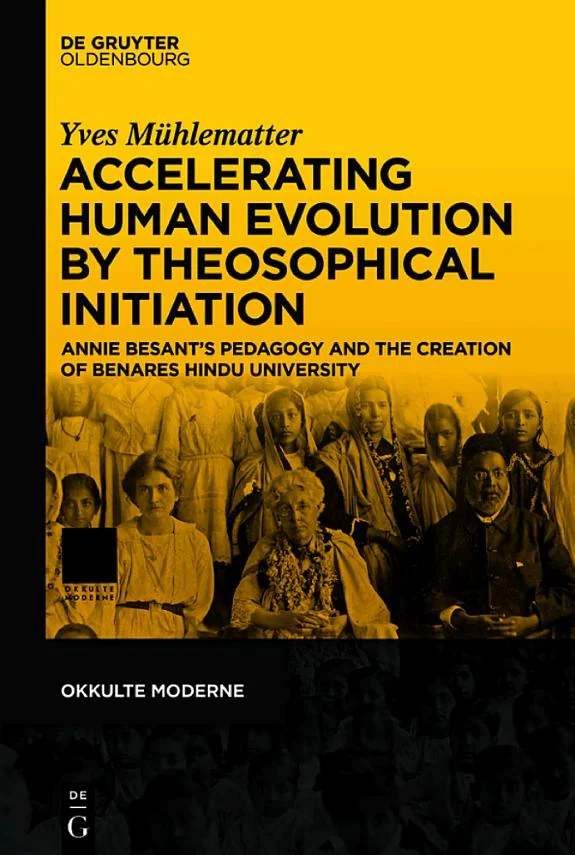
Accelerating Human Evolution by Theosophical Initiation
 76
76

Accelerating Human Evolution by Theosophical Initiation
Mühlematter's "Accelerating Human Evolution by Theosophical Initiation" offers a rigorous examination of the Theosophical path, moving beyond hagiography to critical analysis. The strength lies in its detailed breakdown of initiatory stages and their corresponding virtues, linking them directly to an evolutionary framework. A notable limitation, however, is the dense academic prose, which may challenge readers not already steeped in Theosophical literature. The author's exploration of the "hybridization processes" in translating Hindu traditions into Theosophy, particularly concerning the concept of *dhyana* (meditation) as adapted by figures like H.P. Blavatsky, is particularly insightful. The work provides a valuable, if demanding, perspective on a complex esoteric system. It serves as a focused study for dedicated Theosophists.
📝 Description
76
### What It Is Yves Mühlematter's "Accelerating Human Evolution by Theosophical Initiation" scrutinizes the foundational stages of spiritual development as outlined within the Theosophical tradition. The work meticulously examines how individual virtues align with evolutionary progress, proposing a model for self-directed spiritual advancement. It posits that these initiatory steps are not merely abstract concepts but practical markers on a path toward higher consciousness.
### Who It's For This book is intended for serious students of Theosophy and comparative spirituality. It appeals to those seeking a deeper understanding of the evolutionary arc described by Helena Blavatsky and her successors. Readers interested in the intersection of Eastern religious thought and Western esoteric philosophy will find substantial material for contemplation and study.
### Historical Context Mühlematter's analysis places the Theosophical initiatory system within its historical milieu, particularly the late 19th and early 20th centuries. The work explores the intellectual climate that fostered such syncretic movements, acknowledging the significant "hybridization processes" involved in translating Hindu concepts into Theosophical frameworks. This period saw a surge in interest in Eastern religions, often filtered through Western philosophical lenses.
### Key Concepts The core of the book revolves around the concept of initiation as a structured process within the grand evolutionary scheme. It emphasizes the role of specific virtues as catalysts for progression through these stages. Mühlematter also details the intricate connections and adaptations made when integrating elements from Hindu scriptures and philosophies into the Theosophical lexicon and cosmology.
💡 Why Read This Book?
• Understand the Theosophical model of spiritual evolution: Learn how Mühlematter connects specific virtues to distinct stages of initiation, as detailed in the text. • Analyze the cross-cultural transmission of esoteric ideas: Gain insight into the "hybridization processes" Mühlematter describes, illustrating how Hindu concepts were adapted within the Theosophical tradition. • Grasp the practical application of Theosophical principles: Discover how the stages of initiation are presented not as abstract ideals but as actionable steps for personal spiritual growth, as outlined by the author.
⭐ Reader Reviews
Honest opinions from readers who have explored this book.
❓ Frequently Asked Questions
What is the primary focus of Yves Mühlematter's book on Theosophical initiation?
The book primarily analyzes the stages of initiation within the Theosophical framework, linking them to individual virtues and a concept of evolutionary self-development. It examines how these stages were adapted from Hindu traditions.
When was "Accelerating Human Evolution by Theosophical Initiation" first published?
The book was first published on December 19, 2022, making it a contemporary contribution to Theosophical scholarship.
What does the book mean by "hybridization processes"?
Mühlematter uses "hybridization processes" to describe how elements from the Hindu tradition, such as concepts of spiritual development and initiation, were adapted and integrated into the Theosophical system by its founders and proponents.
Who would benefit most from reading this book?
Students of Theosophy, comparative religion scholars, and individuals interested in the evolution of esoteric thought, particularly the intersection of Eastern and Western spiritual philosophies, will find this work valuable.
Does the book offer practical advice for spiritual development?
While primarily analytical, the book's examination of initiatory stages and virtues provides a conceptual framework for self-development within the Theosophical context, suggesting a path for conscious evolution.
What is the author's approach to Theosophy?
Yves Mühlematter takes an analytical and scholarly approach, examining the structure and historical influences of Theosophical doctrines, particularly regarding initiation and its roots in Hindu thought.
🔮 Key Themes & Symbolism
Initiatory Stages
The book dissects the sequential steps of initiation as conceptualized within Theosophy. These stages are presented not as arbitrary milestones but as integral components of a cosmic evolutionary plan for humanity. Mühlematter explores how each stage corresponds to a specific phase of spiritual maturation and the cultivation of particular virtues necessary for advancement.
Virtues and Evolution
A central tenet is the role of individual virtues in facilitating human evolution. The work posits that specific virtues are cultivated and demonstrated at each initiatory level, acting as the energetic and ethical keys to unlocking higher states of consciousness. This concept aligns with the Theosophical emphasis on moral and spiritual discipline.
Hindu-Theosophical Hybridization
Mühlematter critically examines the "hybridization processes" through which Hindu philosophical and religious concepts were adapted into the Theosophical system. This includes analyzing how ideas about spiritual progression, yoga, and enlightenment from Indian traditions were reinterpreted and integrated by early Theosophists, often through the lens of Western metaphysics.
Self-Development Path
The book frames Theosophical initiation as a path of conscious, evolutionary self-development. It suggests that by understanding and actively engaging with the principles of initiation and virtue, individuals can accelerate their own spiritual growth and contribute to the broader evolution of human consciousness, as envisioned by Theosophical doctrine.
💬 Memorable Quotes
“Initiatory steps are connected to an idea of evolutionary self-development by means of a set of virtues.”
— This core idea highlights the book's thesis: spiritual progress is structured and tied to ethical cultivation. It suggests initiation is not passive but an active process of building character to match evolutionary stages.
“These stages were translated from the 'Hindu' tradition to the 'Theosophical' tradition through multifaceted 'hybridization processes'.”
— This points to the book's focus on intellectual history and syncretism. It emphasizes that Theosophy borrowed and transformed concepts, creating a unique synthesis rather than a direct replication of Eastern philosophies.
“The main subjects of analysis... are the stages of initiation in the grand scheme of Theosophical evolution.”
— This clearly states the book's analytical intent: to deconstruct the Theosophical doctrine of spiritual advancement and its place within a larger cosmic developmental narrative.
“Virtues that are relative to the individual’s position on the path of evolution.”
— This suggests a dynamic and individualized approach to spiritual ethics. It implies that the virtues required change as one progresses, adapting to the evolving consciousness and challenges faced.
“Multifaceted 'hybridization processes' in which several Indian members...”
— This highlights the critical role of Indian thinkers in shaping Theosophy. It moves beyond a solely Western-centric view, acknowledging the complex cultural exchange and contributions from Indian members.
🌙 Esoteric Significance
Tradition
This work is firmly rooted in the Theosophical tradition, tracing its lineage back to Helena Blavatsky and the foundational texts of the Theosophical Society. It engages with the specific cosmology and evolutionary theories developed within this lineage, particularly concerning the stages of human spiritual development. While drawing heavily on Hindu concepts, Mühlematter's analysis focuses on how these were transmuted and systematized within the distinct Theosophical structure, differentiating it from direct adherence to Vedanta or Yoga.
Symbolism
The book implicitly engages with symbols of spiritual ascent and transformation inherent in initiatory traditions. While specific symbols aren't detailed in the blurb, the concept of 'stages' itself functions symbolically, representing hierarchical levels of consciousness and attainment. Virtues like compassion, wisdom, and detachment can also be seen as symbolic markers of progress on the spiritual path within this framework.
Modern Relevance
Contemporary esoteric practitioners and scholars interested in comparative spirituality find Mühlematter's work valuable for understanding the historical development and structural logic of Theosophical initiatory systems. Thinkers in New Age spirituality and Integral Theory, which often explore evolutionary models of consciousness, may find resonance with the book's emphasis on self-development and structured progression, even if they do not strictly adhere to Theosophy.
👥 Who Should Read This Book
• Students of Theosophy seeking a structured analysis of its initiatory doctrines and historical influences. • Comparative religion scholars interested in the syncretic nature of esoteric movements and the transmission of Eastern ideas to the West. • Practitioners of spiritual development looking to understand evolutionary models of consciousness rooted in esoteric traditions.
📜 Historical Context
Yves Mühlematter's work emerges from a scholarly interest in the late 19th and early 20th centuries, a period marked by intense cross-cultural spiritual exchange. Theosophy, founded in 1875 by Helena Blavatsky, was a significant force in this milieu, attempting to synthesize Eastern and Western esoteric traditions. Mühlematter's analysis of "hybridization processes" directly addresses how concepts from Hinduism, particularly regarding spiritual progression and initiation, were integrated into the Theosophical framework. This occurred alongside parallel movements like the Ramakrishna Mission's engagement with the West. The book implicitly engages with the legacy of figures like Annie Besant and C.W. Leadbeater, who further developed Theosophical doctrines. While not widely censored, Theosophy faced considerable skepticism and critique from both religious and scientific establishments of its time.
📔 Journal Prompts
The "hybridization processes" described in the book, what specific Hindu concepts do you see most clearly adapted?
Reflect on the connection between virtues and evolutionary stages presented by Mühlematter.
How does the concept of 'self-development' in Theosophy compare to other spiritual paths you know?
Consider the 'grand scheme of Theosophical evolution' – what elements of this scheme are most compelling to you?
Analyze the role of 'initiation' as a structured process within the context of human spiritual growth.
🗂️ Glossary
Theosophy
A spiritual movement founded in the late 19th century, seeking to understand the underlying principles of all religions and philosophies, particularly emphasizing esoteric knowledge and the evolution of consciousness.
Initiation
In esoteric traditions, a ritual or process marking a transition to a new level of spiritual knowledge, consciousness, or responsibility within a hierarchical structure.
Evolutionary Self-Development
The concept that individuals consciously participate in and accelerate their own spiritual and consciousness growth, aligning with a broader cosmic evolutionary trajectory.
Hybridization Processes
The term used by Mühlematter to describe the complex ways in which ideas, symbols, and practices from one tradition (e.g., Hindu) are blended, adapted, and integrated into another (e.g., Theosophical).
Virtues
Moral qualities or positive character traits (e.g., compassion, wisdom, integrity) considered essential for spiritual progress and ethical living within various philosophical and religious systems.
Hindu Tradition
A broad term encompassing the diverse religious, philosophical, and cultural practices originating in the Indian subcontinent, including concepts of karma, reincarnation, and spiritual liberation.
Stages of Initiation
The distinct levels or phases of spiritual advancement within a specific esoteric system, each characterized by specific tests, knowledge, and attained virtues.