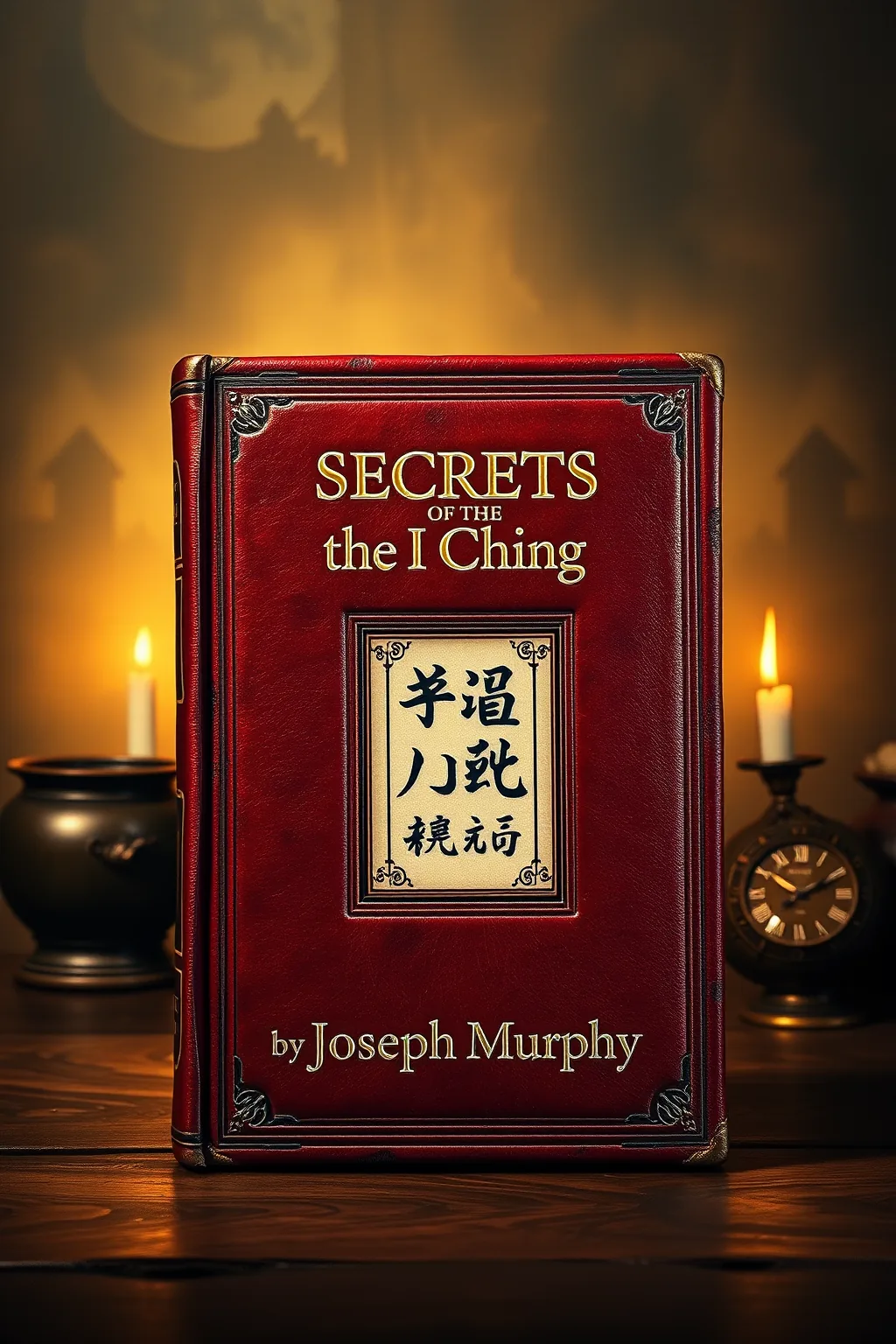
Secrets of the I Ching
 82
82

Secrets of the I Ching
Joseph Murphy's "Secrets of the I Ching" attempts to bridge the ancient Chinese oracle with his familiar brand of mind-over-matter philosophy. The strength of the work lies in its accessibility; Murphy's prose, while dated, renders the complex hexagram system digestible for those already attuned to his metaphysical outlook. He frames the I Ching not as fate, but as a mirror reflecting the consequences of one's mental and spiritual state, a perspective that can be empowering. However, this very framing can feel like a constraint. The book's interpretation of specific hexagrams, such as the "Judgment" or "Image" sections, often feels secondary to the overarching message of mental control. A particular passage that might illustrate this is his likely interpretation of Hexagram 1, Qian (The Creative), focusing on the active, creative power of the mind rather than its traditional associations with heaven and masculine energy in a broader cosmological sense. While offering a unique angle, "Secrets of the I Ching" may leave those seeking a more traditional or textually rigorous engagement with the oracle wanting more. It is a valuable entry for Murphy enthusiasts, but less so for I Ching purists.
📝 Description
82
### What It Is Joseph Murphy's "Secrets of the I Ching" offers a methodical exploration of the ancient Chinese divination system, the I Ching (Book of Changes). Originally published in 1978, this work presents the hexagrams and their interpretations through a lens that seeks to align their wisdom with principles of spiritual and mental science. Murphy, known for his works on the power of the mind and subconscious, approaches the I Ching not just as a predictive tool, but as a guide to understanding universal laws and influencing one's destiny through conscious thought and spiritual alignment.
### Who It's For This book is intended for individuals interested in esoteric philosophies, comparative religion, and practical application of ancient wisdom. It appeals to those who seek a structured approach to understanding the I Ching, particularly readers familiar with Murphy's prior writings on metaphysical principles. Those looking to integrate philosophical insights with practical divination techniques will find value here, especially if they appreciate a blend of Eastern mysticism and Western psychological interpretations.
### Historical Context Published in 1978, "Secrets of the I Ching" emerged during a period of heightened interest in Eastern spirituality and esoteric studies in the West. The latter half of the 20th century saw a surge in translations and interpretations of classic texts, including the I Ching, which had been introduced to Western audiences earlier by figures like Carl Jung. Murphy's work fits into this milieu by offering an accessible, psychologically-oriented interpretation, contrasting with more purely academic or traditional Chinese philosophical readings. It followed a broader trend of popularizing complex philosophical systems for a Western audience, often through the lens of self-help and personal development.
### Key Concepts The core of Murphy's approach lies in interpreting the I Ching's sixty-four hexagrams as symbolic representations of life's dynamic forces and potential outcomes. He emphasizes the concept of mental causation, suggesting that one's thoughts and beliefs can shape reality, and the I Ching's pronouncements can be understood as reflections or guides for aligning one's mental state with favorable outcomes. The book likely delves into specific hexagrams, their constituent trigrams, and the changing lines as catalysts for personal growth and understanding, framing these ancient symbols within a framework of divine order and the power of the subconscious mind.
💡 Why Read This Book?
• Gain a unique perspective on the I Ching's hexagrams, understanding them not just as predictions but as reflections of mental causation, a concept central to Joseph Murphy's philosophy as explored in his 1978 publication. • Learn how to align your subconscious mind with the principles outlined in the I Ching's ancient wisdom, using specific hexagram interpretations to foster personal growth and influence life outcomes. • Explore the symbolic language of the I Ching through the lens of Western metaphysical thought, offering a distinct interpretative framework not commonly found in traditional Chinese commentaries or modern academic studies.
⭐ Reader Reviews
Honest opinions from readers who have explored this book.
❓ Frequently Asked Questions
What is the I Ching and how does Joseph Murphy interpret it?
The I Ching, or Book of Changes, is an ancient Chinese divination text. Joseph Murphy interprets its sixty-four hexagrams as symbolic representations of life's forces, emphasizing how one's thoughts and beliefs can shape destiny and align with universal laws, rather than mere fortune-telling.
When was Joseph Murphy's "Secrets of the I Ching" first published?
Joseph Murphy's "Secrets of the I Ching" was first published in 1978, placing it within a period of significant Western interest in Eastern philosophical and esoteric traditions.
Does this book offer traditional I Ching readings?
While it uses the I Ching's structure, Murphy's book filters interpretations through his own metaphysical and psychological theories. It focuses on mental causation and spiritual alignment, offering a unique, though not strictly traditional, approach to the text's wisdom.
Who is Joseph Murphy and what is he known for?
Joseph Murphy (1898-1981) was an Irish-American author and New Thought minister. He is widely known for his books on the power of the subconscious mind and affirmative prayer, such as "The Power of Your Subconscious Mind."
What are the 'hexagrams' mentioned in the book?
Hexagrams are the core symbols of the I Ching, each composed of six stacked horizontal lines, where each line is either 'broken' (yin) or 'solid' (yang). There are 64 unique hexagrams, representing different states and transformations of existence.
Is this book suitable for beginners to the I Ching?
It can be suitable for beginners who are also interested in metaphysical concepts and the power of the mind. However, readers seeking purely traditional interpretations might find Murphy's approach distinct from standard commentaries.
🔮 Key Themes & Symbolism
Mental Causation and Destiny
Murphy posits that the I Ching's pronouncements are not fixed fate but rather reflections of the individual's dominant thoughts and beliefs. The work emphasizes the power of the subconscious mind to influence outcomes, suggesting that by aligning one's mental state with the wisdom derived from the hexagrams, one can consciously shape their destiny. This interpretation transforms the oracle from a passive predictive tool into an active guide for mental and spiritual cultivation, encouraging readers to view challenges and opportunities through a lens of internal causation.
The I Ching as a Symbolic Map
Rather than treating the I Ching solely as a divinatory system, Murphy presents its 64 hexagrams as a symbolic map of life's universal principles and dynamic changes. Each hexagram, with its interlocking trigrams and changing lines, is interpreted as a stage or a facet of human experience. This perspective encourages a deeper understanding of the cyclical nature of existence and the underlying order that governs it, providing a framework for navigating life's complexities with spiritual insight and conscious awareness.
Spiritual Alignment and Harmony
A central theme is the importance of aligning one's inner state with the principles of divine order as revealed by the I Ching. Murphy suggests that understanding the messages of the hexagrams allows individuals to harmonize their thoughts, emotions, and actions with the flow of the universe. This spiritual alignment is presented as the key to overcoming obstacles, achieving success, and experiencing inner peace, framing the ancient text as a tool for achieving greater spiritual consciousness and well-being.
The Power of Affirmation
Drawing from his broader teachings, Murphy likely integrates the concept of affirmation into his interpretation of the I Ching. The book may suggest that by consciously affirming positive outcomes and the wisdom gained from specific hexagram readings, individuals can reprogram their subconscious minds and manifest desired realities. This application of New Thought principles to the ancient oracle highlights a unique synthesis, where ancient wisdom is activated through modern psychological and spiritual techniques.
💬 Memorable Quotes
“The I Ching is a guide to aligning your mind with universal law.”
— This interpretation highlights Murphy's core thesis: the ancient Chinese text is not merely for fortune-telling, but a tool for consciously directing one's mental and spiritual energy towards favorable outcomes by understanding cosmic principles.
“Your thoughts determine your reality, and the hexagrams reflect this.”
— This paraphrased concept emphasizes the principle of mental causation. It suggests that the wisdom of the I Ching serves as a mirror, revealing how one's internal mental state directly influences external circumstances and perceived destiny.
“Embrace change by understanding its patterns through the Book of Changes.”
— This interpretation focuses on the dynamic nature of the I Ching. It encourages a proactive approach to life's inevitable shifts, viewing the text as a means to comprehend and adapt to change with wisdom and foresight.
“The hexagrams offer wisdom for conscious spiritual development.”
— This statement underscores the book's focus on personal growth. It frames the I Ching's ancient symbols not just as predictive, but as pedagogical tools for advancing one's spiritual understanding and practice.
“Influence your future by harmonizing your inner state with outer wisdom.”
— This interpretation connects internal psychological work with external guidance. It suggests that by achieving a state of inner harmony informed by the I Ching's teachings, one can actively steer their life path.
🌙 Esoteric Significance
Tradition
Murphy's work positions itself within the broader Western Esoteric Tradition, particularly aligning with the New Thought movement, which emphasizes the power of the mind and spiritual laws. While the I Ching is fundamentally rooted in Chinese Taoism and Confucianism, Murphy reinterprets its principles through a lens familiar to Hermeticism and similar philosophies that explore correspondence between the macrocosm and microcosm, and the efficacy of focused consciousness.
Symbolism
The primary symbolism in "Secrets of the I Ching" revolves around the 64 hexagrams, each a combination of two trigrams. These trigrams (e.g., Heaven, Earth, Water, Fire) represent fundamental forces and concepts. Murphy likely interprets these not just cosmologically, but as psychological archetypes and states of consciousness, suggesting that understanding their interplay reveals patterns of cause and effect in both the external world and the individual's inner landscape.
Modern Relevance
Contemporary interest in the I Ching continues across various fields, from mindfulness and personal development to comparative mythology and digital humanities. Murphy's approach, emphasizing the I Ching as a tool for self-understanding and mental empowerment, resonates with modern wellness and self-help movements. Thinkers and practitioners exploring the intersection of ancient wisdom and psychological well-being might find his unique synthesis of Eastern philosophy and Western metaphysical thought particularly relevant today.
👥 Who Should Read This Book
• Students of comparative religion and philosophy interested in how Western metaphysical ideas have been applied to Eastern texts. • Practitioners of New Thought or those familiar with Joseph Murphy's other works seeking to understand his perspective on the I Ching. • Individuals exploring divination systems who are drawn to interpretations focused on psychological insights and personal empowerment rather than strict traditional methods.
📜 Historical Context
Joseph Murphy's "Secrets of the I Ching," released in 1978, emerged within a vibrant period of Western engagement with Eastern philosophies and esoteric traditions. Following the counterculture movements of the 1960s and the growing influence of figures like Alan Watts and the widespread availability of translations of texts like the Tao Te Ching, the I Ching itself had gained significant traction. Carl Jung’s earlier interest and writings on synchronicity and archetypes had also provided a psychological framework for understanding such oracular systems. Murphy's work distinguished itself by integrating the I Ching's symbolic language with the principles of New Thought and metaphysical psychology, a perspective that diverged from more traditional sinological interpretations or purely academic analyses. This era saw a proliferation of books aiming to make complex spiritual and philosophical systems accessible, often with an emphasis on self-improvement and personal empowerment, a trend Murphy's accessible prose and focus on mental causation keenly tapped into.
📔 Journal Prompts
The concept of mental causation as applied to Hexagram 1 (Qian).
Reflect on the symbolic meaning of the trigrams Heaven and Earth in your life.
How can the principles of spiritual alignment, as presented in the I Ching, guide your daily decisions?
Consider a recent challenge and how Murphy's interpretation of its corresponding hexagram might offer a new perspective.
The relationship between subconscious belief and external reality, as suggested by the I Ching.
🗂️ Glossary
I Ching
An ancient Chinese divination text, also known as the Book of Changes, comprised of 64 hexagrams used to offer wisdom and guidance on various situations and transformations.
Hexagram
A symbol composed of six stacked horizontal lines, each either solid (yang) or broken (yin). There are 64 unique hexagrams in the I Ching, representing different states and dynamics of existence.
Trigram
A symbol composed of three stacked lines, each either solid (yang) or broken (yin). The eight trigrams (e.g., Heaven, Earth, Fire, Water) are the building blocks of the hexagrams.
Yang
In the I Ching and Taoist philosophy, the active, masculine, light, and positive principle, represented by a solid line (—).
Yin
In the I Ching and Taoist philosophy, the passive, feminine, dark, and negative principle, represented by a broken line (— —).
Mental Causation
A principle, central to New Thought and Murphy's philosophy, asserting that one's thoughts and beliefs are the primary cause of their experiences and circumstances.
Subconscious Mind
The part of the mind that is not currently in focal awareness but influences thoughts, feelings, and behaviors, often seen as the seat of belief and habit.