Gambler's Dharma
 80
80

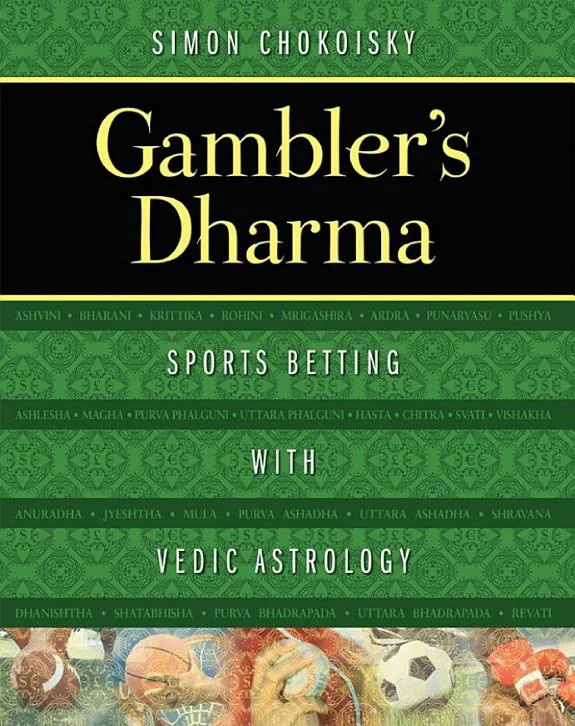
Gambler's Dharma
Simon Chokoisky's Gambler's Dharma attempts to bridge the seemingly disparate worlds of Vedic Astrology and sports betting, a niche endeavor that requires careful execution. The book succeeds in providing a structured, albeit complex, system for analyzing contests. Its strength lies in detailing specific astrological techniques, such as analyzing planetary strengths and directional influences, to assess competitor parity. The author's explanation of how to determine 'whose motivation and drive to win is strongest' through astrological charts is a compelling aspect. However, the book's primary limitation is its steep learning curve; the astrological concepts, while explained, demand a significant degree of prior knowledge or dedicated study to fully implement. A particularly insightful passage details how to interpret the 'dasha' periods of key planets relevant to competition timing. While it offers a unique lens, its practical application for the casual reader remains challenging. The work is a serious attempt to codify esoteric predictive methods for a secular pursuit.
📝 Description
80
Simon Chokoisky published Gambler's Dharma in 2017, detailing how Vedic Astrology can predict sports contest outcomes.
Gambler's Dharma presents a system for forecasting results in one-on-one sporting competitions using principles from Vedic Astrology. The book moves past general horoscopes to establish a practical framework for analyzing the forces at play in any contest. It identifies celestial influences that might give one competitor an advantage on a specific day. This work is for individuals interested in applying astrological methods to real-world situations, especially sports betting. It appeals to those seeking a structured prediction method beyond mere chance. Readers familiar with Vedic Astrology will find a new application, and newcomers can learn the necessary concepts to use the techniques.
The book outlines five specific techniques drawn from Vedic Astrology for contest analysis. These methods assess the energetic strengths, psychological drive, and karmic favor of each participant. The central idea is that astrological configurations at the time of an event can reveal hidden dynamics affecting its conclusion. It treats all birth and competition events as occurrences within space-time.
Published in 2017, Gambler's Dharma appears during a period of renewed interest in ancient predictive systems, particularly within esoteric communities. Vedic Astrology, or Jyotish, is an ancient tradition, but its application to contemporary events like sports betting is a more recent development. The book offers an alternative to statistical or psychological sports analysis, introducing a cosmological perspective on competition.
💡 Why Read This Book?
• Learn to analyze the energetic strengths of competitors using Vedic Astrology's Nakshatras, a concept not found in conventional sports analysis, offering a unique predictive edge. • Discover how to assess the psychological drive and karmic favor of athletes by examining planetary dignity and house placements, as detailed in the book's techniques. • Understand the foundational principles of Jyotish and their direct application to predicting one-on-one contests, moving beyond chance to a system rooted in ancient astrological frameworks.
⭐ Reader Reviews
Honest opinions from readers who have explored this book.
❓ Frequently Asked Questions
What are the core Vedic Astrology concepts used in Gambler's Dharma for sports betting?
The book primarily uses concepts like planetary strengths (dignity), house analysis (especially the 1st, 6th, 7th, and 10th houses), and dasha periods to assess competitor advantages and predict outcomes.
Does Gambler's Dharma require prior knowledge of Vedic Astrology?
While some familiarity is beneficial, the book outlines the basics of Vedic Astrology necessary for its application to sports betting. However, a dedicated study of Jyotish principles will enhance understanding and application.
What types of competitions are best suited for the methods in Gambler's Dharma?
The book focuses on one-on-one competitions where the strengths and weaknesses of two distinct sides can be clearly delineated through astrological analysis, such as tennis matches or boxing bouts.
How does Gambler's Dharma differ from standard sports prediction methods?
Unlike statistical or handicapping methods, Gambler's Dharma introduces an esoteric layer by analyzing celestial influences and karmic factors believed to affect the outcome of events.
When was Gambler's Dharma first published?
Gambler's Dharma by Simon Chokoisky was first published on April 24, 2017.
What are the 'five powerful techniques' mentioned in the book?
These techniques involve analyzing planetary strengths, directional influences, 'dasha' periods, the strength of the ascendant and its lord, and the influence of specific houses related to competition.
🔮 Key Themes & Symbolism
Jyotish in Contests
The work applies the intricate system of Vedic Astrology (Jyotish) to the domain of sports betting. It posits that astrological configurations at the time of a contest can reveal underlying advantages or disadvantages for competitors. This involves analyzing planetary positions, dignities, and house influences to understand the flow of cosmic energies affecting the event. The core idea is that every birth and competition is a space-time event governed by celestial mechanics, offering a predictive framework beyond mere chance or statistics.
Predictive Frameworks
Gambler's Dharma outlines five specific techniques derived from Vedic Astrology for predicting the outcome of one-on-one competitions. These methods focus on quantifying the physical strength, motivational drive, and 'fated' advantages of each side. The book moves beyond general astrological interpretations to provide actionable steps for analysis, enabling readers to forecast results based on celestial timing and planetary influences.
Astrology and Strategy
The book explores the intersection of ancient astrological wisdom and modern strategic thinking, specifically within the context of betting. It suggests that understanding the astrological 'weather' of a competition can inform betting decisions. By examining factors like planetary rulerships and aspects, readers can gain insights into when a competitor might have a celestial edge, thereby developing a more informed and potentially successful betting strategy.
Space-Time Events
A foundational concept presented is that all phenomena with a beginning and an end, including sporting contests, are fundamentally space-time events. This perspective, rooted in a cosmological understanding, implies that these events are subject to the laws and influences of the cosmos. Gambler's Dharma leverages this principle to argue that astrological timing and planetary movements offer a powerful lens through which to view and predict the unfolding of these events.
💬 Memorable Quotes
Direct passages from the work, attributed to the author.
“Everything that is born, which has a lifespan and an ending, is a space-time event. That includes contests.”
— This statement frames competition not just as a sporting match, but as a cosmic occurrence subject to astrological influences, setting the stage for the book's predictive methodology.
“Outlines 5 powerful techniques for predicting the outcome of any one-on-one competition.”
— This highlights the book's practical focus, promising specific, actionable methods derived from Vedic Astrology for analyzing and forecasting sports results.
“Details how to determine the physical strength of each side, whose motivation and drive to win is strongest, and who has fate on their side.”
— This signifies the depth of analysis offered, moving beyond superficial metrics to explore the deeper energetic, psychological, and karmic factors influencing a contest's outcome.
“Win bets on sporting events using the prediction system of Vedic Astrology.”
— This concisely states the book's primary objective: to equip readers with an astrological system designed to improve their success rate in sports betting.
“Describes the basics of Vedic Astrology and how it can be applied to sports betting.”
— This indicates the book's pedagogical approach, aiming to make the complex system of Jyotish accessible to those interested in its application to a specific practical field.
🌙 Esoteric Significance
Tradition
This work firmly resides within the Vedic Astrology (Jyotish) tradition, a complex system of divination originating in ancient India. It departs from traditional Jyotish applications focused on personal horoscopes, marriage compatibility, or auspicious timing for rituals, instead adapting its principles to analyze and predict outcomes in competitive events. The book grounds its methodology in the Vedic understanding of karma and celestial influence, framing contests as specific 'space-time events' subject to planetary forces.
Symbolism
Key symbols include planetary significations (grahas) and their dignities, representing the inherent strengths or weaknesses of competitors. The analysis of houses (bhavas), particularly the 1st (self/competitor), 6th (obstacles/struggle), 7th (opponent), and 10th (outcome/success), are crucial. The concept of 'dasha' (planetary periods) acts as a temporal symbol, indicating when certain astrological influences are most potent, thereby marking periods of advantage or disadvantage for participants.
Modern Relevance
Contemporary practitioners of Jyotish, particularly those exploring its application beyond traditional contexts, draw upon works like *Gambler's Dharma*. It informs modern esoteric approaches to predictive analytics and competitive strategy. Thinkers interested in the intersection of consciousness, cosmology, and probability, as well as those seeking to integrate ancient wisdom with practical, results-oriented applications, find value in its unique methodology.
👥 Who Should Read This Book
• Individuals interested in Vedic Astrology seeking novel applications beyond personal horoscopes, particularly those curious about predictive techniques for competitive scenarios. • Sports bettors looking for alternative or supplementary methods to traditional statistical analysis, aiming to incorporate a deeper, cosmologically-informed perspective into their wagering decisions. • Students of comparative esoteric traditions interested in how ancient systems like Jyotish can be adapted to analyze and predict outcomes in modern secular events.
📜 Historical Context
Published in April 2017, Simon Chokoisky's *Gambler's Dharma* emerged during a period of renewed interest in esoteric and predictive systems, particularly within online communities and niche publishing. While Vedic Astrology, or Jyotish, has ancient roots, its application to modern secular activities like sports betting represents a contemporary evolution. The work enters a landscape where statistical analysis dominates sports prognostication; Chokoisky offers an alternative, cosmologically-informed perspective. This approach contrasts with purely psychological or physical conditioning analyses, drawing parallels to earlier esoteric applications of astrology in fields like finance (mundane astrology) or personal destiny. The book's emergence predates the widespread mainstreaming of AI-driven prediction models, positioning it as a practitioner-focused guide leveraging ancient wisdom.
📔 Journal Prompts
The concept of contests as space-time events.
Analysis of planetary dignity for competitive strength.
Interpreting dasha periods for favorable outcomes.
Assessing the motivation and drive through astrological charts.
The role of fate in one-on-one competitions.
🗂️ Glossary
Jyotish
The traditional Hindu system of astrology, also known as Vedic Astrology. It uses a sidereal zodiac and provides a framework for analyzing celestial influences on earthly events and individuals.
Graha
In Vedic Astrology, a 'graha' refers to a planet or celestial body (including the Sun, Moon, Mercury, Venus, Mars, Jupiter, Saturn) that exerts influence. It can also refer to the lunar nodes, Rahu and Ketu.
Dasha
A system in Vedic Astrology that denotes planetary periods or 'vintages' during which specific planets rule the affairs of an individual or event, influencing its unfolding.
Bhava
A house in a Vedic astrological chart. There are typically 12 bhavas, each representing different areas of life or aspects of an event, such as self, relationships, career, or obstacles.
Sidereal Zodiac
A zodiac based on the fixed stars, which differs from the tropical zodiac used in Western astrology due to the precession of the equinoxes. Vedic Astrology exclusively uses the sidereal zodiac.
Nakshatra
Lunar mansions in Vedic Astrology. The 27 Nakshatras divide the ecliptic into smaller segments, providing a more detailed layer of interpretation beyond the zodiac signs.
Space-Time Event
A concept presented in the book where any occurrence with a defined beginning and end, including contests, is viewed as being situated within and influenced by the fabric of space and time, subject to cosmic principles.
This book appears in 1 collection
🔮 Readers Also Liked
Browse all →

![Mr. Patridge's [sic] judgement and opinion of this frost. Foretelling how long it is like to continue, according to the rules of astrology. ... 1709](/img/thumb/mr-patridge-s-sic-judgement-and-opinion-of-this-frost-foretelling-how-long-it-is-like-to-continue-according-to-the-rules-of-astrology-1709-patridge-mr.webp)







From the “Vedic Astrology” Collection
View all →








More Free Astrology & Cosmology Books
View all →