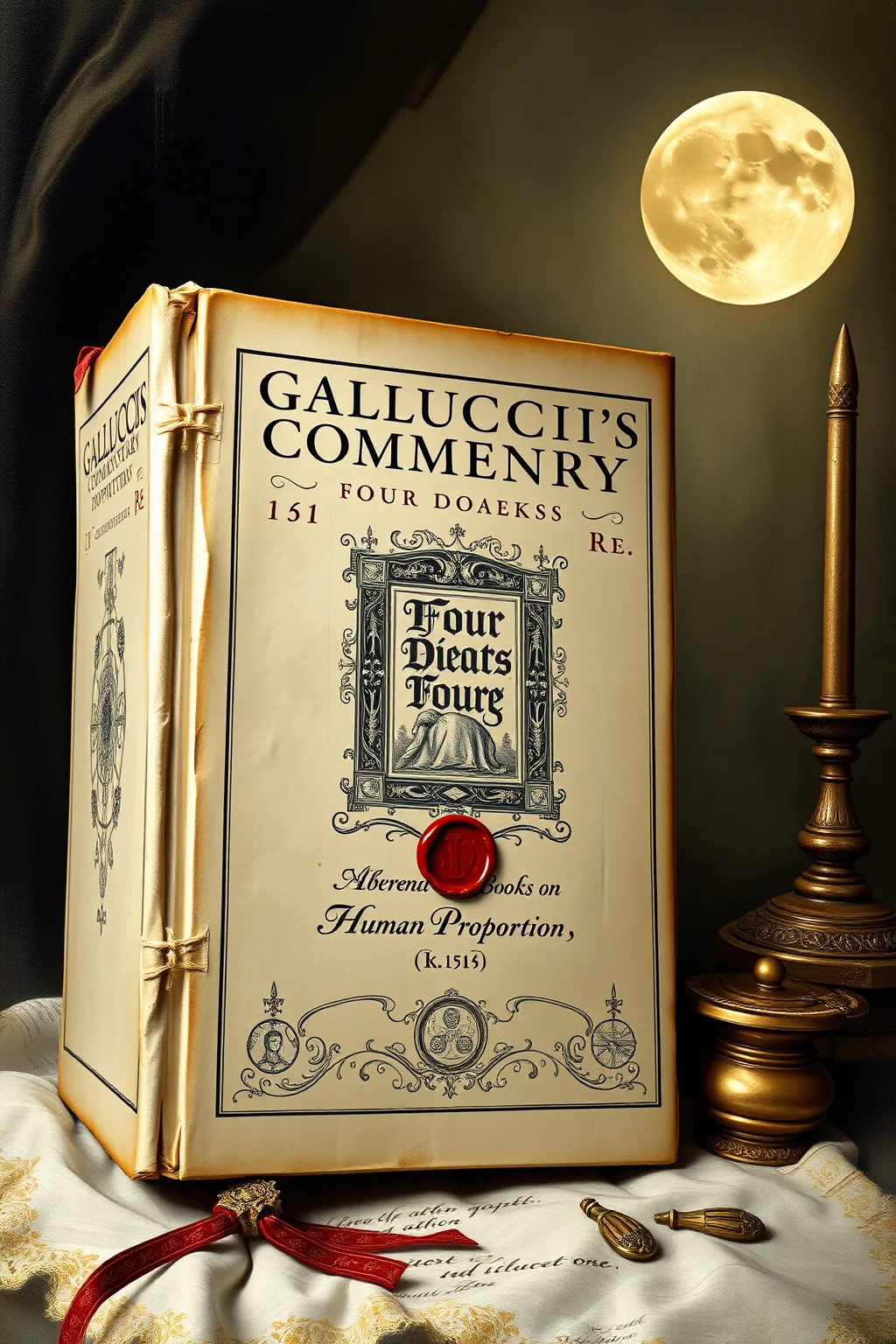
Gallucci's Commentary on Dürer’s 'Four Books on Human Proportion' - Renaissance Proportion Theory
 75
75

Gallucci's Commentary on Dürer’s 'Four Books on Human Proportion' - Renaissance Proportion Theory



Gallucci's Commentary on Dürer’s 'Four Books on Human Proportion' is a masterful exploration of Renaissance proportion theory, seamlessly blending art, astrology, and cosmology. The book is meticulously researched and provides a deep dive into the esoteric underpinnings of Dürer’s work, making it an invaluable resource for modern esoteric seekers. Gallucci’s detailed commentary offers a fresh perspective on the enduring relevance of these ancient principles, making it a must-read for anyone interested in the mystical and mathematical foundations of art. The text is rich in historical context and philosophical insights, providing a comprehensive understanding of how the Renaissance mind viewed the human form and its cosmic connections. For those seeking to deepen their knowledge of esoteric traditions and their influence on art, this book is an essential addition to their library.
📝 Description
75
Published in 1591, Gallucci's Commentary reveals Renaissance ideas on human proportion as divine geometry.
Giovanni Paolo Gallucci's 1591 commentary expands upon Albrecht Dürer's foundational work on human proportion. This text examines how Renaissance thinkers viewed the mathematical ratios of the human body not just as an artistic guide, but as a reflection of cosmic order. Gallucci presents these proportions as a form of hidden knowledge, linking artistic creation with spiritual understanding. The commentary emphasizes symbolism, suggesting that every measurement and geometric principle carries a deeper, metaphysical significance.
The work appeals to those interested in the esoteric dimensions of Renaissance thought. It explores the belief that the human body acts as a microcosm, mirroring the structure of the universe. By studying proportion, readers can gain insight into the philosophical connections between the physical world and the abstract principles governing existence. The text encourages a contemplative approach, blending rigorous analysis with mystical inquiry into the nature of beauty and order.
This commentary situates Renaissance proportion studies within a broader esoteric tradition that saw the physical world as imbued with divine meaning. It connects Dürer's geometric investigations to hermetic principles, where the study of form and number offered a path to understanding universal laws. The text reflects a period where the boundaries between art, science, and mysticism were fluid, and mathematical harmony was believed to be a direct expression of celestial order. Gallucci's work is an example of how these ideas were applied to the human figure, seen as a perfect embodiment of cosmic design.
💡 Why Read This Book?
Reading Gallucci's Commentary on Dürer’s 'Four Books on Human Proportion' today offers a unique opportunity to explore the esoteric foundations of Renaissance art. This book provides valuable insights into the mathematical and philosophical principles that guided some of the most iconic artists of the period. For modern esoteric seekers, it offers a bridge between ancient wisdom and contemporary understanding, enriching one's appreciation of both art and the occult. Whether you are an artist, a historian, or simply curious about the mystical side of the Renaissance, this book will expand your horizons and deepen your understanding of the interconnectedness of art, astrology, and cosmology.
⭐ Reader Reviews
Honest opinions from readers who have explored this book.
❓ Frequently Asked Questions
What makes Gallucci's commentary unique?
Gallucci's commentary stands out for its detailed analysis and the context it provides for Dürer’s original work, making it an essential read for those interested in the esoteric aspects of Renaissance art.
Who should read this book?
This book is ideal for historians, artists, and esoteric seekers who are fascinated by the intersection of art and mysticism.
What topics are covered in this book?
The book covers human anatomy, mathematical proportions, and the philosophical underpinnings of art, all within the context of Renaissance proportion theory.
🔮 Key Themes & Symbolism
Divine Geometry
The book looks at the hidden knowledge of divine geometry, revealing how the proportions of the human body reflect the cosmos. This theme is central to understanding the mystical underpinnings of Renaissance art and its esoteric significance.
Beauty and Symmetry
Gallucci’s Commentary explores the relationship between beauty and symmetry, showing how these principles were seen as keys to artistic mastery and spiritual enlightenment. The text provides insights into the symbolic significance of human proportion, making it a valuable resource for both scholars and practitioners of the occult.
Hermetic Traditions
The work is deeply rooted in the hermetic traditions of the Renaissance, which saw the human body as a microcosm of the divine. By studying the proportions of the human form, one can gain a deeper understanding of the universe and our place within it. This theme is essential for those seeking to explore the mystical dimensions of human beauty and proportion.
💡 Key Ideas
Editorial paraphrase of the work's core concepts — not direct quotes.
The human body is a microcosm of the divine, reflecting the cosmos in its proportions.
This quote highlights the esoteric belief that the human form holds the secrets of the universe, making it a key text for spiritual seekers.
Symmetry and proportion are the keys to artistic mastery and spiritual enlightenment.
This passage underscores the mystical significance of Renaissance art, showing how the study of proportion can lead to a deeper connection with the divine.
The divine geometry of the human body reveals the hidden knowledge of the cosmos.
This quote emphasizes the esoteric dimensions of human proportion, making it a valuable resource for those interested in the mystical underpinnings of Renaissance art.
Beauty is not merely skin deep; it is a reflection of the divine symmetry within.
This passage highlights the symbolic significance of human beauty, showing how it is deeply rooted in the hermetic traditions of the Renaissance.
By understanding the proportions of the human form, we gain insight into the mysteries of the universe.
This quote underscores the philosophical significance of the book, making it a must-read for seekers of esoteric wisdom.
🌙 Esoteric Significance
Tradition
Gallucci's Commentary belongs to the Hermetic tradition, which emphasizes the divine geometry of the human body. This tradition sees the study of proportion as a means of spiritual enlightenment and a deeper understanding of the universe.
Symbolism
Key symbols in this book include the divine proportions of the human body, which are seen as reflections of the cosmos. These symbols are central to the book's esoteric significance, revealing the hidden knowledge of the Renaissance.
Modern Relevance
Today, this work is relevant to modern practitioners of the occult and esoteric arts, who continue to explore the mystical dimensions of human proportion and beauty. It is also valuable for artists and scholars seeking to understand the hermetic traditions of the Renaissance.
👥 Who Should Read This Book
Beginners interested in the mystical dimensions of Renaissance art will find this book an accessible introduction to esoteric symbolism. Scholars and practitioners of the occult will appreciate the depth of knowledge and the symbolic significance of human proportion. Spiritual seekers will benefit from the philosophical insights into the relationship between beauty and the divine. Artists and art historians will find it useful for understanding the hermetic traditions that shaped Renaissance art.
📜 Historical Context
Published in 1591, Gallucci's Commentary on Dürer’s 'Four Books on Human Proportion' emerged during the height of the Renaissance, a time when the study of human anatomy and proportion was seen as a key to unlocking the secrets of the universe. Dürer's original treatise, first published in the early sixteenth century, had already established the importance of symmetry and proportion in art. Gallucci’s Italian translation further popularized these ideas, making them central to arts education, connoisseurship, and patronage. The work's influence extended into the Baroque era, shaping the way artists and scholars understood the relationship between beauty and proportion. It was a time when the human body was seen as a microcosm of the divine, and the study of its proportions was believed to reveal the hidden knowledge of the cosmos.
📔 Journal Prompts
How does the study of human proportion reveal the hidden knowledge of the cosmos?
In what ways does the divine geometry of the human body reflect the universe?
How does the relationship between beauty and symmetry lead to spiritual enlightenment?
What are the key symbols in Gallucci’s Commentary, and what do they represent?
How has the influence of Gallucci’s Commentary shaped modern understandings of esoteric symbolism?
🗂️ Glossary
Divine Geometry
The study of the mathematical proportions of the human body, seen as reflections of the cosmos in esoteric traditions.
Hermetic Tradition
A mystical tradition that emphasizes the study of the divine proportions of the human body and their symbolic significance.
Symmetry and Proportion
Key principles in Renaissance art and esoteric studies, believed to reveal the hidden knowledge of the universe.
Microcosm
The concept that the human body is a small-scale representation of the cosmos, reflecting its divine proportions.
Esoteric Symbolism
The use of symbols and hidden meanings in mystical and occult traditions to convey deeper truths about the universe.
This book appears in 1 collection
🔮 Readers Also Liked
Browse all →






From the “Astrology” Collection
View all →

![Mrs. Davis, (no. 7.) Crown Court, Little Poultney Street, Wardour Street, Soho, ... name and clock face on the door. Who has studied the occult sciences under the most learned sages after many years studious application; answers all adimssable [sic] questions in astrology, ... 1780](/img/thumb/mrs-davis-no-7-crown-court-little-poultney-street-wardour-street-soho-name-and-clock-face-on-the-door-who-has-studied-the-occult-sciences-under-the-most-learned-sages-after-many-years-studious-applica.webp)





More Free Astrology & Cosmology Books
View all →