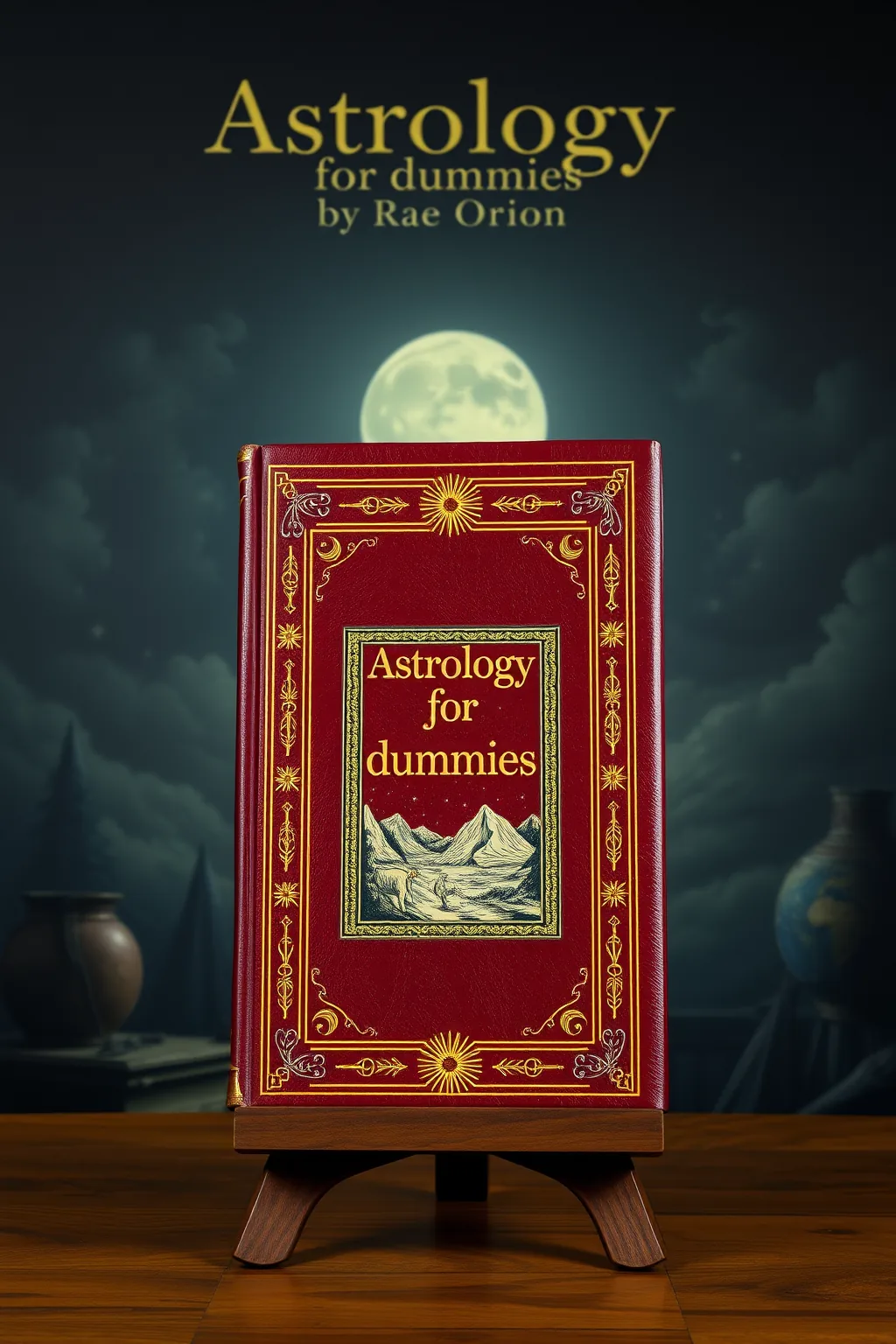
Astrology for dummies
 82
82

Astrology for dummies
Rae Orion’s Astrology for Dummies successfully navigates the challenge of making a complex subject approachable without trivializing it. The book’s strength lies in its clear, step-by-step approach to constructing and interpreting a basic natal chart. Orion’s explanation of the houses, for instance, is particularly effective, framing them as distinct stages of life experience that planets inhabit. However, the book’s primary limitation is its brevity; while excellent for beginners, it provides only a superficial overview, leaving seasoned practitioners wanting more depth. The section on planetary aspects, while present, feels somewhat rushed, offering a taste rather than a full exploration of these crucial interpretive elements. Ultimately, it serves its purpose as a solid, no-frills entry point into astrological study.
📝 Description
82
Rae Orion's Astrology for Dummies, published in 1999, simplifies astrological fundamentals for newcomers.
Rae Orion's Astrology for Dummies offers a clear entry into understanding natal charts. The book breaks down the twelve zodiac signs, ten planets, and twelve houses, explaining how they combine to form an individual's unique astrological blueprint. It aims to make the practice accessible to anyone with no prior experience.
This guide is suited for the curious beginner interested in the basic principles of celestial interpretation. Those seeking self-discovery, personal growth, or a new way to view personality and potential will find its explanations direct and supportive. The book addresses common questions about how astrological elements relate to individual characteristics and life paths.
Published in 1999, Astrology for Dummies arrived during a time of renewed public interest in esoteric subjects, aligning with New Age and self-help trends. It provided a simplified entry into astrological interpretation, contrasting with more complex texts that explored psychological depths, similar to the work of authors like Liz Greene. The book demystifies the astrological chart, presenting the zodiac as symbolic language, planets as energies, and houses as life domains, making these concepts understandable to a general audience.
💡 Why Read This Book?
• Learn the foundational elements of Western astrology, including the zodiac signs, planets, and houses, as presented in Orion's clear 1999 framework, allowing you to read a basic natal chart. • Gain an understanding of astrological archetypes and how they are interpreted, providing a structured way to explore personal strengths and challenges as outlined in the text. • Discover the practical application of astrological concepts for self-reflection, enabling you to use the book’s guidance to analyze your own birth chart for personal insights.
⭐ Reader Reviews
Honest opinions from readers who have explored this book.
❓ Frequently Asked Questions
What is the primary goal of Astrology for Dummies by Rae Orion?
The primary goal of Astrology for Dummies is to demystify astrological concepts for absolute beginners. It aims to equip readers with the fundamental knowledge needed to understand a natal chart, including zodiac signs, planets, and houses, making astrology accessible.
When was Astrology for Dummies first published?
Astrology for Dummies was first published in 1999, positioning it within a period of growing public interest in self-help and esoteric subjects.
Does the book explain how to cast a birth chart?
While the book focuses on interpreting the components of a birth chart, it assumes the reader has access to a cast chart, either through online tools or other resources. Its emphasis is on understanding the symbolism and relationships within it.
What are the main components of an astrological chart discussed in the book?
The book primarily discusses the twelve zodiac signs, the ten planets (Sun through Pluto), and the twelve houses, explaining their individual meanings and how they interact to form a complete astrological picture.
Is Astrology for Dummies suitable for advanced astrologers?
No, Astrology for Dummies is specifically designed for beginners. It provides an introductory overview and lacks the depth and advanced techniques required by experienced astrologers.
What is the significance of the year 1999 in relation to this book?
The year 1999 marks the initial publication of Astrology for Dummies. This timing places the book within a broader cultural context of increased accessibility and popular interest in astrological studies.
🔮 Key Themes & Symbolism
Celestial Archetypes
The work unpacks the twelve zodiac signs not merely as birth dates, but as distinct archetypal energies influencing personality. Each sign is presented with its ruling planet, element, and modality. The planets themselves are depicted as dynamic forces, representing core psychological drives and functions within the human psyche. Understanding these archetypes is presented as the first step toward deciphering one's unique astrological blueprint, offering a framework for self-awareness and understanding interpersonal dynamics.
The House System
Astrology for Dummies elucidates the twelve houses as symbolic arenas of life experience. These houses represent different sectors where the planetary energies manifest and where the zodiacal archetypes play out. The book details how the placement of planets within specific houses in a natal chart indicates areas of focus, potential challenges, and innate talents. This concept provides a practical lens through which to examine how cosmic influences translate into earthly circumstances and personal growth.
Natal Chart Interpretation
The central theme is the construction and interpretation of the natal chart, often referred to as the birth chart. The book guides readers through understanding how the positions of planets at the moment of birth, relative to the zodiac and the houses, form a symbolic map. It introduces the idea that this map offers insights into character, destiny, and life's patterns. The work emphasizes that the chart is not deterministic but rather a tool for self-understanding and conscious navigation of life's path.
Astrology as a Language
Orion presents astrology as a symbolic language, a sophisticated system of communication between the cosmos and the individual. The zodiac, planets, and houses are its vocabulary and grammar. By learning this language, the reader is empowered to 'read' the sky and, by extension, to understand themselves and the world around them more deeply. This perspective frames astrological study as an intellectual and spiritual pursuit, akin to learning any complex symbolic system.
💬 Memorable Quotes
Direct passages from the work, attributed to the author.
“The zodiac signs are distinct archetypes that color our personalities.”
— This highlights the book's approach to astrology as a system of symbolic archetypes, suggesting that each zodiac sign represents a fundamental pattern of human behavior and disposition.
“Planets are the engines of our inner world, driving our actions and desires.”
— This interpretation emphasizes the dynamic and active nature of planetary symbolism in astrology, portraying them as the core energies that motivate and shape an individual's psychological landscape.
“The houses represent different stages or areas of life where these cosmic energies play out.”
— This explains the function of the astrological houses as life domains or contexts where the influences of zodiac signs and planets manifest in tangible experiences and personal development.
“Your birth chart is a unique celestial snapshot at the moment you drew your first breath.”
— This conveys the fundamental concept of the natal chart as a personalized astrological map, emphasizing its specificity to an individual's birth time and its role as a key interpretive tool.
“Understanding astrological symbols helps us understand ourselves better.”
— This captures the self-discovery aspect of astrology presented in the book, suggesting that learning its symbolic language provides a pathway to greater self-awareness and personal insight.
🌙 Esoteric Significance
Tradition
This work aligns with the Western esoteric tradition, specifically drawing from the lineage of psychological and modern natal astrology that gained prominence in the 20th century. It departs from older, more deterministic forms of astrology by emphasizing self-awareness and personal growth. While rooted in the Hermetic principle of 'As Above, So Below,' its presentation is secularized and focused on psychological interpretation rather than prophecy or fate.
Symbolism
Key symbols include the twelve zodiac signs, each representing a distinct archetypal energy (e.g., Aries as the initiator, Cancer as the nurturer), and the ten planets, which embody fundamental psychological functions (e.g., Mercury for communication, Venus for attraction). The houses symbolize specific life domains, from selfhood (1st House) to spirituality (12th House), providing a framework for understanding how these energies manifest in earthly experience.
Modern Relevance
Astrology for Dummies continues to serve as a gateway for many exploring modern astrological practices. Its foundational concepts are referenced in contemporary online astrology communities and by influencers who, while perhaps evolving the interpretations, still rely on the basic sign-planet-house framework it popularized. It remains relevant for those seeking a non-dogmatic, self-help-oriented introduction to celestial interpretation.
👥 Who Should Read This Book
• Absolute beginners curious about astrology and seeking a clear, jargon-free introduction to natal chart basics. • Individuals interested in self-discovery and personal growth who want to explore a new framework for understanding their personality and life path. • Students of comparative spirituality or esotericism looking for a foundational text on Western astrological principles before examining more complex systems.
📜 Historical Context
Published in 1999, Rae Orion’s Astrology for Dummies entered a cultural landscape where interest in esoteric subjects, including astrology, had seen a resurgence since the 1970s. This period saw a mainstreaming of many New Age concepts. The book's accessible format contrasted with more academic or traditional astrological texts, positioning itself as an entry point for a public increasingly curious about self-exploration. It arrived at a time when authors like Stephen Arroyo were popularizing psychological astrology, offering a more digestible alternative. The book benefited from this growing audience but remained firmly in the popular self-help genre, distinct from the more arcane or specialized astrological traditions like sidereal astrology or Hellenistic astrology.
📔 Journal Prompts
The Sun sign's core identity and its expression.
The Moon sign's emotional landscape and needs.
The Ascendant's initial impression on others.
The placement of Mercury and its communication style.
The influence of Mars on drive and action.
🗂️ Glossary
Zodiac
The band of the sky through which the Sun, Moon, and planets appear to move. It is divided into twelve 30-degree segments, each named after a constellation that was historically in that segment.
Planet
In astrology, celestial bodies used for interpretation, including the Sun, Moon, Mercury, Venus, Mars, Jupiter, Saturn, Uranus, Neptune, and Pluto. Each represents distinct archetypal energies.
House
A division of the celestial sphere, typically twelve, representing different areas of life experience where planetary energies are expressed.
Natal Chart
A map of the positions of the planets and zodiac signs at the exact moment and location of a person's birth. It is used for astrological interpretation.
Aspect
The angular relationship between two or more planets in a natal chart, indicating how their energies interact. Common aspects include conjunctions, squares, and trines.
Ruler
The planet that governs a specific zodiac sign or astrological house. The sign or house ruled by a planet is influenced by that planet's nature.
Midheaven (MC)
The highest point in the natal chart, representing career, public reputation, and life direction. It is the cusp of the 10th house.
🔮 Readers Also Liked
Browse all →









More by Rae Orion
All books →


More Free Astrology & Cosmology Books
View all →