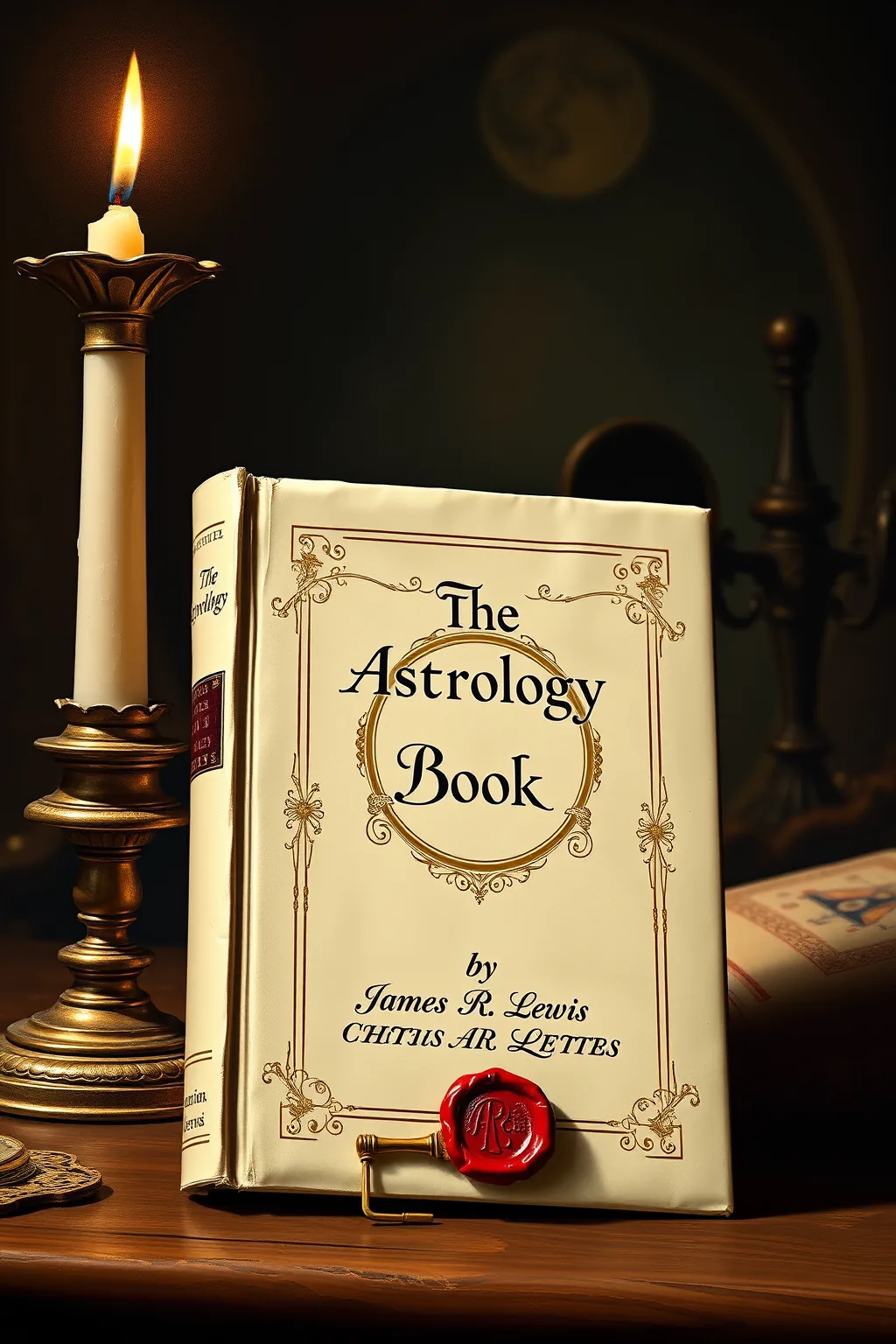
The Astrology Book
 74
74

The Astrology Book
James R. Lewis's "The Astrology Book" offers a commendable survey of a complex subject, avoiding the usual pitfalls of mystical hyperbole. Its strength lies in its methodical approach, tracing astrological thought from its ancient origins through various historical periods. Lewis’s examination of Hellenistic astrology, for instance, provides crucial context often overlooked in popular treatments. However, the work occasionally leans towards a dry academic tone, which might alienate readers seeking more immediate practical application or personal revelation. A notable passage detailing the development of the 12 houses demonstrates the book's potential for illuminating dense material. While comprehensive, it sometimes feels like a catalog of ideas rather than a narrative exploration of astrology's living tradition. Lewis's contribution is valuable for its factual grounding, offering a solid foundation for further study.
📝 Description
74
James R. Lewis's 2009 book examines astrological traditions from Babylonian times to medieval Europe.
Published in 2009, The Astrology Book by James R. Lewis offers a thorough look at astrological practices across different cultures and historical periods. It goes beyond simple horoscopes to investigate how astrology developed historically, its main ideas, and how it has been used in various societies. This volume works as both an introduction for newcomers and a reference for those wanting a deeper grasp of this long-standing discipline. It is suitable for students of esoteric thought, scholars of comparative religion, and anyone interested in the historical and cultural importance of celestial interpretation. Readers who wish to grasp the structural foundations of astrological systems, rather than just predictive methods, will find it especially useful. Lewis's study is part of a scholarly trend that has become more receptive to examining spiritual and mystical traditions previously overlooked. While astrology has ancient origins, its formal academic study gained traction in the late 20th century. This book fits into that academic context, analyzing astrological systems that thrived in Hellenistic Egypt and medieval Europe, providing a different perspective from the psychological or New Age interpretations that became popular concurrently.
The Astrology Book is situated within a growing academic interest in previously marginalized spiritual and mystical traditions. Its analysis of astrological systems from Hellenistic Egypt and medieval Europe provides a counterpoint to more recent psychological or New Age applications. Lewis's work engages with the historical development and core tenets of astrology, tracing its roots from Babylonian times and situating its modern academic study within the late 20th century. This approach acknowledges astrology's place in the history of thought, offering a scholarly perspective on its philosophical underpinnings and symbolic language.
💡 Why Read This Book?
• Gain a structured understanding of astrological history, from its roots in Hellenistic Egypt to its development in medieval Europe, providing context often missing in contemporary astrological texts. • Learn about the core principles of astrological symbolism, including the zodiac, planets, and houses, and how these elements form the basis of complex interpretive systems. • Discover the philosophical underpinnings of astrology, such as the principle of correspondence, offering a framework to understand its place within broader esoteric traditions.
⭐ Reader Reviews
Honest opinions from readers who have explored this book.
❓ Frequently Asked Questions
When was The Astrology Book first published?
The Astrology Book by James R. Lewis was first published in 2009, offering a modern scholarly perspective on ancient astrological traditions.
Does this book focus on modern astrological predictions?
No, while it covers the historical development of predictive techniques, the book primarily examines the historical, cultural, and philosophical aspects of astrology rather than providing a guide to contemporary horoscope casting.
What historical periods does The Astrology Book cover?
The book explores astrological traditions spanning from ancient Babylonian and Hellenistic Egypt through medieval Europe, examining their evolution and influence.
Is James R. Lewis a recognized scholar in esoteric studies?
Yes, James R. Lewis is a prolific author and editor known for his scholarly work in the field of religion and the esoteric, including extensive research on astrology.
Where can I find information on astrological symbolism discussed in the book?
Key concepts like the zodiac, planetary influences, and houses are detailed within The Astrology Book, providing a foundational understanding of astrological symbolism.
Does the book discuss the Hermetic principle of 'as above, so below'?
Yes, the work explores the philosophical underpinnings of astrology, often referencing the Hermetic principle of correspondence, commonly stated as 'as above, so below'.
🔮 Key Themes & Symbolism
Hellenistic Astrological Roots
The book traces the significant development of astrology in Hellenistic Egypt, a period crucial for its synthesis of Babylonian and Greek traditions. Lewis details how concepts like the zodiacal signs, planetary rulerships, and the system of houses became codified during this era. Understanding this foundation is vital for appreciating the subsequent evolution of Western astrology and its enduring symbolic language, moving beyond simplistic notions of fate to a complex system of interpretation.
Symbolic Language of Planets
Central to the work is an exploration of the symbolic meanings attributed to planets within astrological frameworks. Lewis examines how each celestial body—from the Sun and Moon to Mercury, Venus, Mars, Jupiter, and Saturn, and often extending to the outer planets—was associated with specific archetypal energies, psychological traits, and life events. This symbolic lexicon forms the bedrock of astrological interpretation, offering a language to describe human experience and cosmic influence.
The Principle of Correspondence
Lewis frequently touches upon the Hermetic principle of 'as above, so below', a core tenet linking the celestial realm with the terrestrial. This concept underpins the astrological worldview, suggesting that patterns and relationships observed in the heavens mirror those found on Earth and within human consciousness. The book uses this principle to explain the rationale behind astrological correlations and the perceived interconnectedness of all phenomena.
Astrology's Philosophical Underpinnings
Beyond its practical techniques, the book studies the philosophical and often spiritual underpinnings that have historically supported astrology. It discusses how astrological systems have been integrated into various worldviews, from ancient divination to psychological archetypes, and examines the intellectual currents that shaped its reception and practice across different eras. This provides a context for understanding astrology not merely as a predictive tool but as a complex symbolic language.
💬 Memorable Quotes
Direct passages from the work, attributed to the author.
“The system of twelve houses emerged as a critical framework for dividing the celestial sphere.”
— This highlights a foundational structural element of astrology, emphasizing the development of the house system as essential for mapping earthly life onto the heavens.
“Early astrologers sought correlations between planetary movements and observable terrestrial events.”
— This points to the empirical, albeit symbolic, methodology of ancient astrology, where celestial phenomena were observed for their perceived earthly correspondences.
“The zodiacal signs provided a symbolic language to describe personality archetypes and life phases.”
— This emphasizes the psychological and archetypal dimension of astrology, framing the signs not just as calendar divisions but as symbolic descriptors of human experience.
“Hellenistic astrology synthesized existing traditions into a more systematized form.”
— This interpretation underscores the crucial role of the Hellenistic period in consolidating and formalizing astrological practices, laying the groundwork for later developments.
“Hermetic philosophy provided a conceptual basis for understanding celestial influence.”
— This indicates the deep connection between astrological thought and broader esoteric philosophical systems, particularly Hermeticism and its concept of universal interconnectedness.
🌙 Esoteric Significance
Tradition
This work aligns primarily with the Western Esoteric tradition, particularly its historical astrological branches. It examines astrology as a system of divination and symbolic language that has been integrated into Hermetic, Neoplatonic, and later occult philosophies. Lewis's approach emphasizes astrology's role as a structured framework for understanding cosmic order and human destiny, fitting within lineages that view celestial patterns as reflections of divine or universal principles.
Symbolism
Key symbols explored include the twelve zodiacal signs, each representing archetypal energies and life stages; the planets, which act as divine messengers and archetypal forces; and the twelve houses, which map these celestial influences onto specific areas of earthly life. The book elucidates how these symbols form a cohesive language for interpreting personality, destiny, and the relationship between the microcosm (human) and the macrocosm (universe).
Modern Relevance
Contemporary practitioners of psychological astrology and researchers in the history of magic and divination often draw upon foundational texts and historical analyses like Lewis's. Thinkers exploring the symbolic language of the cosmos and its connection to human consciousness find value in its systematic approach. Furthermore, comparative religion scholars studying belief systems that integrate celestial observation with spiritual frameworks utilize such works to understand astrology's persistent cultural influence.
👥 Who Should Read This Book
• Students of Western Esotericism seeking a historical and philosophical grounding in astrological systems, moving beyond superficial applications. • Comparative religion scholars interested in understanding divination, cosmology, and symbolic systems across different cultures and historical periods. • Skeptical inquirers interested in the intellectual history and structured frameworks of astrology, wanting to understand its core components without necessarily adopting its practices.
📜 Historical Context
Published in 2009, James R. Lewis's "The Astrology Book" entered a field where academic interest in esotericism had grown significantly since the late 20th century. The work situates itself within this scholarly trend, offering a structured analysis of astrological traditions that contrasts with the more popular, often psychologized, interpretations prevalent in the late 20th century. Lewis draws heavily on historical scholarship, referencing the development of astrology in Hellenistic Egypt, a period marked by syncretism and the formalization of techniques that would influence Western practices for centuries. He implicitly engages with scholars like Nicholas Campion, whose work also explores the historical and cultural dimensions of astrology, providing a counterpoint to purely astrological or New Age-centric narratives. The book's reception reflects a broader academic acceptance of studying such traditions, moving them from the fringe to a more legitimate subject of historical and cultural inquiry.
📔 Journal Prompts
The twelve houses as a framework for mapping celestial influences onto earthly life.
Planetary symbolism and its connection to archetypal energies.
The principle of 'as above, so below' in astrological thought.
Historical development of the zodiacal signs.
How Hellenistic astrological synthesis informed later traditions.
🗂️ Glossary
Zodiac
A band of the celestial sphere, containing the paths of the Sun, Moon, and planets, divided into twelve equal signs, each associated with specific symbolic meanings and archetypes.
Planetary Rulerships
The assignment of specific zodiacal signs and houses to the influence of particular planets, indicating a symbolic correlation between celestial bodies and earthly domains.
Houses (Astrological)
Twelve divisions of the celestial sphere, typically based on the local horizon and meridian at the time of birth, representing different areas of life and experience.
Aspects
The angular relationships between planets in a birth chart, believed to indicate the nature of their interaction and influence on the individual.
Hellenistic Astrology
The form of astrology that developed in Egypt and the Eastern Mediterranean during the Hellenistic period (roughly 3rd century BCE to 4th century CE), blending Babylonian and Greek influences.
Principle of Correspondence
A fundamental concept in Hermetic philosophy, often expressed as 'as above, so below,' suggesting a symbolic relationship and mirroring between the celestial and terrestrial realms.
Archetype
In Jungian psychology and often applied in astrology, a universal, archaic pattern of thought or imagery inherited from the ancestors, represented by symbols like the planets and zodiac signs.
🔮 Readers Also Liked
Browse all →









More by James R. Lewis
All books →




More Free Astrology & Cosmology Books
View all →