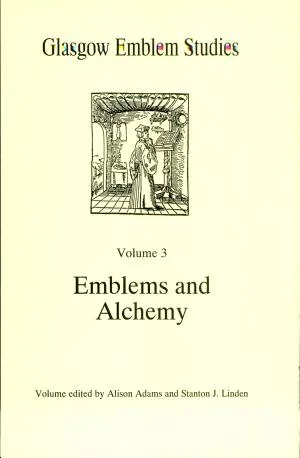
Emblems and Alchemy
 71
71

Emblems and Alchemy
Alison Adams and Stanton J. Linden's Emblems and Alchemy offers a rigorous exploration of the visual language that permeated alchemical thought and practice. The strength of this work lies in its systematic dissection of complex visual allegories, particularly its detailed analysis of the *Mutus Liber*'s illustrations and their alchemical interpretations. However, the book's academic density, while a virtue for specialists, may present a barrier to entry for the casual reader, occasionally becoming bogged down in exhaustive iconographic detail. A particular passage that stands out is the exposition on the hermaphroditic symbolism of the Rebis, illustrating the union of opposites central to the Great Work. Emblems and Alchemy provides a scholarly anchor for understanding the visual dimension of alchemical pursuits.
📝 Description
71
Published in 1998, Emblems and Alchemy analyzes the visual language of alchemical illustrations.
Alison Adams and Stanton J. Linden's book examines the visual symbolism woven into alchemical art and literature. It deciphers the coded meanings within alchemical illustrations and emblems, showing their philosophical and practical roles in the alchemical tradition. The authors move past simple iconography to discuss the psychological and spiritual ideas these visual stories convey.
The work is important for scholars of Renaissance esotericism, art historians studying symbolic imagery, and practitioners of Western alchemy who want a deeper grasp of their tradition's visual vocabulary. It also serves students of comparative mysticism and those interested in how art, science, and philosophy historically connected. The book's analysis of specific emblems, like the Ouroboros and the Rebis, and their portrayal of alchemical processes forms its core. It considers the *lapis philosophorum* not only as a physical objective but also as a symbol for spiritual change. The authors also address the difficulties in interpreting alchemical texts and images, stressing the need for context and tradition.
This book emerged during a time of growing academic recognition for Renaissance Hermeticism and alchemy, fields once overlooked. It joined a body of scholarship that began to view these subjects as complex intellectual systems rather than mere superstition. The book's focus on interpreting visual materials aligns with scholarly shifts that started to highlight the material culture and visual aspects of early modern Europe.
💡 Why Read This Book?
• Gain a concrete understanding of how alchemical concepts like the *lapis philosophorum* were visually encoded in emblems, a method distinct from purely textual exegesis, as detailed in the analysis of specific allegorical plates. • Appreciate the historical context of visual symbolism in Renaissance Hermeticism, learning how illustrations from works like the *Mutus Liber* served as pedagogical tools for practitioners in the late 16th century. • Develop critical skills for interpreting complex esoteric imagery, recognizing how Adams and Linden approach the hermeneutic challenges presented by alchemical iconography, a method applicable to other symbolic systems.
⭐ Reader Reviews
Honest opinions from readers who have explored this book.
❓ Frequently Asked Questions
What is the primary focus of Emblems and Alchemy by Adams and Linden?
The book primarily focuses on the visual symbolism within alchemical tradition, analyzing how emblems and illustrations conveyed complex philosophical and practical alchemical ideas, particularly during the Renaissance.
When was Emblems and Alchemy first published?
Emblems and Alchemy was first published in 1998, a period of renewed scholarly interest in esoteric studies and Renaissance visual culture.
Which alchemical texts are frequently referenced in Emblems and Alchemy?
The work frequently references and analyzes illustrations from key alchemical texts such as the *Mutus Liber* and its associated imagery.
How does Emblems and Alchemy contribute to the study of esotericism?
It contributes by providing a detailed framework for understanding the visual language and symbolic grammar of alchemical practice, moving beyond purely textual analysis to embrace iconographic interpretation.
Is Emblems and Alchemy suitable for beginners in alchemy?
While rigorous, it can be beneficial for beginners who are interested in the historical visual aspects of alchemy, provided they have some foundational knowledge or are prepared for an academic approach.
What is the significance of the Rebis symbol discussed in the book?
The Rebis symbol, often depicted as a hermaphrodite, represents the union of opposites (male/female, volatile/fixed) and is a central motif in alchemical symbolism for achieving the Great Work.
🔮 Key Themes & Symbolism
Visual Language of Alchemy
This theme examines how alchemical knowledge was transmitted not solely through written treatises but through a sophisticated visual grammar. Adams and Linden explore how artists and alchemists utilized emblems – allegorical images with accompanying inscriptions – to represent profound philosophical concepts and practical laboratory processes. These images often employed symbolic creatures, celestial bodies, and mineral transformations to convey the stages of the Great Work, requiring careful decoding by initiates.
The Hermetic Tradition's Iconography
The book situates alchemical emblems within the broader Hermetic tradition, tracing the lineage of symbols and allegories. It highlights how motifs like the Ouroboros, the mercurial serpent, or the hermaphroditic Rebis carried layered meanings, often referencing classical mythology, Neoplatonic philosophy, and biblical narratives. Understanding this iconography is presented as crucial for grasping the esoteric worldview that underpinned alchemical pursuits.
Emblem Books as Pedagogical Tools
A significant aspect explored is the role of emblem books, such as the *Mutus Liber*, as pedagogical instruments in the 16th and 17th centuries. These works were designed to instruct practitioners in the subtle art of alchemy, often through a series of enigmatic images that demanded contemplation and interpretation. The authors discuss how the visual format facilitated a more intuitive or mystical apprehension of alchemical principles, complementing textual instruction.
The Philosopher's Stone as Metaphor
Beyond its literal interpretation as a substance, the Philosopher's Stone (*lapis philosophorum*) is examined as a potent alchemical metaphor. Emblems and Alchemy illustrates how visual representations often depicted the Stone as a goal of spiritual purification and psychological integration, a symbol of perfected matter and enlightened consciousness. The visual allegories underscore the transformative aspect of the alchemical quest, extending beyond material manipulation.
💬 Memorable Quotes
Direct passages from the work, attributed to the author.
“The Rebis, a symbol of the union of opposites, signifies the culmination of the alchemical process.”
— This highlights a core alchemical concept: the reconciliation of dualities (male/female, spirit/matter) as essential for achieving the Great Work, visually represented by the hermaphroditic figure.
“Illustrations in texts like the *Mutus Liber* functioned as visual keys to understanding complex alchemical operations.”
— This points to the intentional design of alchemical imagery as a form of coded instruction, where the visual element was paramount for conveying knowledge to those initiated into its symbolic language.
“The Ouroboros represents the cyclical nature of alchemical transformation and the eternal return.”
— This interpretation emphasizes the snake eating its own tail as a potent symbol for the self-contained, cyclical processes inherent in alchemical operations and the philosophical concept of eternal recurrence.
“Alchemical emblems were not mere decorations but integral components of the philosophical discourse.”
— This asserts the functional importance of visual art in alchemical studies, positioning emblems as active participants in the intellectual exchange and transmission of esoteric knowledge.
“The *lapis philosophorum* symbolizes both material perfection and spiritual enlightenment.”
— This interpretation underscores the dual nature of the ultimate alchemical goal, indicating that the pursuit of the Philosopher's Stone encompassed not only physical transmutation but also profound inner transformation.
🌙 Esoteric Significance
Tradition
This work firmly situates itself within the Hermetic and Renaissance alchemical traditions. It aligns with the Neoplatonic underpinnings of Hermeticism, viewing alchemical processes as mirroring cosmic and spiritual principles. The book departs from purely materialistic interpretations by emphasizing the symbolic and psychological dimensions inherent in the alchemical quest, aligning with traditions that see the Main work as a path of inner transformation.
Symbolism
Key symbols explored include the Ouroboros, representing cyclicality, unity, and the self-devouring nature of transformation, essential for the alchemical process. The Rebis, a hermaphroditic figure, symbolizes the union of opposites (male/female, spirit/matter), a crucial stage in achieving the Great Work. The book also deciphers the meaning of various minerals, celestial influences, and allegorical figures depicted in alchemical emblems.
Modern Relevance
Contemporary practitioners of Western esotericism, particularly those engaged with Hermeticism, Jungian psychology (which extensively drew on alchemical symbolism), and ritual magic, find value in this work. It provides a foundational understanding of alchemical iconography that informs modern symbolic analysis and esoteric practice, aiding in the interpretation of sigils, mandalas, and other visual forms of esoteric expression.
👥 Who Should Read This Book
• Students of Renaissance history and art history seeking to understand the visual language of early modern esoteric thought and its relationship to artistic production. • Practitioners and scholars of Western alchemy and Hermeticism who require a detailed guide to the symbolic interpretation of alchemical texts and illustrations. • Researchers in comparative religion and mysticism interested in the cross-pollination of ideas between visual art, philosophy, and spiritual disciplines across historical periods.
📜 Historical Context
When Emblems and Alchemy was published in 1998, it entered a scholarly landscape increasingly open to the study of Western esotericism. The book addressed a need for rigorous analysis of the visual dimension of alchemy, moving beyond earlier dismissals of the subject as mere pseudo-science. It engaged with the burgeoning field of Renaissance studies, particularly its focus on visual culture and intellectual history. Key contemporaries in this area included scholars like Frances Yates, whose work on Hermeticism had paved the way for deeper investigation. The book's detailed iconographic analysis of works like the *Mutus Liber* offered a counterpoint to purely textual interpretations and contributed to a broader understanding of how symbolic systems functioned within early modern European thought.
📔 Journal Prompts
The allegorical representations of the Rebis in alchemical emblems.
The function of the Ouroboros as a cyclical symbol within alchemical diagrams.
How the *Mutus Liber*'s visual narrative guides the alchemical practitioner.
The transformation of specific mineral symbols into metaphors for spiritual growth.
The hermeneutic challenges presented by coded alchemical imagery.
🗂️ Glossary
Emblem
A symbolic image, typically with an inscription, intended to represent a moral or philosophical idea, often used in alchemical literature for coded instruction.
Alchemy
An ancient philosophical and proto-scientific tradition concerned with the transformation of matter, often interpreted as a metaphor for spiritual purification and enlightenment.
Rebis
A key alchemical symbol, often depicted as a hermaphrodite, representing the union of opposites and the successful completion of the Great Work.
Ouroboros
An ancient symbol of a serpent or dragon eating its own tail, representing cyclicality, unity, eternity, and the self-contained nature of the alchemical process.
Lapis Philosophorum
The Philosopher's Stone, the legendary substance sought by alchemists, believed to be capable of transmuting base metals into gold and bestowing immortality.
Mutus Liber
A French alchemical text published anonymously in 1677, notable for its series of enigmatic illustrations that are central to the study of alchemical iconography.
Hermeticism
A religious, philosophical, and esoteric tradition based on writings attributed to Hermes Trismegistus, emphasizing divine wisdom and the interconnectedness of the cosmos.
This book appears in 1 collection
🔮 Readers Also Liked
Browse all →









From the “Alchemy” Collection
View all →






More Free Alchemy & Hermeticism Books
View all →