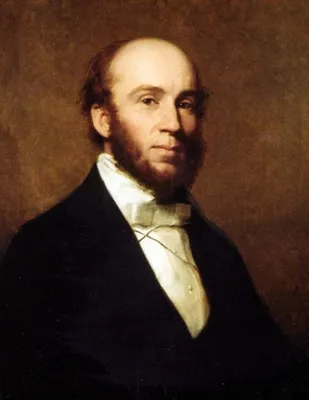
C. Piazzi Smyth
Charles Piazzi Smyth was a British astronomer known for his high-altitude observations and extensive studies of the Great Pyramid of Giza.
Charles Piazzi Smyth, born in 1819, was a British astronomer who served as Astronomer Royal for Scotland for over four decades. His early career involved astronomical work in South Africa and later in Edinburgh, where he implemented early time-signaling systems. A significant portion of his career was dedicated to pioneering high-altitude astronomical observations, inspired by Isaac Newton's suggestions. He conducted expeditions to Tenerife, demonstrating the benefits of observing from elevated locations above atmospheric disturbances, a practice that became standard in modern astronomy. He also made notable discoveries, including the first detection of heat emanating from the Moon and research into the spectra of celestial phenomena.
Beyond his astronomical achievements, Smyth became deeply involved in pyramidology, heavily influenced by John Taylor. He undertook expeditions to the Great Pyramid of Giza to conduct meticulous measurements. From these, he proposed the existence of a "pyramid inch" as a divine unit of measurement, suggesting it was a God-given standard passed down from biblical figures. Smyth linked these measurements to prophecies and biblical narratives, arguing that the pyramid's dimensions encoded divine messages. He was a staunch opponent of the metric system, viewing it as a product of atheistic thought, and used his pyramid research to support British Israelism. Despite modern criticisms, his work provided some of the most accurate measurements of the Great Pyramid at the time and was the first to photograph its interior passages.
Astronomical Innovations and High-Altitude Observation
Charles Piazzi Smyth's astronomical career was marked by a drive to overcome terrestrial atmospheric limitations. Appointed Astronomer Royal for Scotland in 1846, he faced challenges with underfunding at the Edinburgh observatory. Inspired by Isaac Newton's ideas on observing from high altitudes, Smyth secured a grant in 1856 to conduct experiments on Mount Teide in Tenerife. Accompanied by his wife, he established camps at significant elevations, meticulously measuring atmospheric clarity and the quality of celestial observations. His experiments demonstrated superior viewing conditions compared to Edinburgh, leading him to be recognized as a pioneer of modern high-altitude astronomical observation. He also contributed to practical astronomy by installing Edinburgh's first time ball and later the One O'Clock Gun for maritime time signals.
Pyramidological Research and Metrology
Following his astronomical work, Charles Piazzi Smyth became deeply engrossed in the study of the Great Pyramid of Giza, influenced by John Taylor's theories. Smyth undertook expeditions to Egypt to measure the pyramid with unprecedented precision. He proposed that these measurements revealed a divine unit of length, the "pyramid inch," which he believed was a God-given standard dating back to biblical times. He further developed theories linking the pyramid's dimensions to prophecies and astronomical distances, suggesting it held hidden sacred knowledge. Smyth's research also encompassed other metrological concepts like the "pyramid pint" and "sacred cubit." His work in this area was strongly tied to his support for British Israelism and his opposition to the metric system, which he viewed as secular and radical.
Scientific Contributions and Legacy
Beyond his pyramid studies, Piazzi Smyth made several significant scientific contributions. His high-altitude observations in Tenerife were groundbreaking, establishing the value of elevated sites for astronomical work. He was the first to positively detect heat radiation from the Moon and investigated the spectra of phenomena like the aurora and zodiacal light. In collaboration with Alexander Stewart Herschel, he identified harmonic relationships in the spectral emissions of carbon monoxide. Smyth also developed a system for weather forecasting using the "rain-band" in the spectrum of light. Although his pyramidological theories are now largely discredited in Egyptology, his meticulous measurements of the Great Pyramid were highly accurate for his time, and he pioneered the photographic documentation of its interior passages.
Key Ideas
- High-altitude astronomy pioneer
- Pyramid inch as a divine unit of measurement
- Great Pyramid as a repository of prophecy
- Opposition to the metric system
- British Israelism proponent