Billy Graham
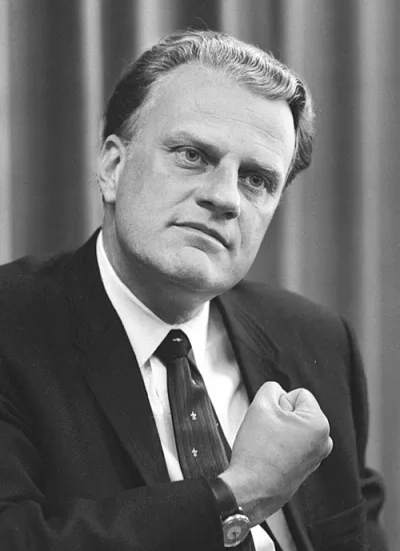
Billy Graham was a prominent American evangelist whose decades-long ministry reached millions globally through sermons, broadcasts, and crusades.
William Franklin Graham Jr., born in 1918, became a globally recognized Southern Baptist minister and evangelist whose ministry spanned over six decades. He gained widespread fame in the mid-to-late 20th century for his large-scale evangelistic campaigns, often held in stadiums and broadcast internationally via radio and television. Graham's influence extended beyond religious circles, as he was known to shape the worldview of many individuals from diverse backgrounds, connecting biblical teachings with contemporary secular perspectives.
Throughout his career, Graham was a vocal advocate for civil rights, actively opposing racial segregation and promoting integration in his revivals. He maintained close relationships with several U.S. presidents and other prominent figures. His extensive reach, estimated to have touched billions through various media and live events, solidified his position as one of the most influential Christian leaders of the 20th century. Graham passed away in 2018.
Early Life and Ministry Beginnings
Born in North Carolina in 1918, William Franklin Graham Jr. was raised on a dairy farm. After a conversion experience at age 16, he pursued theological education, attending Bob Jones College and Florida Bible Institute before graduating from Wheaton College in 1943 with a degree in anthropology. Graham was ordained as a Southern Baptist minister in 1939. His early ministry included hosting a radio program, 'Songs in the Night,' and co-founding Youth for Christ (YFC) after a brief military service. In 1948, Graham and his team established the Modesto Manifesto, a code of ethics designed to ensure integrity in their ministry, which included rules regarding financial practices and personal conduct, such as the widely known 'Billy Graham rule' about avoiding being alone with women other than his wife.
Global Evangelism and Influence
Graham's evangelistic efforts gained significant momentum with the initiation of his 'Crusades' in 1947. These large-scale events, held in major venues worldwide, attracted massive audiences and were frequently broadcast through radio and television. Over his career, Graham's sermons and messages reached an estimated 210 million people in over 185 countries and territories. His televised 'crusades' continued annually from 1947 until his retirement in 2005, and his radio show 'Hour of Decision' aired from 1950 to 1954. Graham's ministry was characterized by its accessibility, aiming to bridge biblical teachings with the realities of contemporary secular life and influencing the worldviews of millions.
Social Advocacy and Relationships
Beyond his evangelistic work, Billy Graham was a notable civil rights advocate who repudiated racial segregation during a period of intense racial strife in the United States. He insisted on racial integration at his revivals and crusades from as early as 1953 and notably invited Martin Luther King Jr. to preach jointly at a New York City revival in 1957. Graham cultivated relationships with several U.S. presidents, including Dwight D. Eisenhower, Lyndon B. Johnson, and Richard Nixon. He also fostered interdenominational dialogue, encouraging unity between Catholics and Protestants, despite initial apprehensions common among evangelicals of his time. His influence was so significant that he was recognized as a 'Great Legitimator,' conferring status and acceptability on various public matters.
Key Ideas
- Evangelical outreach through large-scale crusades and media broadcasts
- Integration of biblical teachings with contemporary secular viewpoints
- Advocacy for civil rights and racial integration
- Fostering interdenominational unity