Beyer, Stephan V.
Stephan V. Beyer is an author associated with the Dorotheenstadt Cemetery in Berlin, a burial ground of historical and cultural significance.
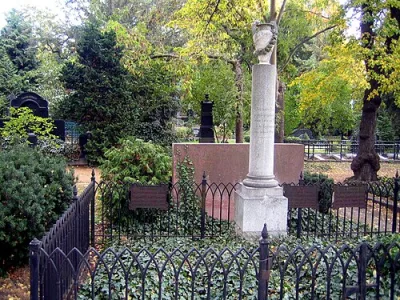
The Dorotheenstadt Cemetery, established in the late 18th century in Berlin's Mitte district, serves as a Protestant burial ground for the Dorotheenstadt and Friedrichswerder parishes. Initially intended for lower-class burials, its proximity to academic institutions led to it becoming the final resting place for many prominent figures in arts, sciences, and philosophy. The cemetery's history includes periods of expansion, land sales, and damage, but it has also been recognized as a cultural landmark and undergone significant restoration efforts.
Notable individuals interred or commemorated include philosophers like Georg Wilhelm Friedrich Hegel and Herbert Marcuse, writers such as Bertolt Brecht and Anna Seghers, and artists and architects like Johann Gottfried Schadow and Karl Friedrich Schinkel. The cemetery also features memorials to resistance fighters against the Nazi regime, including those involved in the 20 July 1944 plot, and honors members of the Berlin Academy of Arts. Its designation as a landmark and ongoing restoration highlight its importance as a site of cultural and historical memory.
Historical Context and Development
The Dorotheenstadt Cemetery originated in the latter half of the 18th century due to Berlin's growing population and the need for more burial space, a concern amplified by fears of epidemics. King Frederick II of Prussia provided land for its establishment, alongside other cemeteries, of which Dorotheenstadt and the French cemetery remain. Founded by two Protestant parishes in the early 1760s, burials commenced in 1770. Over time, it evolved from a burial site primarily for the lower classes to a prestigious location, attracting many notable individuals due to its adjacency to academic and cultural institutions like Berlin University. The cemetery underwent expansions between 1814 and 1826, and faced challenges including land sales and the impact of war, yet it has been preserved and is recognized for its historical and artistic value.
Artistic and Cultural Significance
The cemetery is distinguished by numerous grave markers designed by prominent 19th-century artists and architects, reflecting the rising social status of those interred there. Figures like sculptor Johann Gottfried Schadow and architect Karl Friedrich Schinkel contributed to the cemetery's artistic landscape with their own monuments and designs for others. The site also features collective monuments, including a memorial to resistance fighters executed for their opposition to the Nazi regime, commemorating individuals involved in the 20 July 1944 assassination plot and others who perished due to Nazi persecution. Additionally, a section is dedicated to members of the Berlin Academy of Arts, acknowledging their contributions to culture.
Preservation and Notable Interments
Recognized as a cultural landmark since 1935 and officially listed in 1983, the Dorotheenstadt Cemetery has been the subject of significant restoration projects. These efforts have focused on preserving the graves of distinguished figures, including artists, philosophers, writers, and politicians. Among the many notable individuals buried here are philosopher Georg Wilhelm Friedrich Hegel, playwright Bertolt Brecht, theologian Dietrich Bonhoeffer (commemorated), composer Hanns Eisler, and former German president Johannes Rau. The cemetery's ongoing preservation underscores its role as a repository of German cultural and intellectual history.