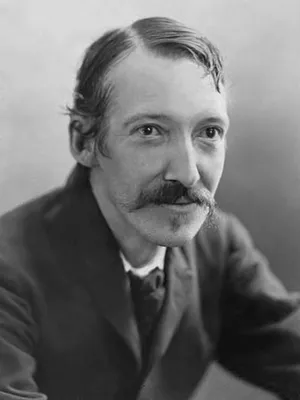
William Stevenson Smith
Robert Louis Stevenson was a Scottish writer known for adventure novels, poetry, and travelogues, who explored darker themes later in life.
Robert Louis Stevenson, born in Edinburgh in 1850, was a prolific Scottish author celebrated for novels like 'Treasure Island' and 'Dr. Jekyll and Mr. Hyde,' alongside poetry and travel writing. Despite lifelong health struggles, he traveled extensively and engaged with London's literary scene. His early life was marked by a family tradition in lighthouse engineering, though he ultimately pursued a literary career against his father's wishes.
Stevenson's writing evolved throughout his life. Initially drawn to romance and adventure, his later works, particularly after settling in Samoa in 1890, explored darker realism influenced by his observations of increasing European and American influence in the South Pacific. He died in Samoa in 1894 at the age of 44. His literary reputation has seen fluctuations but is generally held in high regard today, with his works being widely translated.
Early Life and Influences
Born Robert Lewis Balfour Stevenson in Edinburgh in 1850, he came from a family prominent in lighthouse engineering. His childhood was marked by recurring illness, often necessitating stays in warmer climates, which influenced his early writing and his connection to nature. He spent holidays at his maternal grandfather's home, a minister, and developed a precocious interest in religion, though his nurse's blend of Calvinism and folk beliefs also caused him distress. Despite difficulties fitting in at school due to his eccentricities and frequent absences from illness, he was a prodigious writer from a young age, dictating stories before he could read and compulsively writing throughout his childhood. His father, initially a writer himself, supported his son's literary aspirations, even printing his first publication at age 16.
Education and Literary Pursuits
Stevenson's formal education was sporadic due to his poor health, involving short stints at various schools and extensive periods with private tutors. He attended Edinburgh University to study engineering but showed little enthusiasm, dedicating more energy to extracurricular activities like the debating society, The Speculative Society, and amateur dramatics. He also traveled annually to inspect the family's engineering projects, experiences that provided material for his writing rather than fueling an interest in engineering itself. In 1871, he formally decided to pursue a literary career, a choice his father eventually accepted with resignation. He also studied law to ensure financial stability, though his true passion lay in writing.
Rejection of Tradition and Evolving Views
As Stevenson matured, he moved away from his conservative upbringing. His personal style became more unconventional, and he began to question established religious beliefs, eventually declaring himself an atheist. He joined clubs that challenged parental teachings and explored bohemian lifestyles. This period of intellectual and personal exploration is reflected in his writings, where he began to justify his unconventional path, famously articulating his philosophy in "An Apology for Idlers," where he championed happiness and individual pursuits over conventional success metrics. His later works would delve into more complex and darker aspects of human nature and society.
Key Ideas
- The pursuit of happiness and individual fulfillment over conventional societal pressures.
- The exploration of dual nature and moral ambiguity.
- The influence of environment and health on character and writing.
Notable Quotes
“Now I often wonder what I inherited from this old minister. I must suppose, indeed, that he was fond of preaching sermons, and so am I, though I never heard it maintained that either of us loved to hear them.”
“A happy man or woman is a better thing to find than a five-pound note. He or she is a radiating focus of goodwill and a practical demonstration of the great Theorem of the Liveableness of Life.”
Books by William Stevenson Smith
2 free public domain books · Read online or download