Swami Vivekananda
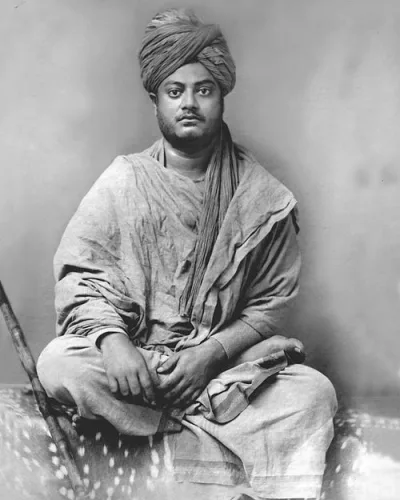
Indian monk Swami Vivekananda introduced Vedanta and Yoga philosophies to the Western world.
Swami Vivekananda (1863–1902) was a pivotal Indian Hindu monk instrumental in bringing Vedanta and Yoga philosophies to the West. He was recognized as a significant philosopher and social reformer in India and a highly effective proponent of Vedanta internationally. The Indian poet Rabindranath Tagore suggested studying Vivekananda's work to understand India, noting his entirely positive outlook. His influence has led to extensive scholarly attention, with hundreds of books written about him and his teachings in various languages over the past century.
Numerous disciples and scholars have documented his life and philosophy. Sister Nivedita, a close associate, authored works like 'The Master as I Saw Him' and 'Notes of some wanderings with the Swami Vivekananda'. Extensive research has also been conducted by Sister Gargi, resulting in a multi-volume series titled 'Swami Vivekananda in the West: New Discoveries'. Bengali scholar Sankari Prasad Basu has contributed significantly with several Bengali books detailing Vivekananda's life and his interactions with contemporary India. Monks from the Ramakrishna Math and Mission have also authored notable biographies and analyses of his contributions.
Introduction of Vedanta and Yoga to the West
Swami Vivekananda played a crucial role in disseminating the philosophies of Vedanta and Yoga beyond India. His lectures and teachings in the Western world introduced these ancient Indian spiritual traditions to a new audience, significantly shaping the discourse on Eastern thought in the West. He is regarded as one of the most successful missionaries of Vedanta, establishing a lasting presence for these teachings internationally. His efforts were instrumental in bridging cultural and philosophical divides, fostering a greater understanding and appreciation of Indian spirituality among Westerners.
Philosophical and Social Impact
Beyond his international outreach, Swami Vivekananda was a prominent figure in India, recognized for his philosophical insights and his contributions to social reform. He articulated a vision for India that was both spiritually grounded and socially progressive. His ideas resonated deeply within his homeland, influencing subsequent generations of thinkers and activists. The poet Rabindranath Tagore's observation that Vivekananda embodied positivity and offered a unique lens through which to understand India underscores his profound impact on national consciousness and intellectual life.
Legacy and Scholarly Examination
The enduring significance of Swami Vivekananda's work is evident in the vast body of literature dedicated to his life and philosophy. Over the last century, hundreds of scholarly books have been published in multiple languages, exploring his multifaceted contributions. His disciples, such as Sister Nivedita, and dedicated researchers like Sister Gargi, have produced seminal works that document his experiences and teachings. Furthermore, scholars like Sankari Prasad Basu and monks from the Ramakrishna Mission have continued to analyze and disseminate his thought, ensuring his legacy remains a subject of ongoing study and inspiration.
Key Ideas
- Vedanta philosophy
- Yoga philosophy
Notable Quotes
“in Vivekananda there was nothing negative, but everything positive.”