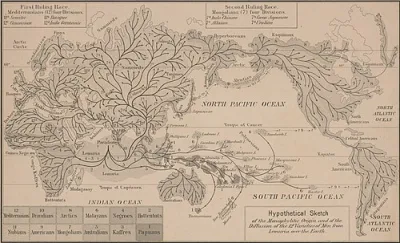
Lemuria, a sunken continent theory, originated scientifically but was adopted by occultists to explain human origins and ancient wisdom.
The concept of Lemuria began as a scientific hypothesis in 1864, proposed by zoologist Philip Sclater to explain the distribution of lemur fossils between Madagascar and India. He theorized a sunken landmass in the Indian Ocean, which he named Lemuria. This idea gained traction beyond scientific circles when biologist Ernst Haeckel suggested it as a potential cradle of humanity in 1870. The theory was further developed by occultists, most notably Helena Blavatsky, founder of Theosophy, who integrated Lemuria into her mystical doctrines as the homeland of ancient human ancestors. Although scientific theories of plate tectonics and continental drift in the 20th century rendered the original geological hypothesis obsolete, the idea of Lemuria persisted in esoteric and popular culture, often associated with lost continents and advanced ancient civilizations.
Scientific Origins and Esoteric Appropriation
Initially proposed by zoologist Philip Sclater in 1864, Lemuria was a hypothetical sunken continent conceived to bridge the biogeographical gap between Madagascar and India, explaining the presence of lemur fossils. This scientific postulation, intended to account for observed patterns in nature, was soon adopted and transformed by occultists. Ernst Haeckel, a biologist, further propelled the idea into popular discourse by suggesting Lemuria as a potential ancestral home for humans. Helena Blavatsky, a central figure in Theosophy, significantly elaborated on this, embedding Lemuria within her spiritual framework as the origin point of humanity and a repository of profound ancient knowledge. Blavatsky's influential writings cemented Lemuria's place in Western esotericism, shifting its perception from a scientific curiosity to a mystical lost land.
Lemuria in Occult and Pseudoarchaeological Narratives
Following its scientific discrediting due to the acceptance of continental drift, the concept of Lemuria flourished in esoteric traditions and pseudoarchaeological theories. Helena Blavatsky's Theosophy posited Lemuria as the homeland of one of humanity's root races, a concept that spawned extensive fringe literature. James Churchward, for instance, wrote extensively about a similar lost continent he called Mu, which he linked to Lemuria. These narratives often describe Lemuria as a highly advanced civilization that predated recorded history, possessing sophisticated knowledge and spiritual wisdom that influenced later cultures. The idea of survivors or descendants of Lemurians living in hidden places, such as underground cities like Telos beneath Mount Shasta, became a recurring theme, attracting numerous spiritual groups and adherents who continue to pilgrimage to these locations.
Cultural and Mythological Connections
The myth of Lemuria also found resonance in various cultural contexts, including colonial Australia and Tamil literature. In Australia, the idea of Lemuria was interwoven with notions of lost races, reflecting colonial anxieties and attempts to forge unique historical narratives. Some Tamil writers have associated Lemuria with Kumari Kandam, a legendary sunken landmass described in ancient Tamil texts, proposing it as the origin of civilization. These interpretations highlight how the Lemuria concept has been adapted and reinterpreted across different cultural and historical landscapes, often serving to explain ancient origins, lost histories, or to construct unique cultural identities.
Key Ideas
- Hypothetical sunken continent in the Indian Ocean, initially proposed to explain biogeographical anomalies.
- Adopted by occultists as the homeland of ancient human ancestors and a source of lost wisdom.
- Associated with advanced ancient civilizations and hidden survivors in esoteric traditions.
- Connected to other mythical lost lands such as Mu and Atlantis.
- Interpreted in cultural contexts like colonial Australia and linked to Tamil legends of Kumari Kandam.
Books by
2 free public domain books · Read online or download