Samuel Sambursky
Samuel Sambursky's work explores the historical evolution of cosmographical beliefs, particularly the concept of a flat versus spherical Earth across ancient cultures.
Samuel Sambursky's contributions, as reflected in this historical overview, delve into the ancient understanding of the Earth's shape. While the idea of a spherical Earth emerged in ancient Greek philosophy with figures like Pythagoras and was later supported by empirical evidence from Aristotle, the concept of a flat Earth persisted for centuries across various civilizations. Many pre-Socratic Greek philosophers, for instance, subscribed to a flat Earth model, and this view was also prevalent in early Egyptian, Mesopotamian, and Israelite thought, often depicting the world as a disk floating on water with a firmament above.
This flat-Earth cosmography was also a common feature in ancient Chinese thought until the 17th century, and initially among early Islamic scholars. While a historical myth suggests medieval Europeans widely believed in a flat Earth, scholarly consensus indicates a spherical view was generally held. The text also notes the persistence of flat-Earth ideas as a modern conspiracy theory. Sambursky's work, therefore, provides a detailed examination of these differing cosmological views and their historical trajectories.
Ancient Cosmographical Beliefs
Ancient Near Eastern cultures, including Egyptians and Mesopotamians, commonly envisioned the world as a flat disk adrift on a vast ocean, a perspective echoed in early Greek poetry like Homer's Shield of Achilles. The Israelites shared this view, imagining the Earth as a water-borne disk beneath a solid, domed firmament holding the celestial bodies. In ancient China, a flat, often square, Earth coexisted with a round heaven, a belief that remained dominant until European astronomical influence in the 17th century. The Norse and Germanic peoples also adhered to a flat-Earth model, encircled by an ocean and centered by a world axis, though later Norse texts began to describe a spherical Earth.
Philosophical and Scientific Developments
The notion of a spherical Earth began to take root in ancient Greek philosophy with Pythagoras in the 6th century BC. However, many pre-Socratic thinkers, such as Thales, Anaximander, Anaximenes, Xenophanes, Anaxagoras, and Democritus, continued to advocate for a flat Earth model, often with varying explanations for its stability and the phenomena of day and night. By the 4th century BC, Plato wrote of a spherical Earth, and his student Aristotle provided significant empirical evidence supporting this view. This knowledge gradually disseminated, and by the early Christian era, the spherical Earth was widely accepted, despite some exceptions and persistent flat-Earth beliefs in other regions like ancient China.
Misconceptions and Modern Persistence
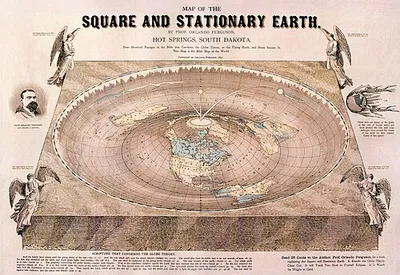
A widespread historical myth claims that medieval Europeans largely believed the Earth was flat; however, this notion was largely fabricated in the 17th century and popularized in the 19th century as a polemical tool. Despite overwhelming scientific evidence and observable effects of Earth's sphericity, pseudoscientific flat-Earth conspiracy theories have experienced a resurgence in the 21st century. Since the 2010s, belief in a flat Earth has increased through modern societies and social media, although a firm conviction remains relatively rare across all age groups.
Key Ideas
- Evolution of cosmographical beliefs from flat to spherical Earth models.
- Prevalence of flat-Earth cosmography in various ancient cultures (Near East, Greece, China, Norse).
- Emergence and evidence for the spherical Earth concept in ancient Greek philosophy.
- Debunking the myth of widespread medieval flat-Earth belief in Europe.
- Modern resurgence of flat-Earth theories as a conspiracy.
Books by Samuel Sambursky
2 free public domain books · Read online or download