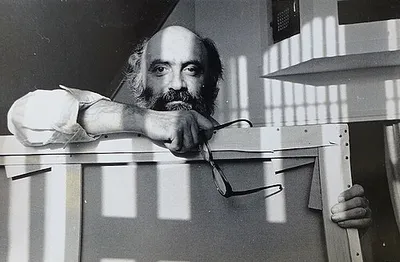
Samuel Bak
Samuel Bak is a Holocaust survivor and artist whose work explores themes of shattered worlds and memory through allegory and metaphor.
Born in 1933 in Vilnius, Samuel Bak is a painter and writer who experienced the Holocaust at a young age, including confinement in the ghetto and forced labor camps. He and his mother were among the few survivors of their extensive family. After the war, they lived in displaced persons camps in Germany before immigrating to Israel in 1948. Bak studied art in Israel and Paris, and has since lived in various locations, including the United States since 1993, where he became a citizen. His artistic style incorporates elements of postmodernism, drawing from surrealism, cubism, and pop art, often using symbolic substitutions and allusions to historical artworks.
Bak's art frequently addresses the profound impact of his childhood experiences, particularly the destruction and dehumanization of the Holocaust, though he does not limit his work solely to this theme. He employs allegorical and metaphorical devices, such as using toys to represent lost children or books to symbolize vanished readers. His work is characterized by a sense of a "shattered world," reflecting the irreparable nature of historical trauma. Bak views his art as a means to enlighten and educate the public about the extremes of human behavior witnessed during the Holocaust, emphasizing his duty to prevent such horrors from recurring.
Early Life and Holocaust Survival
Samuel Bak was born in Vilnius in 1933. His artistic talents were recognized early in life. The onset of World War II and the subsequent German occupation of Vilnius in 1941 forced Bak and his family into the ghetto. During this period, he held his first exhibition within the ghetto at the age of nine. He later participated in an exhibition organized by poets Avrom Sutzkever and Szmerke Kaczerginski. Sensing impending danger, these poets entrusted Bak with the community's official record, the Pinkas, which he filled with his own work over the next two years. Bak and his mother found temporary refuge in a convent before being deported to a labor camp, from which they again escaped to hide in the convent until the war's end. Tragically, his father was killed shortly before their liberation. Bak and his mother emerged as two of the few survivors from a once large Jewish community.
Artistic Development and Themes
Following the war, Bak and his mother resided in displaced persons camps in Germany, where he continued to paint and briefly studied art. He repudiated his Bar Mitzvah ceremony during this time. In 1948, they emigrated to Israel, where Bak furthered his art education at the Bezalel Academy. He also studied in Paris and lived in various European locations before settling in the United States in 1993. Bak's artistic style blends postmodernist approaches with influences from surrealism, cubism, and pop art. He avoids direct depictions of atrocities, opting instead for allegorical representations. Bak uses symbolic substitutions, such as toys for children or books for readers, and references iconic artworks to convey the profound sense of a "shattered world" and the enduring impact of historical trauma, particularly the Holocaust.
Philosophical and Educational Intent
Samuel Bak's art is deeply engaged with the philosophical implications of destruction and dehumanization, stemming from his childhood experiences. He views his work as a means of confronting and communicating the "unspeakable atrocities" of the Holocaust, though he does not wish to confine his artistic scope solely to this subject. Bak emphasizes the role of his art in educating and enlightening the public, suggesting that the Holocaust served as a stark demonstration of humanity's capacity for both extreme good and evil, shaped by upbringing rather than inherent nature. He considers it his moral obligation to use his art to help ensure that such horrors are not repeated.
Key Ideas
- Art as a means of processing and communicating trauma
- Allegorical representation of destruction and loss
- Exploration of the human capacity for good and evil
- The concept of a "shattered world" resulting from historical events
Notable Quotes
“when in 1944 the Soviets liberated us, we were two among two hundred of Vilna's survivors—from a community that had counted 70 or 80 thousand.”
“a sense of a world that was shattered.”
“Holocaust was a laboratory which tells you that human beings can do the best and the worst. It is not because they are born very good or very evil – there's no such thing. But they are brought up in very different ways.”
“It is my duty to help not let such horrors happen again.”
Books by Samuel Bak
2 free public domain books · Read online or download