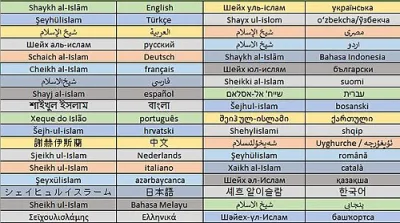
Shaykh al-Islam was a historical honorific title for prominent Islamic scholars, evolving in meaning and function across different eras and regions.
The title Shaykh al-Islam, meaning 'Elder of Islam,' was historically bestowed upon distinguished scholars of Islamic sciences. Its usage originated in Khurasan around the late 4th Islamic century, initially serving as an informal designation for influential jurists whose legal opinions (fatwas) held significant weight. In the eastern regions, rulers sometimes conferred the title upon learned individuals who fulfilled various official duties, even if they were not primarily muftis (legal interpreters).
Over time, the title's significance and application varied. In the Ottoman Empire, it evolved into an official position, designating the chief mufti who held considerable religious and administrative authority, advising the sultan and legitimizing state policies. This official role persisted until the abolition of the Ottoman Caliphate in 1924. The title's conferral was not always uncontested, with some scholars' right to the title being debated by their contemporaries, highlighting the complex scholarly landscape of the time.
Origins and Classical Usage
The honorific title Shaykh al-Islam emerged in the region of Khurasan towards the end of the 4th Islamic century (around the 10th century AD). Initially, it was reserved for learned individuals and mystics, similar to other titles beginning with 'sheikh.' In the major cities of Khurasan, the title appeared to be unique to a single individual within a given time and place, indicating a high level of influence among its holders. While these individuals were prominent scholars, evidence does not suggest they routinely issued fatwas. Under various dynasties, including the Ilkhans, Delhi Sultanate, and Timurids, the title was often granted by rulers to high-ranking ulama who performed diverse functions but were not necessarily muftis. In regions like Syria and Egypt, it was an honorific designation for influential jurists, rather than an official post. By the 14th century (700 AH) in western Islamic lands, the term became more closely associated with the issuance of fatwas.
Controversies and Scholarly Debates
The application and recognition of the Shaykh al-Islam title were sometimes subject to scholarly dispute. A notable instance involved Ibn Taymiyyah, who was granted the title by his supporters. However, adversaries, such as the Hanafi scholar 'Ala' al-Din al-Bukhari, contested this usage, even issuing a fatwa declaring it an act of disbelief to refer to Ibn Taymiyyah as Shaykh al-Islam. Conversely, other scholars defended the title for Ibn Taymiyyah. The Shafi'i scholar Ibn Hajar al-Asqalani praised Ibn Taymiyyah's standing, affirming his title as Shaykh al-Islam, a sentiment recorded by his student al-Sakhawi. Ibn Taymiyyah's follower, Ibn Qayyim al-Jawziyya, also defended the title's use for him. Both Ibn Taymiyyah and Ibn Qayyim were known for diverging from the mainstream views of scholars across the four major Sunni legal schools of their era and later periods.
The Ottoman Shaykh al-Islam
Within the Ottoman Empire, spanning from the 14th to the 20th centuries, the title Shaykh al-Islam evolved into a significant official position, equivalent to the Grand Mufti. This role was the apex of a structured hierarchy of ulama. The selection of a Shaykh al-Islam was typically made by royal decree from among the qadis (judges) of prominent cities. The Shaykh al-Islam held the authority to confirm new sultans, although the sultan's authority ultimately superseded theirs. A key function was the issuance of fatwas, providing authoritative interpretations of Islamic law derived from the Quran. The importance of the Shaykh al-Islam's role, representing Sharia law, grew significantly by the 16th century, enhancing their power. The official office of the Shaykh al-Islam was eventually abolished in 1924, concurrently with the dissolution of the Ottoman Caliphate, and was succeeded by the Presidency of Religious Affairs in Turkey.
Key Ideas
- Honorific title for eminent Islamic scholars
- Evolution of the title's meaning and function across historical periods and regions
- Association with issuing legal opinions (fatwas)
- Official religious authority in the Ottoman Empire
- Scholarly debates surrounding the conferral of the title
Notable Quotes
“His status as imam, sheikh, Taqiyuddin Ibn Taimiyah, is brighter than the sun. And his title with Shaykhul Islam, we still often hear from holy orals until now, and will continue to survive tomorrow..”
Books by
2 free public domain books · Read online or download