Robert Place
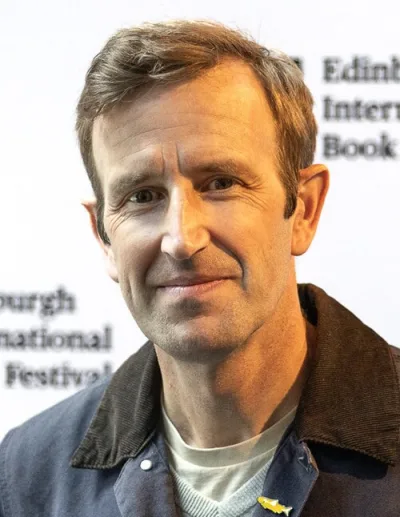
Robert Macfarlane is a British author known for his nature writing, exploring landscape, language, and deep time.
Robert Macfarlane is a British writer and Fellow of Emmanuel College, Cambridge, born on August 15, 1976. He is recognized for his books that delve into themes of landscape, nature, place, people, and language. His notable works include "The Old Ways," "Landmarks," "The Lost Words," and "Underland." Macfarlane's writing often explores the profound connections between humanity and the natural world, examining how landscapes shape us and how we, in turn, perceive and describe them.
Educated at Cambridge and Oxford, Macfarlane began his academic career at Emmanuel College, Cambridge. His father is a respiratory physician, and he is married to Julia Lovell, a professor of modern Chinese history and literature. Macfarlane has received critical acclaim and awards for his literary contributions, including the Guardian First Book Award and the E.M. Forster Award for Literature. He has also been considered a contender for the Nobel Prize in Literature.
Explorations of Landscape and Language
Macfarlane's literary output is deeply rooted in explorations of the natural world and the human relationship with it. His books, such as "Mountains of the Mind" and "The Wild Places," investigate our fascination with wildness and precipitous landscapes, examining the psychological and imaginative hold these environments possess. He also delves into the linguistic connections to place, as seen in "Landmarks," which celebrates the rich vocabulary used to describe terrain and nature. This work highlights the reciprocal shaping of people and place, emphasizing how language itself is intertwined with our experience of the environment. His writing often involves journeys and deep observation, seeking to understand the enduring presence of nature in contemporary life.
Deep Time and Subterranean Worlds
With "Underland: A Deep Time Journey," Macfarlane extends his exploration to the vast timescales of the Earth's past and future. This work ventures into subterranean realms, both mythical and real, to examine geological processes and the deep history embedded within the planet. The book connects these profound temporal scales to human culture and consciousness, suggesting a dialogue between the surface world and the hidden depths beneath. His later work, "Is a River Alive?" (2025), continues this engagement with nature by exploring animistic perspectives and the Rights of Nature movement, further investigating the intrinsic value and agency of the natural world beyond human constructs.
Cultural Impact and Collaboration
Macfarlane's work has had a significant cultural impact, particularly "The Lost Words: A Spell Book," created with artist Jackie Morris. This book addresses the omission of natural history words from children's dictionaries, aiming to re-engage young people with the language of the natural world. It became a phenomenon, inspiring grassroots campaigns to place copies in schools and hospices, and has been adapted into various art forms. Macfarlane also collaborates with filmmakers, contributing scripts and narratives to documentaries like "Mountain" and "River," which further extend his explorations of nature and landscape to visual media, often featuring prominent narrators and musicians.
Key Ideas
- The reciprocal relationship between landscape and the human mind/imagination.
- The importance of language in understanding and connecting with nature.
- Exploration of 'deep time' and the Earth's geological history.
- The concept of 'wildness' and its presence in contemporary environments.
- The influence of place on identity and culture.
Books by Robert Place
5 free public domain books · Read online or download