Proclus Diadochus
Proclus was a pivotal late antique Neoplatonist philosopher whose complex system profoundly influenced subsequent mystical and philosophical traditions.
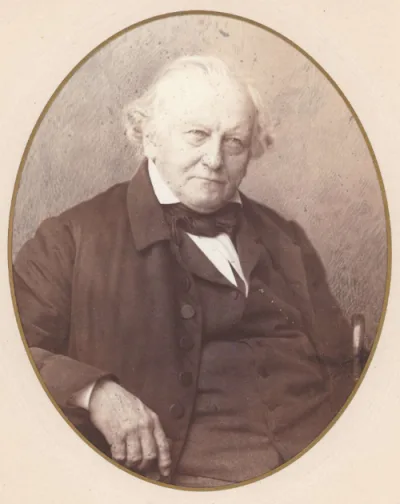
Proclus Diadochus (412–485 AD) was a prominent Greek Neoplatonist philosopher, considered one of the last significant classical thinkers of late antiquity. He developed an intricate and comprehensive Neoplatonic system that exerted considerable influence on Byzantine, Islamic, Scholastic, and German Idealist philosophy, notably impacting G. W. F. Hegel. Born in Constantinople to a distinguished family, Proclus initially studied rhetoric, mathematics, and law in Alexandria, with aspirations for a legal career. However, he found philosophy more compelling and returned to Alexandria to study Aristotle and mathematics before moving to Athens in 431 AD. There, he became a student at the Neoplatonic Academy under Plutarch of Athens, Syrianus, and Asclepigenia. He eventually succeeded Syrianus as the head of the Academy in 437 AD, remaining there until his death, except for a brief exile. Marinus, his successor, documented his life and achievements, portraying him as a virtuous individual who attained happiness. Proclus lived as a vegetarian bachelor in Athens, known for his prosperity and generosity, reportedly writing prolifically.
Neoplatonic System and Key Concepts
Proclus's philosophical system is characterized by its elaborate development of Neoplatonism. He adhered to the core Neoplatonic concepts of the three primary hypostases: The One (hen), The Intellect (nous), and The Soul (psyche). A distinctive feature of his philosophy is the postulation of 'henads,' individual divine unities, situated between the ultimate One and the realm of Intellect. These henads, existing beyond being, serve as the source of causal chains (seirai), imbuing them with specific characteristics. Proclus identified these henads with the Greek gods, seeing each god as representative of a particular set of causal influences. He also proposed that each henad participates in every other, creating a polycentric divine system. His philosophy emphasized the soul's journey from material concerns back to its divine origins in the One, viewing philosophy as a means of liberation from bodily passions and preparation for spiritual ascent. He incorporated the practice of theurgy, as advocated by Iamblichus, believing that divine powers extend into the material world and can be accessed through ritualistic practices, words, and objects.
Philosophical Method and Works
Proclus viewed himself not as an innovator but as a preserver and interpreter of Plato's authentic teachings. He believed Plato's writings were divinely inspired and structured to reveal profound truths, often veiled from the uninitiated. His extensive commentaries on Plato's dialogues, including the Timaeus, Parmenides, Republic, Cratylus, and Alcibiades, served as vehicles for presenting his own philosophical system as a faithful exposition of Platonic thought. In his commentary on the Timaeus, he explored the Soul's role in bridging the gap between the Forms within Intellect and the material world, describing the Soul's construction through mathematical proportions that allow it to imprint its ideas onto Body. Beyond commentaries, Proclus authored significant systematic works. 'Elements of Theology' outlines 211 propositions detailing the progression from the One to the descent of individual souls. 'Platonic Theology' systematizes Plato's dialogues to elucidate divine hierarchies. He also wrote essays on providence, fate, and the existence of evils, preserved in Latin translation.
Contributions to Mathematics and Legacy
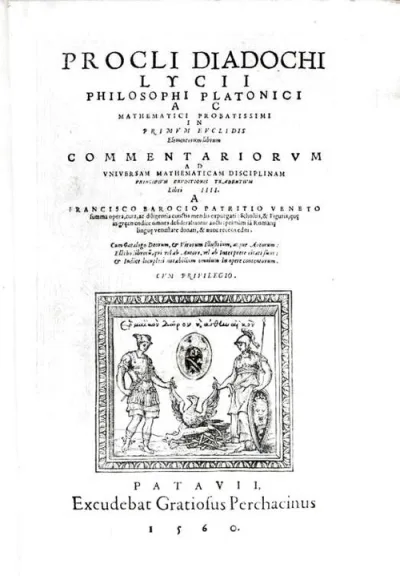
Proclus also made significant contributions to the history and philosophy of mathematics. His commentary on the first book of Euclid's Elements is a crucial source for understanding ancient mathematics, particularly its Platonic philosophical underpinnings. Within this work, he presented a historical sketch of geometry, drawing on the lost 'History of Geometry' by Eudemus of Rhodes, and provided approximate dates for early geometricians. He also listed mathematicians associated with Plato, categorizing them by generation. Proclus's philosophical ideas, particularly his intricate metaphysical system and his interpretations of Plato, had a lasting impact. Though often indirectly, through figures like Pseudo-Dionysius the Areopagite, his thought influenced Byzantine, Islamic, and later Western philosophical traditions, shaping concepts of divine hierarchies and mystical ascent.
Key Ideas
- Neoplatonic triad: The One, Intellect, Soul
- Henads: Individual divine unities bridging the One and Intellect
- Causal chains (seirai) originating from henads
- Identification of henads with Greek gods
- Philosophy as liberation of the soul
- Theurgy as a means of spiritual ascent
- Plato's dialogues as divinely inspired texts
Books by Proclus Diadochus
12 free public domain books · Read online or download