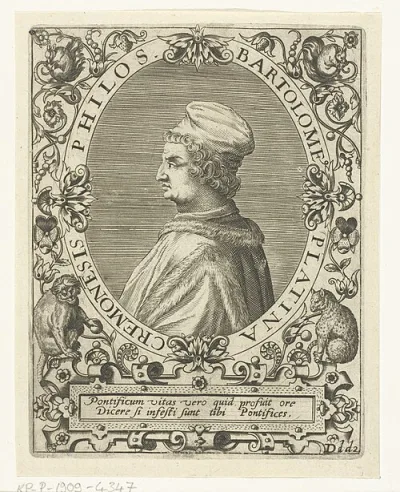
Bartolomeo Sacchi, known as Platina, was a Renaissance humanist, writer, and the first author of a printed cookbook.
Bartolomeo Sacchi, who adopted the name Platina after his birthplace, was an Italian Renaissance humanist and writer. He began his career as a soldier before finding patronage with the Gonzaga family. His studies in Florence under the Byzantine humanist John Argyropulos exposed him to prominent humanist circles and the ruling Medici family. Platina later secured a position as a papal writer, aligning himself with the Roman Academy, a group influenced by Platonic thought. However, his career was disrupted when Pope Paul II imprisoned him due to suspicions surrounding the Roman Academy. His fortunes improved under Pope Sixtus IV, who appointed him Vatican librarian in 1475. This appointment followed his completion of a history of the popes, a work critical of Paul II. Platina is widely recognized for authoring what is considered the first printed cookbook, a significant contribution to culinary literature. His writings, particularly his history of the popes, influenced historical perspectives for centuries, though later research has questioned some of his accounts.
Humanist and Papal Circles
Born in 1421 near Cremona, Bartolomeo Sacchi, known as Platina, navigated the intellectual and political landscape of the Italian Renaissance. He served as a private soldier before becoming a tutor to the sons of Ludovico III Gonzaga in Mantua. His pursuit of knowledge led him to Florence, where he studied Greek under John Argyropulos and connected with influential humanists like Cosimo de' Medici. In 1462, he moved to Rome and obtained a sinecure as a papal writer under Pius II. Platina became associated with the Roman Academy, a circle of humanists led by Pomponio Leto, which was influenced by Platonic philosophy. This association, however, led to his imprisonment under Pope Paul II, who harbored anti-humanist sentiments. Platina and other members of the Academy faced accusations of conspiracy and immorality, though charges were eventually dropped or members acquitted, with some found guilty of immorality.
Vatican Librarian and Historian
Following his release and a period of continued association with the Roman Academy, Platina's career was revitalized by the pro-humanist Pope Sixtus IV. In 1475, Sixtus IV appointed Platina as the first Vatican librarian, a position he held until his death. This significant role came after Platina authored a history of the popes, a work that offered a perspective deeply critical of his former persecutor, Paul II. This historical account, considered the first systematic handbook of papal history, shaped historical opinions for centuries, despite later scholarly scrutiny revealing party spirit and a lack of detailed examination in places. Platina also undertook the task of compiling a collection of important privileges of the Roman Church, a work still preserved in the Vatican archives. A notable fresco by Melozzo da Forlì depicts Sixtus IV appointing Platina to his prestigious Vatican post.
Culinary Contributions and Historical Narratives
Platina's most enduring legacy in some respects is his authorship of what is widely regarded as the first printed cookbook. Beyond this culinary milestone, his historical writings, particularly his Lives of the Popes, played a crucial role in shaping the historical narrative of the papacy. While his work provided valuable insights and influenced perceptions for centuries, it is also noted that Platina sometimes exhibited party spirit and that critical research has since challenged certain aspects of his accounts. One notable instance of his narrative influence, though later disproven by historical analysis, involved the legend of Pope Callixtus III excommunicating Halley's comet. Platina connected the appearance of the comet with the Pope's decree for prayers against the Turks, contributing to a misinterpretation that persisted for centuries among historians.
Books by
2 free public domain books · Read online or download