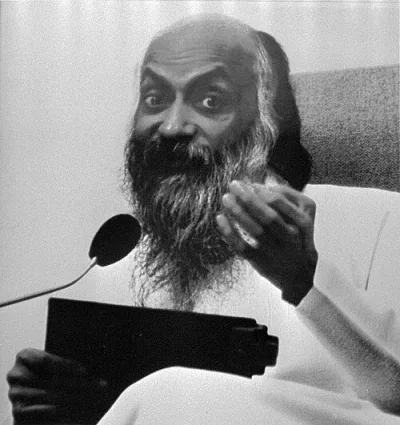
Osho was an Indian mystic and spiritual teacher who founded the Rajneesh movement, known for his controversial teachings on meditation and worldly desires.
Born Chandra Mohan Jain in 1931, Osho, also known as Bhagwan Shree Rajneesh, was an Indian philosopher, mystic, and founder of the Rajneesh movement. He rejected organized religion, emphasizing personal spiritual experience and advocating for practices like dynamic meditation. Osho encouraged his followers to engage fully with life while maintaining detachment from material possessions and desires. His early life involved academic pursuits and a growing critique of established religious and political systems. He experienced a spiritual awakening in 1953 and later resigned from his university post to travel and lecture across India, gaining a following for his unconventional views.
In 1970, Osho began initiating followers in Mumbai, expanding his teachings by commenting on various spiritual and philosophical traditions. By 1974, an ashram was established in Pune, offering therapies and attracting a Western audience. Tensions with the Indian government led to the movement's relocation to the United States in 1981, where they established a commune in Oregon. This period was marked by significant conflict with local authorities and legal battles, culminating in Osho's deportation in 1985 following accusations of criminal activity by his close associates. After facing entry bans in numerous countries, he returned to India, reviving his ashram in Pune, where he passed away in 1990. His teachings and the Osho International Foundation continue to influence New Age thought.
Early Life and Intellectual Development
Born Chandra Mohan Jain in 1931, Osho spent his early years with his maternal grandparents, experiencing a formative period of freedom from imposed education. His childhood was marked by profound encounters with death, including the loss of his grandfather and a childhood girlfriend, which fostered a deep contemplation of mortality. As a student, he was known for his intellect and rebellious spirit, engaging in formidable debates. His intellectual journey led him to explore various consciousness-expanding methods, including yogic exercises and meditation, alongside a deep interest in communist literature from figures like Marx and Engels. This early engagement with radical ideologies, including anarchism, shaped his critical stance towards established systems.
Academic Career and Spiritual Awakening
Osho, then known as Rajneesh, pursued higher education in philosophy, earning a Master's degree from the University of Sagar in 1957. He subsequently taught philosophy at Jabalpur University, where he was recognized for his sharp intellect. During this period, he also traveled extensively across India, lecturing under the name Acharya Rajneesh. His public talks were critical of mainstream religions, political ideologies, and figures like Mahatma Gandhi, advocating for capitalism and modern technology as essential for India's progress. He viewed orthodox religions as stagnant and ritualistic. He announced experiencing a spiritual enlightenment in 1953. These controversial views, alongside his emphasis on meditation and spiritual exploration, began to attract a dedicated following and led to the establishment of meditation centers.
Teaching, Meditation, and the Rajneesh Movement
Osho developed a unique approach to spirituality, rejecting institutional dogma and emphasizing direct personal experience. He advocated for meditation, developing a dynamic meditation technique designed for modern individuals to release suppressed emotions and achieve inner silence. Rejecting traditional asceticism, he encouraged his followers to embrace life fully, integrating spiritual practice with worldly engagement. In 1970, he began initiating followers as 'neo-sannyasins' and expanded his teachings through extensive discourses on global religious traditions, mystics, and philosophers. The establishment of an ashram in Pune in 1974 attracted a significant Western following, integrating methods from the Human Potential Movement and offering various therapies.
Controversies and Transnational Expansion
The Rajneesh movement's growth led to significant confrontations, both in India and later in the United States. In the late 1970s, the movement faced government pressure and financial claims in India. In 1981, the focus shifted to the U.S., with the establishment of a large commune, Rajneeshpuram, in Oregon. This venture encountered substantial opposition from local residents and state authorities, resulting in protracted legal disputes over land use and development. The situation escalated in 1985 when Osho publicly implicated his secretary, Ma Anand Sheela, and her associates in serious criminal activities, including a mass food-poisoning incident and assassination plots. Following these events, Osho was deported from the U.S. on immigration charges, and subsequently denied entry to numerous countries.
Key Ideas
- Rejection of institutional religion and dogma in favor of direct spiritual experience.
- Advocacy for meditation, including unique techniques like dynamic meditation.
- Encouragement of embracing life fully while practicing detachment from worldly desires.
- Critique of traditional religious practices and social/political orthodoxies.
Notable Quotes
“I have been interested in communism from very childhood...communist literature — perhaps there is no book that is missing from my library. I have signed and dated each book before 1950. Small details are so vivid before me, because that was my first entry into the intellectual world. First I was deeply interested in communism, but finding that it is a corpse I became interested in anarchism — that was also a Russian phenomenon — Prince Kropotkin, Bakunin, Leo Tolstoy. All three were anarchists: no state, no government in the world.”