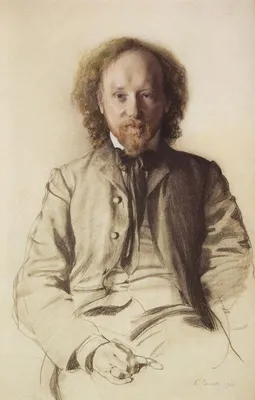
Vyacheslav Ivanov was a Russian Symbolist poet and philosopher who blended ancient archetypes with Christian spirituality.
Vyacheslav Ivanov (1866-1949) was a prominent figure in Russian Symbolism, contributing significantly through his poetry, journalism, and philosophical essays. He developed a unique approach to Russian Symbolism that aimed to reconnect Russian culture with Christian spiritual foundations while simultaneously reinterpreting classical and Renaissance artistic archetypes. Ivanov championed the idea of a "choral" culture, seeking to move beyond individualism towards an "over-individual religious community" through myth-creative art, a concept that gained prominence during World War I and the Russian Revolution.
His creative output included translations of classical tragedies and Renaissance poetry, alongside original works exploring themes of Dionysian cults and spiritual quests. After emigrating to Italy, Ivanov maintained a distance from Russian émigré circles and joined the Catholic Church, seeking to interpret Dostoevsky's work for a Western audience. Near the end of his life, he penned "The Story of Svetomir the Tsarevich," an epic intended to encapsulate his life's work and vision for Russia's spiritual resurrection. His extensive archival legacy is preserved across research centers in Moscow, St. Petersburg, and Rome.
Symbolist Poetics and Philosophical Underpinnings
Ivanov's early poetry collections, particularly "Lodestars" (1902-1903) and "Transparency" (1904), marked his entry into the Symbolist movement, though he often distanced himself from the term "Symbolist" itself and was critical of purely aesthetic innovation. His poetry sought to express universal truths, drawing heavily on the cultural heritage of antiquity, the Middle Ages, and the Renaissance. Ivanov believed that poetic language should transcend everyday speech, approaching a divine "Logos." This approach involved a fusion of "native" and "universal" elements, reflecting his intellectual journey and personal spiritual experiences. His work aimed to bridge the gap between the tangible world and higher spiritual spheres, often blending intellectual contemplation with intense inner feeling.
"Cor Ardens" and Mystical Synthesis
The two-volume collection "Cor Ardens" ("The Flaming Heart") (1911-1912) represents a significant synthesis of Ivanov's diverse interests. This work, comprising over 350 poems, delves into personal mystical experience and its transformative effects on the individual. It explores the central "Sun-Heart" image, influenced by Nietzsche and Russian modernism, and integrates Christian notions of resurrection with Dionysian concepts of sin as a path to divinity. The collection also includes a politically charged cycle, "Arcana," which interprets apocalyptic themes. "Cor Ardens" further incorporates influences from Sufi mysticism through the "Hafiz circle" and references classical figures, demonstrating Ivanov's broad engagement with various spiritual and philosophical traditions in his quest for a unified understanding of existence.
Cultural Vision and Esoteric Interests
Ivanov's broader philosophical project involved advocating for a "choral" culture, aiming to overcome individualism by fostering an "over-individual religious community" through art and myth. This vision intensified during periods of societal upheaval, such as World War I and the Russian Revolution. His antiquarian studies, particularly those focused on the cult of Dionysus, were intrinsically linked to his spiritual and literary explorations. Ivanov's interest in ancient mystery traditions, such as Pythagoreanism, further underscores his engagement with esoteric thought, viewing these ancient practices as foundational to understanding spiritual organization and communal experience.
Key Ideas
- Russian Symbolism as a blend of Christian spirituality and classical archetypes
- Choral culture: Overcoming individualism through community and myth-creative art
- The "Sun-Heart" as a central symbol of mystical experience and transformation
- Dionysianism and Christianity as paths to spiritual understanding
Books by
4 free public domain books · Read online or download