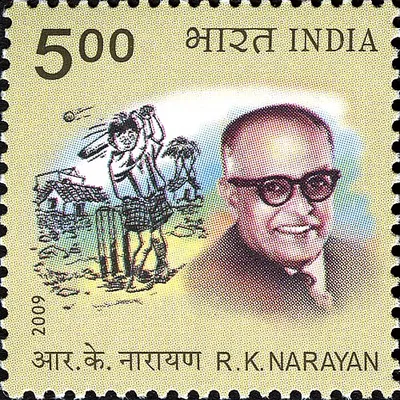
Narayan Dutt Shrimali
R. K. Narayan was a prominent Indian novelist known for his fictional town of Malgudi, exploring everyday life and societal shifts.
Rasipuram Krishnaswami Narayanaswami, widely known as R. K. Narayan, was a significant Indian writer, born in 1906, celebrated for his novels set in the fictional South Indian town of Malgudi. He is recognized as a leading figure in early Indian English literature. Throughout his extensive career, Narayan authored over 200 works, including novels, short stories, and plays, often depicting the social fabric and daily lives of his characters as they navigated between tradition and modernity.
Narayan's literary contributions earned him numerous accolades, such as the AC Benson Medal from the Royal Society of Literature and India's Padma Vibhushan and Padma Bhushan awards. His writing style, characterized by its focus on ordinary life, humor, and compassion, has drawn comparisons to authors like William Faulkner. A notable aspect of his career was the creation of Malgudi, a town that served as a backdrop for exploring the evolving socio-political landscape of India, both during British rule and after independence. His works, including "Swami and Friends," "The Bachelor of Arts," and "The English Teacher," often drew from his personal experiences and addressed various social customs and emotional challenges.
Early Life and Literary Beginnings
Born in Madras in 1906, R. K. Narayan grew up in a Tamil Brahmin family. His father's profession led to frequent relocations, and Narayan spent part of his youth under his grandmother's care, who nicknamed him Kunjappa. His education involved various schools in Madras, and he developed an early passion for reading, influenced by authors like Dickens and Wodehouse. Despite a brief foray into pro-independence activities in his youth, his family maintained an apolitical stance. After moving to Mysore, Narayan's father's transfer to Maharaja's College High School provided access to a well-stocked library, further fueling his reading and early writing endeavors. Following a year spent reading and writing after failing his university entrance exam, he eventually passed and attended Maharaja College. A short, unsatisfactory stint as a school teacher, which ended in protest, solidified his resolve to pursue writing as a career. His first published piece was a book review, and he began contributing local interest stories to publications, though initial earnings were meager. His first novel, "Swami and Friends," which introduced the fictional town of Malgudi, was written in 1930 but faced initial rejection and ridicule.
Marriage, Career Development, and Graham Greene's Influence
In 1933, Narayan married Rajam, overcoming astrological and financial obstacles. His marriage coincided with his role as a reporter for "The Justice," a Madras-based newspaper advocating for non-Brahmin rights, which exposed him to diverse people and issues. Crucially, his manuscript for "Swami and Friends" reached Graham Greene through a friend at Oxford. Greene's recommendation led to the book's publication in 1935, and he advised Narayan to shorten his name for wider appeal. "Swami and Friends," semi-autobiographical, received favorable reviews despite low sales. His subsequent novels, "The Bachelor of Arts" (1937) and "The Dark Room" (1938), also published with Greene's assistance, explored themes of adolescent transition and marital discord, respectively. The death of his father in 1937 necessitated Narayan accepting a government commission due to financial constraints. Greene remained a key supporter, instrumental in publishing Narayan's first four books, including the semi-autobiographical trilogy.
Personal Tragedy and Literary Evolution
The death of his wife, Rajam, from typhoid in 1939 profoundly impacted Narayan, leading to a period of deep depression. He never remarried and focused on raising their young daughter, Hema. This personal loss became the inspiration for his novel "The English Teacher," which, along with "Swami and Friends" and "The Bachelor of Arts," formed an unintentional autobiographical trilogy. Narayan later confirmed that "The English Teacher" was largely autobiographical, reflecting his grief. Buoyed by some success, Narayan launched a journal, "Indian Thought," in 1940, which, despite initial subscriber interest, ceased publication within a year due to management challenges. His first short story collection, "Malgudi Days," was published in 1942. During World War II, he established "Indian Thought Publications," which proved successful and continues under his granddaughter's management. By 1948, his books had gained a devoted international readership, prompting him to build his own house in Mysore. He also wrote a screenplay for the Gemini Studios film "Miss Malini" (1947).
Later Career and Notable Works
Following "The English Teacher," Narayan's writing style shifted towards a more imaginative and external approach, though still drawing from personal experiences and intermixing biographical elements. This new style was evident in his subsequent works. "The Financial Expert" (1951) is considered his masterpiece and was lauded as highly original, inspired by a true story of a financial expert named Margayya, related by his brother. Another novel, "Waiting for the Mahatma," loosely depicted a fictional visit by Mahatma Gandhi to Malgudi and explored a protagonist's romantic feelings while attending Gandhi's discourses. Narayan's prolific output and unique narrative style, centered around the enduring fictional town of Malgudi, cemented his reputation as a major voice in world literature, earning him numerous honors throughout his career, including the Sahitya Akademi Fellowship.